
Ruby examines the portrayal of indigenous peoples and English relations with indigenous peoples during Elizabethan England’s first attempt to colonise North America; the ‘lost colony’ of Roanoke.
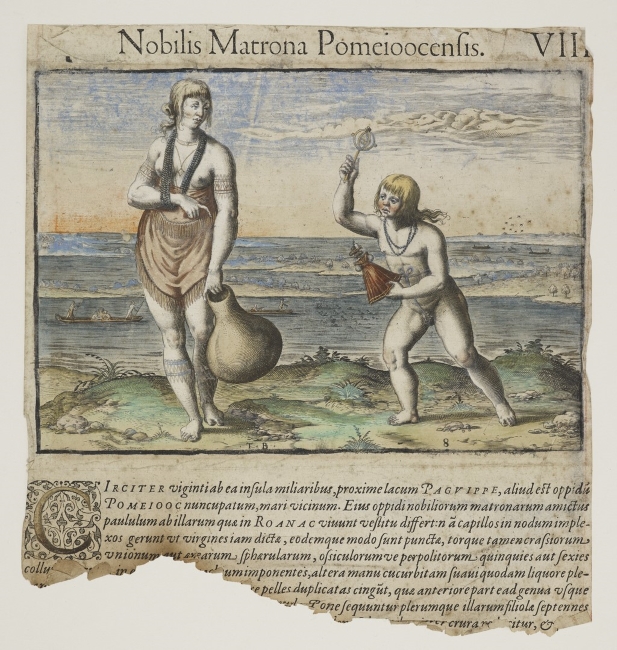
In a small corner of the first iteration of our Traces of Displacement exhibition (curated by our in-house Modern and Contemporary curator Leanne Green, the Traces of Displacement constituent group, and our Fine Art Curatorial Assistant Hannah Vollam) were two engravings, each one roughly the size of an A4 piece of paper. They show four figures (two in each work) each dressed in robes draped around their middles in front of lush green scenery with a far-reaching ocean beyond. They are idyllic and hopeful depictions of a ‘New World’ desperately sought for by Elizabethan England, who, according to some, were over a century and a half into the Little Ice Age at the time the engravings were created (1). This period of unforgiving temperatures had begun roughly in 1300 and worsened in 1570, just eight years before Sir Walter Raleigh joined his first expedition to North America. This blog post is not about that particular expedition, but this climate of hope and desperation, as well as competition with other European countries. Spain, who had already set up trade with countries in the ’New World’ and had started their colonisation projects in earnest, was the major competition. All these elements set the stage for a strange and tragic narrative in which these prints are a fairly major player.

A Cheiff Lorde of Roanoac and A Cheiffe Ladye of Pomeiooc (1590) by John White (c1560-c1610) were produced as a result of several expeditions to an island which is now a part of North Carolina called Roanoke. This name, as well as John White, may sound familiar for those who are either interested in early American colonial history, or are into unsolved mysteries such as the ‘Lost Colony of Roanoke’ (which will be discussed later). These particular works are copies of watercolours produced during an expedition in 1585, led by Sir Richard Grenville and funded by Raleigh and Queen Elizabeth I (2) and were included in a book called A briefe and true report of the new found land of Virginia: of the commodities and of the nature and manners of the naturall inhabitants (otherwise simply known as America) published in 1590.
In 1585, within the fleet of five ships and two pinnaces with 600 men (at least half of whom were soldiers (3)), five individuals on board would become especially important to our understanding the prints as well as the greater narrative of this early cultural encounter. They were Thomas Harriot (an English astronomer and, most importantly in this case, ethnographer, and author of America, 1590), John White (an English explorer, artist, and cartographer), Ralph Lane (an English explorer and ex-sheriff of County Kerry, Ireland), Manteo (son of the principal leader of Croatoan) and Wanchese (a warrior from Roanoke) (4).
Manteo and Wanchese were on a return voyage home, after leaving with the previous (and much more successful) reconnaissance mission a year before in 1584 on the orders of Wingina, a weroance (via his brother Granganimeo (5)). Weroance translates roughly to- “he is wise”/ “he is rich”/ “he is of influence” (6) and is the leader of a group of tribes/communities/villages- Wingina had a lot of power in the region the English had landed. Manteo and Wanchese had spent nine months living in Raleigh’s mansion in London, having taught Harriot Carolina Algonquian (part of a family of Native American languages) and had in turn become fluent in English. This language exchange is important to note, as without it Harriot would have been unable to write his book, which detailed the traditions and practices of Native American communities in that area, as well as documenting plants, fruits, animals and minerals native to Ossomocomuck (now coastal North Carolina). Over the course of those nine months, Manteo had struck a friendship with Harriot and saw the English as his allies, while Wanchese wasn’t so keen and did little to aid this cultural exchange.
The writing of this book was no passive act of scientific curiosity, as reading through this historical document, it reveals itself to have a deeply sinister use. The text begins mostly as an encyclopaedia of how to sustain oneself within a different and ‘new’ country- essentially how to survive off the land. Then it arrives at the people, which Harriot writes are “not to be feared; but they shall have cause both to fear and love us, that shall inhabit with them” and then goes on to describe how they have “no tooles of weapons of iron or steele to offend us (…) those weapons that they have, are onlie bowes made of Witch hazle, & arrowes of reeds; flat edged truncheons also of wood about a yard long, neither have they any thing to defend themselves but targets made of barcks; and some armours made of stickes wickered together with thread” (7). Make no mistake, this was never about creating legitimate trade relationships with another country; this document is literally a how-to handbook for effective colonisation.
The aim of Sir Walter Raleigh’s personal brand of colonisation wasn’t quite so straightforward and was focused more on cultural assimilation on the Native American’s parts, rather than brute force. In an essay composed years after the three missions discussed in this blog, he wrote: “No Christian prince, under the pretence of Christianity (…) may attempte the invasion of any free people not under their vassaladge” but instead to “instructe them in liberall arts of civility” and make them “renounce their impietyes” (8). This basically meant stripping the Native Americans of their culture, way of life and religion- in other words, it advocated for cultural genocide. This is bad enough without the fact that the 1585 expedition’s voyage was captained by Sir Richard Grenville, a man who, when drinking, was known to “take the glasses betweene his teeth and crash them into peeces and swallow them downe, so that oftentimes the blood ran out of his mouth” and during the early days of exploration, set the village of Aquascogoc on fire after believing that they had stolen his silver drinking cup (9).
This assumption of European superiority was, unsurprisingly, only the English point of view in this early encounter. Despite many American historians and historic societies describing these expeditions, and later settlement, in Roanoke as the actions of courageous and innovative English forces, the reality of the matter is quite different. As Michael Leroy Oberg writes: “We can, for instance, view Roanoke and the attempt to settle there not as a heroic beginning, but as an English failure and an Indian victory, even if the fruits of that victory were decidedly ambivalent.” (10)
Without the hospitality of the of the Roanoke, Croatoan and Pomeiooc people, the English would have likely poisoned themselves eating unfamiliar fruits or would have been overcome by the extreme weather and difficult terrain without being able to predict or understand it as the Native American people in that area did. Initially the English did not even know the name of the region, having believed it was known as ‘Wingandacon’, due to a local man, likely Granganimeo, saying it in response to “where are we?” and wrote this in all their reports and were entirely confident in their understanding of the people’s language and responses. Wingandacon means something along the lines of “you wear good clothes”, certainly not the name of the region (11).
Wingina, the weroance, saw an opportunity in the English as in 1584, when the English first arrived (before John White’s expedition) he was at war with the Pomeioocs (a woman and child from that community is depicted by John White) on behalf of the Secotans, who he was allied with. He was wanting to acquire montoac (power) and he believed that the English could supply it with their muskets and cannons (12), so he welcomed the initial English troops with open arms via his brother. He was accomplished in maintaining trade relations with outsiders, as he already had these relationships with those from other communities across America, which were integral for peacekeeping and maintaining alliances- as well as the supply of goods which aided their way of life.
His initial diplomacy and wary trust of the English would be his downfall however, as nearly a year into the 1585 mission, Edward Nugent, on the orders of his superior Ralph Lane, murdered him, decapitated him, and stuck his head on a spike. There is much to discuss as to why this extreme action was taken, and I highly recommend further reading on this subject- in particular The Head in Edward Nugent’s Hand (2007) by Michael Leroy Oberg.
This brutal killing destroyed the Ossomocomuck region’s (until then) patchy but reasonably peaceful relationship with the English and sent them running back to the shores where they were picked up by Sir Francis Drake’s ships (who happened to be passing the area). They briefly considered returning to Roanoke with Drake but due to severe weather, they decided to head back to England (13). Despite the English having murdered Wingina as well as many Croatoan people, Manteo also returned with the English (14). It is unknown whether his motives were to maintain his alliance with them but ally himself he did and was the first Native American from that region to be baptised the following year (15). Another rescue mission was sent, only to find that Lane’s troops had already left; fifteen soldiers were left behind with provisions to last for roughly twelve months.
Nearly a year later, Manteo and John White would return to Roanoke with over a hundred colonists (who were mostly families), though from the beginning, very little went according to plan. They were initially meant to set up a colony in the Chesapeake Bay area and make a quick stop at Roanoke on the way to drop off Manteo and check on the 15 soldiers who stayed ten months there. By the time they made it back to Roanoke, the soldiers were already dead, but their navigator Simon Fernadez decided to change the plan and left the colonists behind. It is not entirely known what his reasonings were for this course of action; it was likely because he wanted to escape the incoming hurricane season, or he was ready to head back to sea to pursue his privateering, or perhaps it was due to his being nicknamed “the swine” by his crewmates and he was, quite frankly, done with them (16) (17).
No matter the reason, the colonists were stuck on Roanoke, while the authorities in England believed them to be in Chesapeake Bay- not an ideal situation, particularly considering the events that had taken place there less than a year before. When the English landed on Roanoke in 1587, the local Native Americans readied their weapons, but when they saw that the passengers were mostly families and not soldiers, as well as sighting Manteo, they decided not to attack.
John White was the governor of this colony of over a hundred colonists, including his daughter who was pregnant and gave birth to Virginia Dare, the first English child born in North America. While White had prior experience of living and working with, researching people from other cultures and exploring the ‘new world’, his diplomacy skills were lacking. He was under the impression that the Croatoans and Roanokes had initiated the attack that culminated in the beheading of Wingina, and had offered forgiveness towards the Roanoke people, who (understandably) turned down the prospect of apologising to the English. White then decided to attack Wanchese, who had likely killed the fifteen men left behind between the 1586 and ’87 voyages, taking Manteo with him as his guide. They mistakenly murdered people of the Croatoan tribe, potentially stripping the English of one their few allies left after their disastrous attempts of diplomacy and their brutal acts of violence over the previous couple of years (18).
This severe estrangement from the only people who could aid the colonist’s survival meant that after some time, the rest of the colonists demanded that John White should go back to England to bring back supplies, which he did. To say this return trip didn’t go to plan would be an understatement- due to the Spanish Armada effecting the use of ships back in England, an attempted journey in which he was interrupted by French pirates who “playd extreemely upon us with their shot” and hit White “in the side of the buttoke” and stole the ship’s supplies (19), by the time John White successfully returned to Roanoke, he had been absent for three years. He found almost no trace of the colony or his own family on the island; the only indication they were potentially still alive was a carving on a tree and a fencepost near their previous settlement, with the word ‘Croatoan’ etched into the former, and ‘Cro’ on the latter.
Before White had left Roanoke three years previously, he and the other colonists had created a code which would indicate if the colonists had resettled somewhere else, and if they had, whether they had been taken by force. The code was to write down the name of the location, and if they had been taken against their will, add a cross alongside it (20). No cross was ever found near the now famous Croatoan sign, though that isn’t to say this entirely rules out not leaving of their own free will. Due to the extreme weather conditions, White had to abandon his search for the lost colonists and return to England.
No one knows for certain what exactly happened to the lost colonists of Roanoke; speculations range from a mass attack, wiping out the entire settlement to mass alien abductions or a zombie plague ravaging the island (I’m not making this up) (21). The most common assumption (and the most likely) is that the local Croatoan community took pity on the colonists, who were unlikely to last long on their limited supplies and knowledge of the area, and incorporated them into their tribe. They had little reason to attack the colonists as, as I mentioned earlier, they consisted mostly of families, not soldiers, who (in isolation) posed very little threat to the local tribes. The only way they were a likely threat to the local tribes in their pitiful state was possible contagious viruses that the local Native American people had no immunity to, which became, mostly inadvertently, a biological weapon during the colonisation process of America. This appears not to be the case in this particular situation though influenza from the English had infected tribes in the local area during the previous two years (22).
What actually happened to the colonists in Roanoke is currently only possible to speculate on, so this is not of concern when discussing these prints. What is important to note, is that this atmosphere of speculations and conspiracy theories has existed since John White returned to England. The book, A briefe and true report of the new found land of Virginia: of the commodities and of the nature and manners of the naturall inhabitants was initially published in Latin in 1588 then published in English around the time that John White returned having failed to retrieve the lost colonists. This is in part due to how long it takes to compile a document such as this, but it also speaks to a curiosity and concern that may have been widespread by the time it was published.
This work was re-printed repeatedly until at least 1888, by which point other works documenting the American landscapes and peoples would have been far more up to date; but the mystery that this document was entangled with would have still been tantalising to those curious enough to spend time reading this, quite frankly, dense document. At this point, with higher literacy levels among the population, this book would have been read by not only people working in royal courts, the navy and academic circles, but educated members of the public as well. It is still used as a primary text by academics, novelists and researchers when attempting to understand the strange and brutal events that occurred in the 1580s on the shifting and changeable North Carolina coastline.
References
(1) https://www.newyorker.com/magazine/2019/04/01/how-the-little-ice-age-changed-history
(2) https://www.hrp.org.uk/tower-of-london/history-and-stories/sir-walter-raleigh/#gs.whk8qj
(3) https://community.dur.ac.uk/4schools.resources/Roanoke/Timeline.htm
(5) Milton, G. Big Chief Elizabeth, (2000), p.59.
(6) Oberg, Michael L. The Head in Edward Nugent’s Hand: Roanoke’s Forgotten Indians, (2007), p.18
(7) Harriot, T. A briefe and true report of the new found land of Virginia of the commodities and of the nature and manners of the naturall inhabitants. Discouered by the English colon there seated by Sir Richard Greinuile Knight in the eere 1585. Which remained vnder the gouernement of twelue monethes, at the speciall charge and direction of the Honourable Sir Walter Raleigh Knight lord Warden of the stanneries who therein hath beene fauoured and authorised b her Maiestie :and her letters patents: This fore booke is made in English by Thomas Hariot seruant to the abouenamed Sir Walter, a member of the Colon, and there imploed in discouering Cum gratia et priuilegio Caes. Matis Speciali (2nd Edition) 1590. Page 24.
(8) Milton, G. Big Chief Elizabeth, (2000), p.322
(9) Ibid p. 91, 117
(10) Oberg, Michael L. The Head in Edward Nugent’s Hand: Roanoke’s Forgotten Indians, (2007), p.3
(11) Ibid p.3
(12) Milton, G. Big Chief Elizabeth, (2000), pp.166, 167.
(14) Ibid.
(15) Oberg, Michael L. The Head in Edward Nugent’s Hand: Roanoke’s Forgotten Indians, (2007), p.3.
(16) https://www.ncpedia.org/biography/fernandez-simon
(17) https://en.wikipedia.org/wiki/John_White_(colonist_and_artist)#cite_note-9
(19) Milton, G. Big Chief Elizabeth, (2000), p.249
(20) Ibid p.243
(21) https://www.youtube.com/watch?v=xjmXzYdxuTQ
(22) Mires, Peter B. “Contact and Contagion: The Roanoke Colony and Influenza.” Historical Archaeology, vol. 28, no. 3, 1994, pp. 30–38. JSTOR, http://www.jstor.org/stable/25616316. Accessed 13 May 2023.
 A Place Between The Trees