
This Christmas discover (or rediscover) Mary Louisa Molesworth, one of Victorian Britain’s favourite female authors, and her partnership with Walter Crane, in this post by Bria.

Winter, especially around Christmastime, always brings with it a sense of wonder, and a sense of magic. A different kind of magic than say, Halloween, where delight is taken in what goes bump in the night. Christmas, however, seems to be a whirlwind of fantasy and possibility. Whether it is the yearly ritual of watching It’s a Wonderful Life (1946) or attending a performance of The Nutcracker, the lure of the fairy tale is impossible to ignore. Here at the Whitworth, within the cavernous archives, we have Walter Crane’s fairy tale illustrations that occasionally like to make themselves known.
One collection of illustrations we will focus on today are the illustrations accompanying Mrs Molesworth’s A Christmas Posy (1888), a collection children’s short stories. We will be using Crane’s illustrations as a portal into Mrs Molesworth’s life, with a particular focus on Crane and Molesworth’s working relationship. Once known as a key player in the world of Christmastime publishing for children, Mrs Molesworth’s stories were popular and often lauded as one of the best examples of Victorian children’s literature. Her work was known for blending the fantasy and the real to create world of adventure for young readers.
Beginnings of a Writer
Mary Louisa Molesworth (29 May 1839 – 20 January 1921) was born in Rotterdam, the Netherlands. Her family moved to Chorlton, Manchester in 1841, the height of Manchester’s industrial prowess, and spent her childhood there. Molesworth describes the house, 86 Bloomsbury, Rusholme Road as a “only a rather small and dull house in a dull street” (Green 1964: 14). Jane Cooper argues that her childhood in Manchester served as a key inspiration for her children’s stories, often writing about children in smoky, clanging industrial towns, going so far as to refer one character’s home-town as “Smokytown” (Cooper 2002: 26).
Mrs Molesworth was a prolific writer, having published 101 books between 1870 and 1911 (Moss 1988:50), writing novels for adults under the name of Ennis Graham, and short stories of both realistic and fantastical persuasions for children.
A Long Relationship
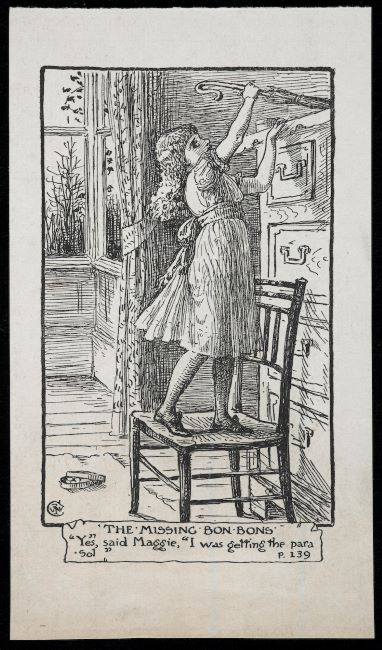
Thirty-three artists illustrated Mrs Molesworth’s stories across twenty different publishers (Cooper 1988:181), but we shall be focusing on the work of Walter Crane for the Macmillan publishing house. In our collection, we have illustration proofs of the cover page for A Christmas Posy, as well two illustrations from two stories from A Christmas Posy.
Published in November 1888, in time for the Christmas season, A Christmas Posy was praised by The Spectator reviewing column for containing stories “told with her wonted grace and command of pathos. It would difficult to say which of the eight is the best” (The Spectator 1888). The illustrations we have in our collections bring to life the worlds Mrs Molesworth created, so much so that they are proof of a fruitful working relationship between Walter Crane and Mrs Molesworth.
According to Walter Crane’s autobiography, his partnership with Mrs Molesworth and Macmillan began in 1874 with Tell Me a Story, wherein he would continue to “supply the illustrations to these very pretty stories” (Crane 1907 [2015]: 157) for years afterwards.
Walter Crane’s and Mrs Molesworth’s working relationship began in 1874, working with Macmillan publishing house to produce facsimiles and illustrations for her stories. Crane writes in his autobiography that he first illustrated for Tell Me a Story (1875) and he continued “to supply the illustrations to these very pretty stories” (Crane 1907 [2015]: 157) for years afterwards. Crane was the longest illustrator working with Mrs Molesworth, and this is due to Crane enjoying Mrs Molesworth’s stories, and applying a level of “care and thoughtfulness” to his illustrations” (Cooper 2002: 188).
Not only was it a fruitful relationship between Crane and Molesworth, but it was one that was also supported by Mrs Molesworth’s Macmillan publisher, George Lillie Craik (husband to English novelist Dinah Craik). Indeed, it was Craik that introduced Crane and Molesworth to each other, and the triad worked as a solid publishing unit. So much so, as Jane Cooper writes, that “Louisa had twice mentioned to Craik that the variety offered by a collection of stories seemed to please Crane when she had discussed the project with him, and this obviously had a good effect on the illustrations he produced” (Cooper 2002: 290).
One of my favourite examples that Cooper gives in detailing their working relationships, was the episode in which, during a crisis in publishing deadlines, Crane was able to hand-deliver “12 beautiful drawings to Macmillan’s” on October 4th, in time for Christmas publication (Cooper 2002: 216). Even though, as Mrs Molesworth herself acknowledged, Crane was busy with other illustration projects, the fact that he was able to hand-deliver 12 illustrations for Mrs Molesworth’s work shows much Crane respected and admired Mrs Molesworth’s work. A Christmas miracle, indeed.
Conclusion
What is fascinating about the afterlives of these two titans in British publishing, is that there is less fascination about the two’s working relationship, or even about Mrs Molesworth herself, than Walter Crane. Indeed, it was only through the sleuthing skills of my colleague and fellow Visitor Team Assistant, Steph, in finding these proofs, that I was able to go on this journey and learn about Mrs Molesworth. This was someone who was a mainstay in the Christmas publishing calendar, with her stories captivating both young and adult audiences alike.
Christmas, to me, is all about rediscovering childlike wonder for stories and fantastic realms during this period of endless night. A warming glow during this winter is what we all need, and I hope you take time to discover, or rediscover, something from your past. –Bria

Bibliography
– “A Christmas Posy”. By Mrs. Molesworth (Book Review) 1888, The Spectator (1828) Ltd, London.
– Cooper, Jane (1988), “‘Just really what they do’ or, Re-reading Mrs Molesworth”, Signal, vol. 57, 181-196.
– Green, Roger Lancelyn (1964), Mrs Molesworth (New York, H.Z. Walck).
– Moss, Anita. (1988). “Mrs. Molesworth: Victorian Visionary”, The Lion and the Unicorn 12(1), 105-110.
 A Place Between The Trees