
Dark, dank and full of mystery, holes and underground spaces are central to many of the tales that we tell. In this post, Jake explores why they have such a grip on the imaginations of artists and adventurers alike.

If you’ve ever spent much time treading the paths of Whitworth Park, you will no doubt have come across a myriad of sculptures, ranging from ephemeral ‘ghost’ trees to hulking stone monoliths. You could be forgiven however, for passing by what is arguably one of the most interesting without a second glance. ‘Bus de la Lum’ sits low to the ground, only just peeking out above the grass. Three shapeless bronze masses, bound by bronze rope. Outwardly unassuming, it’s a sculpture that belies an archaic, brooding folklore – one that transports you to a distant time and place.

Bus de la Lum is an artwork by Nico Vascellari (b.1976), inspired by the legends surrounding his childhood home of Vittorio Veneto in northern Italy. The village that Vascellari grew up in is situated between a great, rolling plain on one side and dense forests and valleys on the other. It is amongst these trees and cloughs that you will find the original Bus de la Lum, a gigantic, plunging chasm in the ground. Literally translated as ‘Hole of Light’, the pit was named as such because of the glowing will-o’-the-wisp that would rise from its murky depths during the night and eerily hover above it in the darkness.

Local folklore has long attributed this mysterious glowing to dark magic. Stories tell of witches who have made their home in the pit, that capture children and burn their bodies in the night. Unsurprisingly, the Hole of Light quickly became regarded as a place of evil and death. The truth behind the glowing does little to disprove this association; the glowing vapours rise from decomposing livestock and woodland creatures, unfortunate enough to fall into the pit. Just like their imagined origins, the light signifies death. During World War Two Bus de la Lum took a more tragic turn. The place became a mass graveyard for prisoners of war, partisans and fascists alike, most of whom were tossed into its depths while still alive.
As a believer in animism, the idea that all objects, places and creatures possess a distinct spirit and essence, Vascellari has always been fascinated with Bus de la Lum. Not only for its significance in his childhood but also for its absolute embodiment of evil. In Vascellari’s words, ‘That place became interesting for me for somehow representing evil, but without taking any side. It was just evil, that’s it. And that’s something that doesn’t happen so often.’ To capture this spirit of evil and transfer it elsewhere, Vascellari dropped hulking slabs of rope bound clay from a height matching the depth of the pit, before casting them in bronze to create his sculpture. Each mass representing an anonymous body, twisted and brutally disfigured. Knowing this, to stand among these unassuming sculptures quickly becomes an act of mind-travelling to the bottom of the crater and feeling the weight of hundreds of years of darkness and decay around you.
While he was researching Bus de la Lum, Vascellari began looking for other places around the world that carried a similar spirit and legend. One place that really impressed him was Darvaza, a hole in the middle of the desert in Turkmenistan. In the 1970s, Soviet scientists were drilling for gases there when they struck a cavern. The ground under them collapsed, creating a giant chasm, 70 metres wide and 30 metres deep. Geologists believed that poisonous gases would soon begin leaking from its depths. As a solution, the chasm was set on fire, the geologists believing that any poisonous gas would be burned away, and the flames would extinguish in a matter of days. More than 40 years later and the fire is still raging. Darvaza, in the local language, means gates of hell.

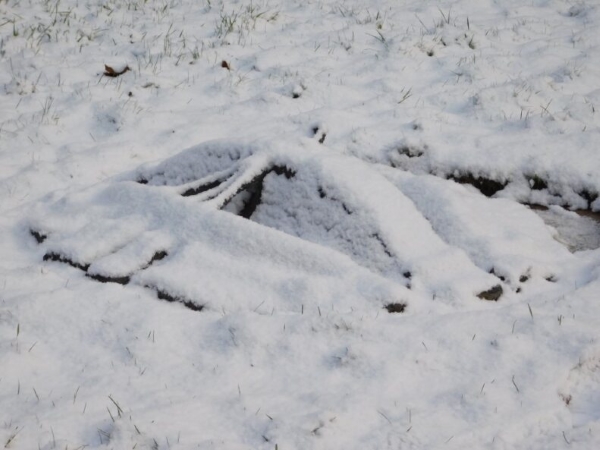
Inspired by the connection between these two mythical pits, more than five thousand miles away from one another, I began to wonder if there was anywhere a little bit closer to home that embodied a similar spirit. A quick search into Manchester ‘holes’ turns out to generally be far more banal than fantastical; holes acting less as a ‘gate to hell’ and more like an inconvenience on the way to work. ‘’Neighbours are fed up with it’: huge sinkhole closes Greater Manchester street,’ reads one headline. ‘Huge sinkhole becomes tourist attraction in Manchester after sewer collapse,’ says another. In contrast to Bus de la Lum, these holes are home to wheelie bins rather than witches, placed on the road by locals to warn drivers but that have ended up being subsumed by the growing chasms themselves.


A deeper dive into the holes of Manchester sees some more intriguing tales come to light. One of the wonders of the Peak District, Eldon Hole, was for hundreds of years believed to be a bottomless refuge for the Devil himself. When a man named Charles Cotton lowered himself down into it, he reportedly abseiled for over a mile and never reached the floor. Another man was later sent down, but when raised was found to be unconscious before dying soon after. The ‘Peak Hollows’ also act as a source of continuous fascination for ramblers exploring the National Park. Taking a multitude of forms, both man-made and natural, these hollows shift every space that they inhabit to one of mystery.

Of all the sites that appear while researching, one carries more stories than any other: Boggart Hole Clough, ‘the most haunted place in Greater Manchester’. A large urban country park in Blackley, the 200-acre woodland was bought by Manchester council in the 1890s. Much like Whitworth Park, the clough was a place for industrious Victorian Mancunians to while away the weekend, play sports and relax away from the grey and smog of the city centre. Suffragettes and early labour members even gave speeches there. Because of its use as a deer park, it has long resisted deforestation and remains one of the only patches of truly ancient woodland in Manchester. Despite the woodland’s inspiring history and reputation as a beauty spot, the area was given its name by something much more horrifying and unnerving.

Popular fiction would have you believe that Boggarts are just mischievous little house spirits but in fact they are creatures that have cropped up in countless forms throughout the last 500 years of Northern folklore. “Boggart” is actually the world used to describe all solitary spirits and ghouls in the Northwest of England, ranging from headless phantoms to ominous ghost hounds. As British folklore historian, Simon Young, says, ‘When you go back and look at 19th century sources, when people in Manchester ran through the door and said, ‘I have just seen a Boggart!’- and this comes up in a lot in sources’ what they meant was they saw something creepy and supernatural.’

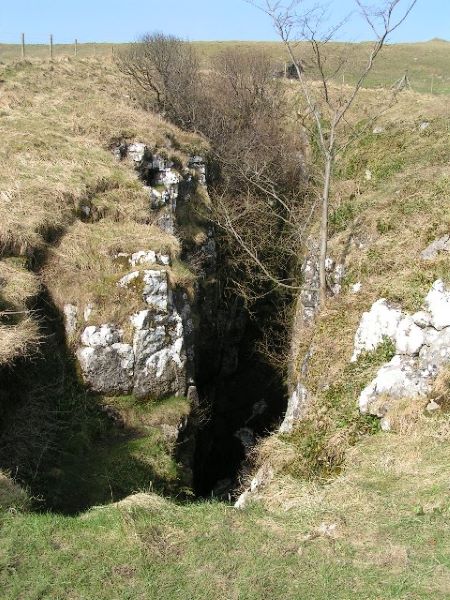
It is claimed that Boggart Hole Clough is the final place in the Northwest where Boggart folklore has truly survived, despite the once rural park now being surrounded by housing estates, flats, and main roads. This may be thanks to the huge amount of ‘Boggart holes’ there. Indeed, when you visit the park, it is pocked with places that drop down into the landscape whether that be ravines, caves or potholes. In old Northwest folklore these holes were believed to be the lairs of Boggarts. Folklore may have also kept its stronghold there as the site lies on the very old parish boundary between Middleton and Manchester – and there is a belief that parish boundaries are unguarded, supernatural spaces where you would be most likely to come across monsters like Boggarts.
One particularly unnerving story tells of three unfortunate men, Plant, Chirrup and Bangle, who set out into Boggart Hole Clough late at night in search of St. John’s fern seed. The supposedly magic-giving plant grew there in bountiful amounts, in a part of the clough that was known as ‘the glen of the hall of spirits’. However, the men were clearly foraging too loudly as something awoke under them. ‘Darkness came down like a swoop. Beautiful children were seen walking in their holiday clothes, graceful female forms sung mournful and enchanting airs. The men stood terrified and fascinated. A crash followed, as if the whole of the timber in the clough was being splintered and being torn up, strange and horrid forms appeared from the thickets, the men ran as if sped on the wind.’ Other tales tell of Boggarts like the nut-man who let out ear-piercing wails as he danced between the hazel bushes to the east of the park, and even an evil demon who lived in a hole there called the Devil’s Pit.

While nowadays visitors to the park may be lucky enough not to encounter those dreadful apparitions, there is a very tangible monolith to their memory. Erected by the Boggart Hole Clough Community Action Trust, the monolith provides a similar function to Nico Vascellari’s Bus de la Lum sculpture in turning your imagination to a different time and place, in this case the mythical landscape of pre-industrial Manchester. It was born when the trust was required to fell a tired old beech tree and they decided to do something a little more creative with it than just taking it to the tip. They turned the tree upside down, burying its upper half deep into a narrow clough, its roots now poking up to sky, matted like the split ends of some woody half-creature. Then they carved a gnarly face into its trunk.

Rather than an evil spirit, the members of the Trust fondly think of this Boggart monolith as a protective deity. They’ve drawn on the origins of the word Boggart, which comes from the German Bärgeist, literally translated as ‘gate ghost’. The trustees like to view ‘gate ghosts’ as spirits that protect little areas, this one in particular guarding the entrance to their rather small clough. Peter Milner, the Trust’s secretary, has admitted that they didn’t create the monolith for publicity reasons, as publicising the space doesn’t really help the wildlife – so perhaps the monolith is supposed to act as a reminder to us to be respectful to the nature of the park and stay away from places that others might call home. Could this have been what the Boggarts encountered by Plant, Chirrup and Bangle were trying to communicate as well? ‘Stay out of our woods!’
When you look at sites like Bus de la Lum, Darvaza and Boggart Hole Clough, it becomes clear that holes have a real magnetism. There is something irresistible about them that appeals to scientists, explorers and artists alike. Moving past folklore, many holes defy explanation. Some pits can appear overnight as if by random, others have existed for billions of years; they exist in both the most mundane and hard to reach places on earth. Many seem to be completely bottomless. Their contents are oftentimes a complete mystery. The hole is at the same time wonderful and scary. Always fantastic at inspiring the imagination, is it any wonder that so many of our most beloved stories contain them? These unknown abysses have the power to transform everyday environments into landscapes of myth and enchantment.

 A Place Between The Trees