
Join Ruby as she unravels the story of the pigment ‘mummy brown’. Here she discusses the ethical issues behind the historical use of such pigments and the displaying of human remains with Dr Campbell Price, Egyptologist and Curator of Egypt and Sudan at Manchester Museum.

On a balmy day in 1881, a group of artists, writers and their children sit in an orchard outside a grand mansion in what is now West Kensington. They have just finished lunch and have been discussing a trip to a colourman’s workshop, where one of the artists procures his pigments. Lawrence Alma-Tadma, a Dutch artist who had moved to London around a decade prior, begins to tell his hosts, the Burne-Jones’, that his colourman has offered to show him an Egyptian mummy that he keeps in his studio to produce a pigment called ‘Mummy Brown’. Edward Burne-Jones, the pre-Raphaelite artist, is initially sceptical then horrified at the idea as he had assumed that the name of the pigment had little to do with the materials it originated from. (1)
The long-bearded and balding artist then flees from his orchard to his studio and rifles through his collection of paints. After scrambling around for some time, he finds a small metallic tube with the inscription: Mummy Brown. A wave of guilt and shame later, he rushes to the garden and proclaims that this pigment is “made of dead Pharaohs and we must bury it accordingly!”. (2)
The party gather around a patch of grass where a small grave, little more than an indent in the green grass, is bored into the ground by hand and Edward gently lowers the tube into the soil. One of his young daughters finds a daisy root to mark the final resting place of a few crumbs of an anonymous ancient Egyptian (3) while the final rites are read aloud.
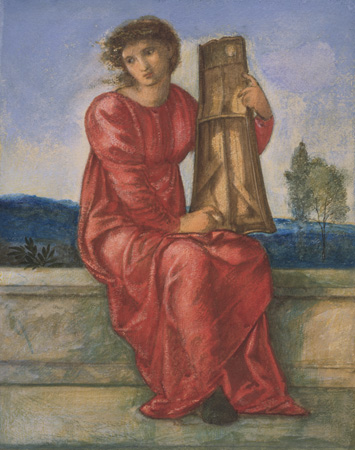
This unusual funeral was observed by Edward’s wife Georgiana and her nephew Rudyard Kipling, both of whom would later write about this day, immortalising the artist’s moral panic about his usage of the infamous pigment. The curious thing is it was fairly common knowledge that crushed up mummies had been used in pigment and medicinal remedies for at least 800 years before this incident, the first medicinal use of crushed mummies, or Mumia, beginning in the 11th Century CE (4). Mummy Brown would also be technically available for nearly another hundred years afterwards, the last tube being sold in England as late as 1964, when the colour-makers Roberson’s of London’s had run out of mummy body parts a year prior (5). The company’s managing director informed a journalist for Time magazine that:
“We might have a few odd limbs lying around somewhere (..) but not enough to make any more paint. We sold our last complete mummy some years ago for, I think, £3. Perhaps we shouldn’t have. We certainly can’t get any more.” (6)
We may now be reading this quote in horror, the flippant use of human remains for rather unnecessary purposes being morally objectionable, but are we so different from the Roberson’s managing director? As a rather morbid child I would often visit museums exhibiting Egyptian mummified remains and their sarcophagi, and gaze upon the corpse inside. Certainly, until recently, there was a certain level of voyeurism in terms of display methods that were, to many, perfectly acceptable if not, quite frankly, expected among curious visitors. So expected in fact, that when the Manchester Museum announced in 2008 that it would cover the unwrapped mummies in their Egyptology section, the public reaction was so negative that one individual believed that future generations wouldn’t be interested in history or Egyptology without being able to see these dead bodies (7).

Are we really entitled to viewing human remains in museological context? Is it that important for the general public to know what thousands of years inside a tomb does to a body? Is it our right? While we may no longer paint canvasses with ground-up human remains, our contemporary attitudes might not be too far away from the pigment makers of the 1800s. Have we really moved on?
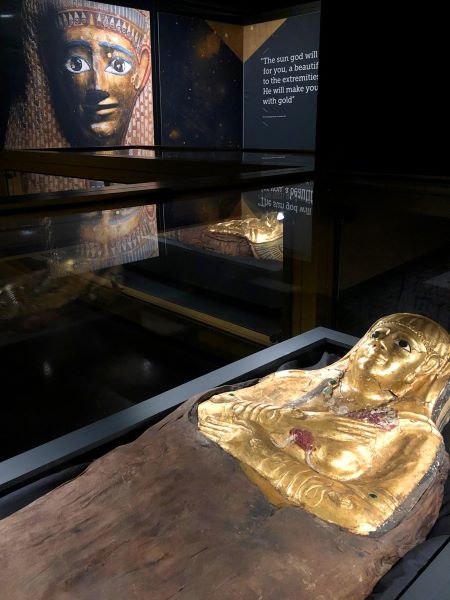
To try to answer this question, I met with Dr Campbell Price, Egyptologist and Curator of Egypt and Sudan at Manchester Museum, who has curated the Golden Mummies of Egypt exhibition (as well as many others). I take a seat in his airy and light office where every surface is covered in books, and after a bit of small talk, I ask if he thinks one of the reasons why we’re still obsessed with viewing mummified remains is because of media? Of big blockbuster films? “Yes,” he replied “absolutely. You think of the Mummy films, I mean I saw the last one (which wasn’t great) where the mummy was hypersexualised and seen as desirable, and I think that has a lot to do with how we view mummies now.”
After talking briefly in his office, he said “Why don’t we go down to the stores and actually have a look at some stuff?”- of course I was thrilled to, it’s not every day you have this opportunity is it? We left his office and travelled down and down a narrow staircase, through doors and storage rooms, and I couldn’t help but feel as though I was descending into a tomb complex, some ancient burial site. Price unlocks doors upon doors, each room a treasure trove of different objects; a taxidermized bird here, a Mycenae death mask there- until we reach the room containing organic matter.
We discuss the issues around storing all of these mummified people lined up across from us, a scene which looks almost morgue-like due to the room’s pristine whiteness. We walk up some metal stairs towards the smaller storage shelves and stand the narrow space between the metal cases and delve into the boxes contained within.
We start discussing the dissection of a mummified body in 1975 at the Manchester Museum, where a multidisciplinary team unwrapped a Ptolemaic body of a young woman found at Hawara which was recorded for a documentary for the BBC. The film was marketed and aestheticized as an autopsy and “resulted in the atomisation of the corpse” (8). Campbell crouches down and picks up what looks like a comically oversized mason jar seemingly filled with soil. “This is what was swept up from the unwrapping.” Oh. “We’ve got to be very careful about how we display this and how and when we loan it, as it does essentially contain human remains as well as fibres from the linen.” He then goes on to find a small cardboard box with a few sections of wrappings inside; “perhaps these were used for Mummy Brown as well?” he posits, and indeed, they are a very similar colour.

We talk about the idea of unwrapping in a museum context (the unwrapping of mummies has also occurred at hospitals and private residences), and about the point of them. “The thing is, I’ve been to CT and MRI scans of mummies before, with several other experts from different academic fields. The problem is, we couldn’t agree on what we were seeing- at all! It’s all up to interpretation, which, debatably, makes these unwrapping events and CT scans a tad futile.”
I bring up the fact that not all of the remains used for mummy brown and/or Mumia were from ancient Egyptians, but also criminals and enslaved people, who hadn’t been dead especially long. I ask him if it was less to do with the bodies being specifically mummies, and more to do with how much these lives were valued by society at the time?
“Yes, it’s exactly that. You have to remember that this, selling mummies, was a business. There was someone who sold something to someone else, and then that someone else sold these remains to a pigment maker. These transactions weren’t necessarily anything to do with the Egyptian government but were more closely linked to people lower down the social ladder, merchants for instance. There was a lot of money to be made.” I ask him if it was like a necro-economy? “Yes, exactly.”
He then goes to open a drawer which contains around 5-6 mummified cats; most of us who have been to Ancient Egypt themed exhibitions will have seen one before, but I doubt many of us have seen them without the glass casing. I can’t describe the smell other than being exactly what you expect a thousand-year-old dead cat to smell like, but seeing close-up the care that was given to these small creatures is very moving.
“You know they were shipped over to Europe for fertilizer?” I did know this, but seeing them in the flesh, it feels so wrong. Yes, cats have no sense of the afterlife or religion, but their owners and those who mummified them certainly did.
The ethics of displaying human remains is a very contentious issue. “When we reopened after Covid, we were concerned about how to display Asru (the partially uncovered mummy in the Manchester Museum). Especially after the pandemic and the murder of George Floyd, for example, the idea of displaying a dead body was one we had to really think about properly. We decided on a compromise of maintaining Asru out on display, but without a sensor-operated light, and to ask visitors what they think of her being on view.”
We discuss the quote I used earlier from the 2008 blog post about covering mummies, and I wonder if people, including myself, believe that it is our right to see these bodies? I remember seeing Asru as a child when she was fully uncovered, presented in a way that I would now find rather voyeuristic and peep show-like.
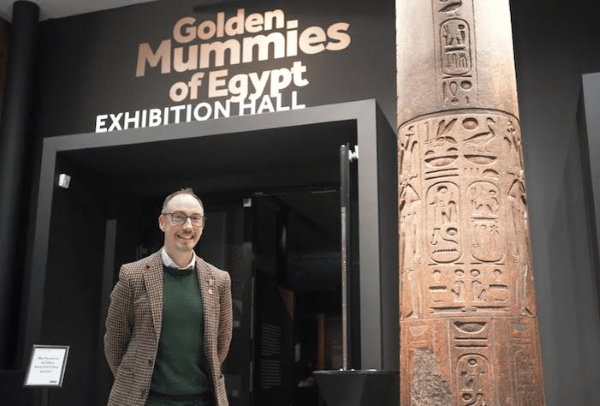
“What we’ve got to remember is that we often think people of the past are stupid, are ignorant, but actually we still have to capacity to be just as stupid. We aren’t necessarily better off than they were in terms of our understanding of the world.” Sort of like an ebb and flow of morality?
“Yes, that’s a good way to put it. We talk about Burne-Jones’ reaction to Mummy Brown, but then you have the guy from the pigment maker, talking about how they’ve got ‘a few limbs lying around’. Anytime we talk about a period of history where something contentious was happening, there were always people who disagreed with it. Like Edward Burne-Jones and Mummy Brown.”
I ask him if we’ll ever come to a unanimous decision about displaying human remains? “We’ll be having this conversation about displaying mummies and the ethics of it long after we’re gone, as there aren’t really any easy answers.”
We talked a little longer about ethics and morality around Egyptology, but Campbell had to head off for a meeting with Greg Jenner, the Horrible Histories historian and host of You’re Dead to Me on Radio 4, a perfectly good reason to end any conversation if you ask me! Look, I’m a Radio 4 and podcast nerd- Greg Jenner’s a very big celeb to me. As I left the Manchester Museum, I thought about how lucky it is that we have academics and specialists like Price; to open doors for people and take time to educate others. I hope through reading this, you will feel more enlightened about the strange history of painting with and eating mummies. It’s a good bit of trivia at a pub quiz at the very least.
References
(1) Burne-Jones, G, Memorials of Edward Burne-Jones, Macmillan, London, 1904, p.114
(2) Rudyard Kipling: Something of Myself and other Autobiographical Writings (ed Thomas Pinney), Cambridge University Press, 1990, pp. 9-10
(3) Burne-Jones, G, Memorials of Edward Burne-Jones, Macmillan, London, 1904, p.114
(4) https://www.nationalgeographic.com/history/article/mummy-eating-medical-cannibalism-gory-history
(5) https://www.artinsociety.com/the-life-and-death-of-mummy-brown.html
(6) Ibid.
(7) https://egyptmanchester.wordpress.com/2008/05/06/covering-the-mummies/
(8) Price, Campbell, Golden Mummies of Egypt, Manchester University Press, 2023, p.46
 A Place Between The Trees
Fascinating article. Let’s hope Van Dyke brown is other than Van Dyke. Very interesting.
LikeLiked by 1 person