
This is the first in a series of reviews of books from the Visitor Team’s Carbon Literacy Bookshelf. Today we hear from Bria, who shares her thoughts on George Monbiot’s ‘This Can’t Be Happening.‘
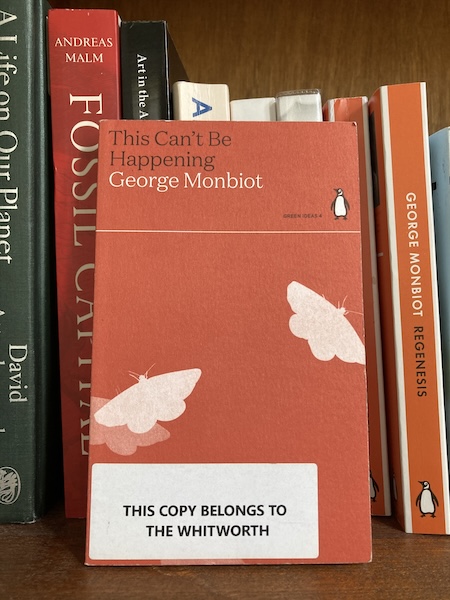
Welcome to the first book review of our Carbon Literacy Bookshelf! In this series, members of the Visitor Team will read and offer their thoughts on the books we have purchased relating to the climate crisis. Through this, we hope to expand our knowledge and turn these learnings into actions, both within the gallery and beyond.
Today’s book review is on George Monbiot’s This Can’t Be Happening, published in 2021 by Penguin Random House UK as part of their Green Ideas series. Monbiot is an investigative journalist and a columnist for The Guardian, as well as a climate activist. This book is a collection of his columns and protest speeches from December 2017 to June 2019, with a foreword published in August 2020. I mention the date range because I believe it is important to situate these writings and speeches in their context, especially since all of these (bar the foreword) were written before the COVID-19 pandemic. The landscape of the UK’s political-economy changed significantly post-2020, to the point that anything before that year seems like a distant memory, rather than being just over a few years old.
This book is a useful tentpole for those beginning to awaken their climate consciousness – it touches on various issues in the UK’s climate crisis. By shining a light on the decline in wildlife, the prevalence of agricultural sprawl, and the pitfalls of the so-called “green growth”, you can use this text to leap into various other topics in the climate canon.
What makes these collections of essays and speeches interesting is that the wider political-cultural economy of the UK is interrogated as the structural reasoning behind the climate crisis. Monbiot argues that the pervasive thinking of economic growth and the endless demand for resources is a problem that is embedded into how we live. He argues that the problem is neoliberalism.
I found myself most persuaded by the essays focusing on paying attention – particularly, the experiment conducted on counting the number of moths in his back garden. It follows the similar structure to his other essays: introduce an anecdote, sprinkle in some other analyses on present environmental destruction, end on a plea for adhering to feelings of community and justice. Other essays seem cloying in comparison to this one, as Monbiot takes something that is often overlooked (the moth) and turns it into a potent symbol of extinction and decline.
However, given the short nature of these essays, it is inescapable to feel that something is missing. When reading the blurb that Monbiot is a “leading voice” in climate activist circles, I wonder if this is the best we can do. This comes from a place of surprise, maybe even anger, that the foreword (again, written in August 2020), fails to mention community action during COVID-19 and the Black Lives Matter protests in the wake of George Floyd’s murder. Is it from an attempt to make these essays timeless? If so, what is the point, when a good number of Monbiot’s anecdotes are his personal experiences with declining wildlife from his childhood onwards? When the collection of essays is focused on collective action, how can you not mention the collective community work that took place when you were writing this foreword? This is especially glaring when considering how biosecurity, health, and racial inequalities are inextricably linked to climate justice.
This is where the political angles of the essays seem to lose their sharpness, when you place them in the context of their writing. Consider how recently, we have witnessed a roll-back on our green policies and acceptance of conspiracy theories against 15-minute cities. [1] If we seek to create a harmonious community that values harmonious human-natural relationships, we must hold to account those that seek to destroy it.
What the cultural sector can take away from this book is the importance of narratives and storytelling. We are in a unique position in the public eye to offer open and responsive narratives that may not be explored in the news or media. If Monbiot is calling for a change in narrative, one that focuses on community and solidarity, then I would argue that the cultural sector has the resources and space to create these dialogues, and guide them into action.
1 Zuidijk, D. and Rudgard, O. (2023) 15-minute cities: What are they and why are they controversial?, Bloomberg.com. Available at: https://www.bloomberg.com/news/articles/2023-10-03/15-minute-cities-what-are-they-and-why-are-they-controversial (Accessed: 16 April 2024).
 A Place Between The Trees