
In part two of Steph’s ‘Exploring the Floating World’ project, we examine some of the earlier ukiyo-e prints within the Whitworth’s collections and learn about the introduction of colour to ukiyo-e prints.
The Basic Printing Process
For an ukiyo-e print to come into being, an artist had to draw a design on paper. This design or a copy of the design would then be handed over to the block cutter or carver (or a team of master block cutters and their apprentices), the person who carved the wooden blocks necessary to create a woodblock print. The block cutters would place the design face down over a block of wood and eventually start to carve the design into the wood. Many initial drawings tended to be destroyed during the carving process.
The raised areas of the block would be those to which ink was applied during the printing process. The wooden key blocks blocks used for printing ukiyo-e images in Japan were often, but not always, carved from cherry wood- specifically that of the yamazakura, which is now less common than it was in the past and therefore more expensive. [1] Yama means mountain and sakura is the word for cherry blossom, when the two words are combined the sa sound in sakura becomes a za sound. The preference for cherry wood was apparently due to its characteristically ‘fine grain’ and tendency to not splinter. [2] Any areas left bare on a monochrome print, or an initial outline of a print are areas where the block cutter removed more wood, carving more deeply into the block. To create the blocks for ukiyo-e prints, the block cutters or carvers would carve along the grain in a downwards direction, as opposed to carving across the grain, which according to Salter helped to give the prints their distinctive ‘flowing’ lines. [3]
Once completed, the blocks would then be prepared by the printers, who would use them to create many imprints of the original design. This whole chain of production was usually organised and managed by a publisher, who had probably commissioned the artist who produced the original design and whose name might also be included on the finished prints. [4] The names of the block cutters and printers, however, were usually not included on ukiyo-e prints. Printers would use a round, flat tool called baren to transfer images onto the paper, with the printing block facing upwards towards them and the paper face down. The paper would usually be made of mulberry fibres and would be slightly damp at the time of printing to allow it to better absorb ink and fine details from the printing blocks. Traditional woodblock printing methods are still practised by some in Japan today.
There are a number of similarities between the process of creating a woodblock print and the process of creating a woodcut print. Both processes can result in the destruction of the artist’s original drawing.
The very first ukiyo-e prints were monochrome, as we can see with prints designed by some of the earlier ukiyo-e artists whose works have ended up in the Whitworth’s collections.

The piece above and the piece below are both by Hishikawa Moronobu (1618-1694) and are two of three by the artist in the Whitworth’s collections, to my knowledge. All of our Moronobu prints, that I am aware of, depict ‘types of women’ (according to the titles of the works). At the time of writing, I had only been able to find photographs of these two prints. I believe these prints may be some of the earliest ukiyo-e pieces we have in the Whitworth’s collections. Moronobu was a prominent artist in Edo during his lifetime and helped to establish the ukiyo-e genre. He was known for his works depicting beautiful women (bijinga), among other things.

The lady at the forefront of the piece pictured above appears to me to be carrying a child, with the head of the infant? peeking out from the top of her kimono. The lady in the middle has something jutting out from her kimono- is it a sword? Could this figure be a youth in disguise, his head unshaved? Above the images on both prints there is some text in what seems to be cursive hiragana. I’m unable to understand the text myself, as I regrettably do not speak (or read) Japanese. I suspect these prints may have been illustrations for something, either intended to be bought in an album or book or possibly to be purchased as single sheet prints. If anyone can understand the text on these prints and/ or has a better idea as to the purpose of the prints and the figures depicted on them, please do let me know in the comments!
Moronobu initially produced designs for embroidery. He later began to produce designs for woodblock illustrations for books, such as Ise monogatari hirakotoba (‘Tales of Ise in Plain Language’).[5] We know that Moronobu also produced designs for shunga (erotica), a subject which was later prohibited by the bakufu.
Those who have examined his work extensively have noted that it appears he was familiar with the techniques of the Tosa and Kanō schools of painting.[6] The Tosa school began in the seventeenth century and produced artists who painted for the imperial court. The Kanō school of painting emerged during the fifteenth century and was influenced by Chinese styles of painting. The school enjoyed popularity with wealthy people across different social classes, from the Tokugawa bakufu and their Ashikaga predecessors to the wealthier merchants among the chōnin. The style of the Kanō school became so popular that it later filtered down to the less wealthy. Artists who were more familiar with the style, through having undergone some training with the Kanō school, would adapt elements of the style to meet increasing consumer demand for cheaper, mass produced work.[7] There were also those who produced what you might consider imitations of the style, having never undergone training in the style themselves but attempting to copy it in order to keep attracting sales.[8]
The Addition of Colour
The first colour ukiyo-e prints to emerge were coloured by hand, which was a time-consuming process and resulted in more expensive prints. Okumura Masanobu (1686-1764 CE), who also designed some of the older ukiyo-e prints I could find in Whitworth’s collections, is known for having produced a richly coloured print of a kabuki theatre in 1740.[9] That print, like all ukiyo-e prints up to the mid-eighteenth century, was coloured by hand- with the colour being applied via brushes. Masanobu was also among the first ukiyo-e artists to design works to which colour was added by way of printing blocks, something he worked on in earnest and became adept at during the 1730s.[10] Below you can see a piece from the Whitworth’s collections which has been attributed to Masanobu and dated to around 1700-1724 CE. I suspect, based on the date range, that this may be an example of tan-e, which are prints to which colour in the form of an orange red were applied by hand.

Zhong Kui or Shoki, depicted by Masanobu in the print above, was a historical figure from China who became associated with protection from diseases as well as demons. This figure was depicted in a number of ukiyo-e prints by various artists, which includes the likes of Katsushika Hokusai.
Adding colour to ukiyo-e prints by way of printing blocks meant that more blocks were needed to produce a single print, as each colour would need a designated block. The outlines of a design would be applied first in black ink with what is referred to as the key block. Then colours could be added using different blocks which corresponded to certain areas of the print.
Initially, the addition of colour by way of blocks was only done with a very limited colour palette. The pigments used were often created from plants at first but as time went on new synthetic pigments, such as Prussian blue, were used. Dayflower, Japanese indigo, madder, redbud, safflower, and turmeric are just some of the plants pigments which were used to create pigments to add colour to ukiyo-e prints.[11] Colours could also be layered/ printed over one another to create other colours, such as printing blue over yellow to make part of a print green. Unfortunately, not all plant-based pigments last very long and some are more prone to fading than others. Prussian blue, a synthetic pigment, was created for the first time during the eighteenth century, it then made its way into Japan via trade with China and was famously used by the likes of Hiroshige and Hokusai.[12] [13] Both Hiroshige and Hokusai became well-known for their prints focusing on landscapes as their subject of choice.
Prints known as benizuri-e were some of the earliest of the woodblock prints to which colour was applied by way of printing blocks, rather than by hand. The term benizuri-e refers to the beni (a rose-red or pink) used in such prints.[14] Red pigments may have given such prints their name but green pigments were also used in benizuri-e. Earlier hand-coloured prints containing these pink and red hues were known as beni-e.[15] Tan-e were another form of early hand-coloured print, which in this case contained a red-orange pigment. The difference in the shades of red employed in these types of early hand-coloured prints was down to the ingredients commonly used to create the colours. Tan was one of the first colours ever applied to ukiyo-e prints.[16] It was created using ‘red oxide of lead’, whereas beni had more botanical origins; it was created from safflower and a fermented ‘acidic liquid derived from the outer layer of the stones of Japanese plums.'[17]
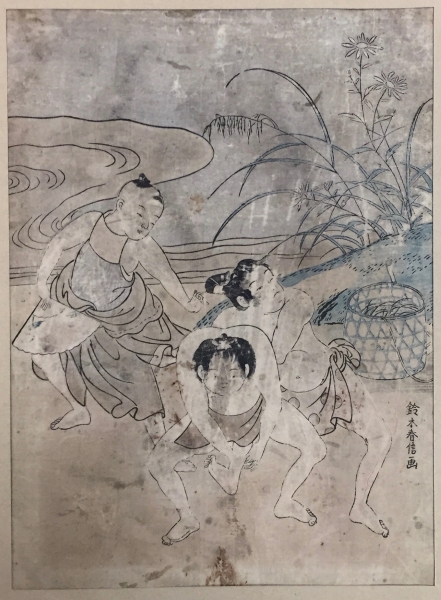
The print above is the work of another relatively early ukiyo-e artist called Suzuki Harunobu. At first glance, very few colours appear to have been applied to this print. Some pigments fade with time, however, so it may have originally been more colourful than it appears now. I do not know if the background was originally a different shade of blue to that of the vegetation in the print (perhaps this was once green and the yellow pigment has faded over time, leaving behind only the blue?) or if the greyish shade which appears in the photograph indicates the background was once covered in mica powder- a material which is known to have been applied to some of Harunobu’s prints.
Harunobu is credited with pioneering nishiki-e, which emerged in the 1760s. Nishiki-e (‘brocade pictures’) were multi-coloured prints and the amount of colour used in these prints reminded people of brocade fabrics, from which they derive their name. Nishiki-e were distinguished from other coloured prints in that there was no blank space, instead the entire print was filled with colour. They are believed to have first emerged during the 1760s, with Harunobu producing nishiki-e prints at a daishōkai (a gathering/ party organised for printing calendars) in 1765. [18] [19] Such events were highly fashionable and allowed Harunobu and other Ukiyo-e artists to meet with other artists, as well as other prominent cultural figures.[20] Early nishiki-e, such as those designed by Harunobu in 1765, were printed in just a few colours but later nishiki-e prints contained many more colours.[21]
According to Nishiyama Matsunosuke, before nishiki-e emerged, blank space in ukiyo-e prints ‘was charged with great meaning’ and areas which were left bare were ‘deeply related to Buddhist notions of emptiness.'[22] Matsunosuke also points to the use of Western forms of perspective in nishiki-e, which indicates a shift in not only the use of colour but also artistic styles as techniques which were new to Japan were adopted in the production of ukiyo-e prints.[23] However meaningful those blank spaces may have been, it appears that the appeal of prints filled with more colour largely eclipsed monochrome prints and prints with less colour. These new multi-coloured prints proved popular both in Japan and abroad, continuing to appeal to domestic and foreign consumers throughout the rest of the Edo period.[24]
Ukiyo-e prints continued to be produced throughout the Edo period and also throughout the Meiji period (1868-1912 CE). In the next instalment of this series, we will look at some of the subjects, styles and pigments which were eventually prohibited in ukiyo-e prints with varying degrees of success. – Steph
References
[1] Rebecca Salter, Japanese Woodblock Printing (University of Hawai’i Press, 2001), pp. 15-16.
[2] Salter, Japanese Woodblock Printing, p.15.
[3] Salter, Japanese Woodblock Printing, p.15.
[4] Salter, Japanese Woodblock Printing, p.11.
[5] Rebekah Clements, A Cultural History of Translation in Early Modern Japan (University of Cambridge Press), pp.59-60.
[6] Joshua S. Mostow, Pictures of the Heart: The Hyakunin Isshu in Word and Image (University of Hawai’i Press, 1996), pp.101-102
[7] Department of Asian Art. “The Kano School of Painting.” In Heilbrunn Timeline of Art History. New York: The Metropolitan Museum of Art, 2000–. http://www.metmuseum.org/toah/hd/kano/hd_kano.htm (October 2003)
[8] Department of Asian Art. “The Kano School of Painting.” In Heilbrunn Timeline of Art History. New York: The Metropolitan Museum of Art, 2000–. http://www.metmuseum.org/toah/hd/kano/hd_kano.htm (October 2003)
[9] Conrad Totman, Early Modern Japan, (University of California Press, 1995), pp.391-392.
[10] Totman, Early Modern Japan, p. 391.
[11] Betty J. Fiske, ‘Conservation of Japanese Woodblock Prints: Display, Storage and Treatment’, Impressions 28 (2006-2007), pp. 66-67.
[12] Sarah Lowengard, ‘Colours and colour making in the eighteenth century’, in Maxine Berg and Helen Clifford (editors), Consumers and Luxury: Consumer Culture in Europe, 1650-1850 (Manchester University Press, 1999), pp.108-109.
[13] Salter, Japanese Woodblock Printing, p.102.
[14] Salter, Japanese Woodblock Printing, p.10
[15] Salter, Japanese Woodblock Printing, p.27.
[16] Salter, Japanese Woodblock Printing, p.10.
[17] Salter, Japanese Woodblock Printing, p.27.
[18] Andreas Marks, Japanese Woodblock Prints, (Köln, 2019), pp.18-19.
[19] Nishiyama Matsunosuke, (author) and Gerald Groemer (editor and translator), Edo Culture: Daily Life and Diversions in Japan, 1600-1868 (University of Hawai’i Press, 1997), pp. 70-71.
[20] Matsunosuke (author) and Groemer (editor and translator), Edo Culture: Daily Life and Diversions in Japan, 1600-1868 (University of Hawai’i Press, 1997), p. 71.
[21] Salter, Japanese Woodblock Printing, p.10.
[22] Matsunosuke (author) and Groemer (editor and translator), Edo Culture: Daily Life and Diversions in Japan, 1600-1868 (University of Hawai’i Press, 1997), p. 71.
[23] Matsunosuke (author) and Groemer (editor and translator), Edo Culture: Daily Life and Diversions in Japan, 1600-1868 (University of Hawai’i Press, 1997), p. 71.
[24] Matsunosuke (author) and Groemer (editor and translator), Edo Culture: Daily Life and Diversions in Japan, 1600-1868 (University of Hawai’i Press, 1997), p. 71.
Primary Sources
List of Prohibitions Concerning Clothing for Edo Townsmen (1719) in Constantine Nomikos Vaporis (editor), Voices of Early Modern Japan: Contemporary Accounts of Daily Life During the Age of the Shoguns, Second Edition (London, 2021), p.27, Source: Donald H. Shively, “Sumptuary Regulation and Status in Early Tokugawa Japan”, Harvard Journal of Asiatic Studies 25 (1964-65): 129.
Suzuki Harunobu (1724-1770 CE), Boys Wrestling, woodblock print. Accession number: P.5476 Source: the Whitworth.
Okumura Masanobu (1686-1764 CE), Zhong Kui (Shoki) the Demon Queller, attacking a Demon with a sword and umbrella, c.1700-1724 CE. Accession number: P.1996.163 Source: the Whitworth.
Hishikawa Moronobu (d.1694), Types of Women: Two Men with Swords, and a Woman, woodblock print c.1680. Accession number: P.5702.2 Source: the Whitworth.
Hishikawa Moronobu (d.1694), Types of Women: Three Ladies, woodblock print. Accession number: P.5702.1 Source: the Whitworth.
Further Reading
Department of Asian Art. “The Kano School of Painting.” In Heilbrunn Timeline of Art History. New York: The Metropolitan Museum of Art, 2000–. http://www.metmuseum.org/toah/hd/kano/hd_kano.htm (October 2003)
Rebekah Clements, A Cultural History of Translation in Early Modern Japan (University of Cambridge Press).
Julie Nelson Davis, Partners in Print: Artistic Collaboration and the Ukiyo-e Market (University of Hawai’i Press, 2015).
Julie Nelson Davis, Picturing the Floating World: Ukiyo-e in Context (University of Hawai’i Press, 2021).
Betty J. Fiske, ‘Conservation of Japanese Woodblock Prints: Display, Storage and Treatment’, Impressions 28 (2006-2007), pp. 60-75.
Monta Hayakawa and C. Andrew Gerstle, ‘Who Were the Audiences for “Shunga?”‘, Japan Review 26 (2013), pp.17-36.
Alan Hockley, The Prints of Isoda Koryūsai: Floating World Culture and its Consumers in Eighteenth Century Japan (University of Washington Press, 2003).
Andreas Marks, Japanese Woodblock Prints, (Köln, 2019).
Nishiyama Matsunosuke (author) and Gerald Groemer (editor and translator), Edo Culture: Daily Life and Diversions in Japan, 1600-1868 (University of Hawai’i Press, 1997).
Joshua S. Mostow, Pictures of the Heart: The Hyakunin Isshu in Word and Image (University of Hawai’i Press, 1996).
Keiko Nakamachi, ‘Genji Pictures from Momoyama Painting to Edo Ukiyo-e: Cultural Authority and New Horizons’, in Haruo Shirane (editor) Envisioning the Tale of Genji: Media, Gender and Cultural Production (Columbia University Press, 2008), pp.171-210.
Woldemar von Seidlitz and Dora Amsden, Impressions of Ukiyo-e (New York, 2023).
Minah Song, ‘East Asian Manuscript and Printing Inks’, in Abigail Bainbridge (editor), Conservation of Books (London, 2023).
Conrad Totman, Early Modern Japan, (University of California Press, 1995).
Constantine Nomikos Vaporis, ‘Anatomy of a Ukiyo-e (Woodblock Print) in Constantine Nomikos Vaporis (editor), Voices of Early Modern Japan: Contemporary Accounts of Daily Life During the Age of the Shoguns, Second Edition (London, 2021), pp.228-229.
 A Place Between The Trees
One thought on “Ukiyo-e: From Monochrome to Colour”