
This is the second review in a series looking at books from the Visitor Team’s Carbon Literacy Bookshelf. Today we hear from Urussa, who shares her thoughts on Mike Berners-Lee’s ‘How Bad Are Bananas.’
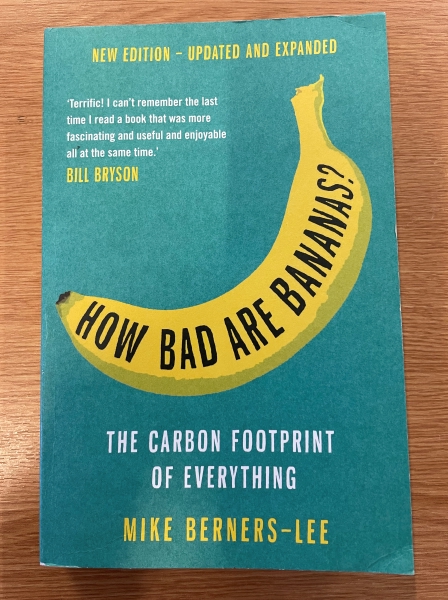
From products which emit less than 10 grams of carbon (for a carbon footprint) all the way up to a billion tonnes of carbon, Mike Berners-Lee outlines, demonstrates, and reiterates the impact, effect, and consequence of embodied carbon emissions (the energy/carbon it took for a product to be made) and carbon emissions afterward. Berners-Lee advocates for a 5-tonne carbon lifestyle per year. It is not, according to Lee, a long-term sustainable effort but if everyone in Europe was to cut down to 5 tonnes (the average UK person emits 13 tonnes), it could go a long way toward an all-low-carbon world.
Methodically, and sometimes unfeelingly, Berners-Lee writes the second edition of this book, first published 10 years ago, and now published with more fervor, urgency, and acceptance of the flawed attempts to reach global net zero. An example of astonishing measure. A Range Rover Sport, in being built, has already emitted 25 tonnes of carbon. No amount of usage, according to Mike Berners-Lee, justifies its existence.
More everyday examples are used, comparing getting water from a tap to a bottle of water, which are respectively 0.2 grams of carbon versus 320 grams of carbon from a locally sourced and distributed liter bottle of water (but the average liter bottled water is 400 grams). The discrepancy between 0.2 grams and 400 grams is immense. The book follows a similar approach, where the same item, coming from close or far, being able to be used once or used infintely, hugely impacts the carbon footprint of it.
The genre of books about the climate emergency or climate change, anecdotally speaking, feel immense in tone and nature. The gravity of the situation is dire, yes. The tone of writing is dire also. However, it offers tangible ways to reduce carbon emissions. It makes me reflect on the recent news of schoolchildren in South Korea who have successfully held the South Korean government accountable for more than just targets but a philosophical duty toward future generations to keep the Earth habitable. The book similarly asks us to be mindful of what we can control as consumers of cars, the internet, and other products.
To name some examples, the everyday banana’s 110 grams to the not-so-everyday Range Rover Sport HSE’s 25 tonnes of carbon. To tap water at 0.2 grams compared to wars (between 9 million and 3.3 billion tonnes). If representation is of importance, I see myself reflected in the items used (a banana), wasted (the UK’s annual carbon footprint of 840 million tonnes).
The book targets and misses you in that sense. It gives you relief that you won’t cause a war’s worth of emissions, but the tone of the book is a bit neutral around emotional subjects where it unemotionally suggests that war, due to killing people creates negative emissions (but of course defeats the objective, according to Berners-Lee), can be off-putting.
Berners-Lee does well when he talks about the misconceptions around digital being environmentally friendly—when speaking about the world’s ICT, the carbon emissions and embodied carbon created to run the world’s ICT is sizeable. This is shown in another example: the Rolls-Royce, which, in its making, reaches a sizeable footprint that may never be mitigated. This is a great strength of the book, focusing beyond the product and on the process’s carbon footprint (referred to as embedded emissions here).
All the problems don’t equal all our problems but are still interconnected. To no fault of Berners-Lee, climate change and its effects always seem to be retrospectively speaking as our consumption and its effects, as it changes and impacts so quickly. What the governments sign up to, what goals are, what language is being used. This book will demonstrate a certain thinking we held at a certain time, a sense of urgency. It will be overtaken by another set of goals, language, and desire to face the ecological problems of carbon emissions.
 A Place Between The Trees