
Inspired by the quince which grows in our Alex Bernstein Garden, Jason explores the culinary uses and health benefits of the golden pome.
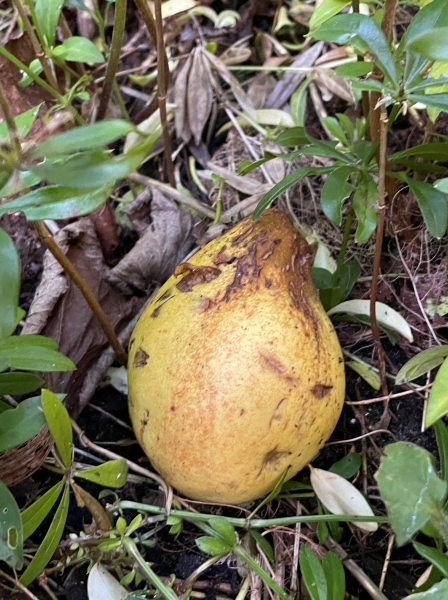
I had never heard of a quince until my adult years began.
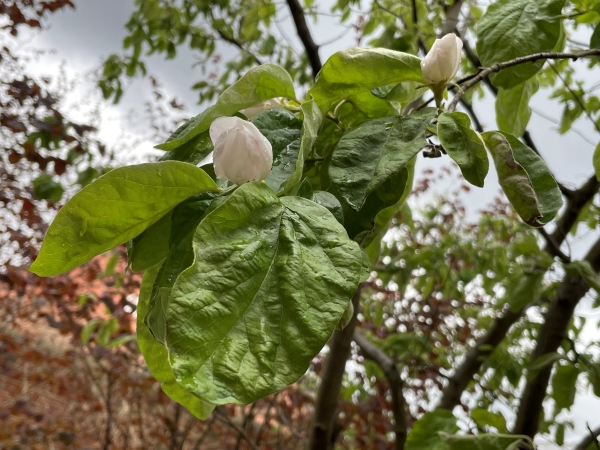
Quince (Cydonia oblonga) are pomes (like an apple or pear). They are believed to originate from the Caucasus region and have expanded exponentially to nearly every corner of the world. Although we don’t often see them in our supermarkets, due to their high pectin content they are often found as jellies, preserve or pastes (also known as quince cheese or membrillo) on our shelves. These delicious products are sweet with a tangy undertone, pairing well with savoury foods.
The fruit is usually found green, transitioning to a bright yellow as it ripens and is picked in late autumn.
The fruit itself is packed full of nutrients, including fibre, calcium, vitamin C (15% daily value) and copper (13% daily value), as well as antioxidants such as quercetin (Al-Zughbi and Krayem 2022). Quercetin has potential benefits of lowering blood pressure and inflammation and can be found in many other fruit and vegetables (Debeek and Marra 2019).
Antioxidants are protective molecules which we naturally produce to help defend our body from cellular damage. A variety of food sources from berries, oranges and dark chocolate to broccoli, cauliflower and many other leafy greens can greatly increase our antioxidant capacity. These in-turn help to balance out our bodies by counterbalancing unstable molecules called ‘free radicals,’ caused by natural processes, and environmental pollutants. So, it is very important to have a reliable source of antioxidants to keep your body in check.
Below I have included a link to delicious.com.au to help inspire anyone wanting to try something a little bit different to quince cheese.
https://www.delicious.com.au/recipes/collections/gallery/savoury-dessert-quince-recipes/irgzvpiw
Let us know how you get on!
Thanks for reading.
 A Place Between The Trees