
In the run up to Halloween, explore the details in ‘The Witches’ Procession’ by Agostino Musi and learn about popular beliefs surrounding witches in early modern Europe with Steph.
For more information about the #WhitworthBestiary project, view the the Whitworth Bestiary project page..
Witches are everywhere in October; on Halloween decorations, our screens, knocking on our doors on the 31st and even inspiring novelty sweets, homeware and plush toys. But how were witches perceived from the fifteenth century into the eighteenth century, when people faced accusations which could have very real consequences? Join me for a quick (and very simplified) overview of the beliefs surrounding witches in early modern Europe.
Lo Stregozzo, also known as The Witches’ Procession, depicts muscular male figures, some of whom appear to be pushing the skeleton of a strange creature along. One of the male figures at the front of the procession holds a baby under his arm. Atop the large skeleton sits a crone holding a vessel of some sort, which belches smoke, and with her are more unfortunate infants- one of whom is firmly in her grasp. A smaller figure can be seen riding a goat. Yet another figure kneels atop a smaller skeleton, which appears to have features taken from various animals. The distressed babies in the engraving may be a nod to the diabolical deeds some people believed witches got up to at the witches’ sabbath.
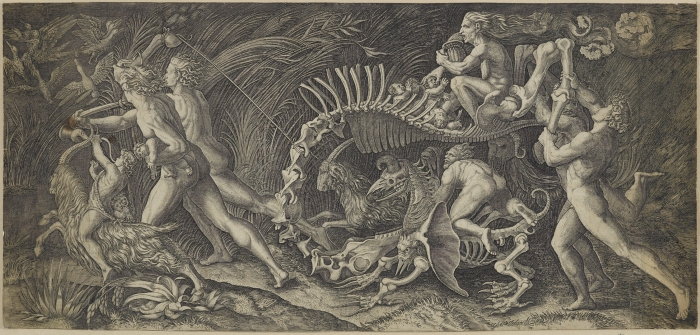
There are texts discussing what was thought to occur at this nocturnal gathering going back to the early fifteenth century. The witches’ sabbath was effectively a diabolical orgy and, over time, the imagery of the sabbath was adopted in stories about witches not just parts of mainland Europe but also eventually in England. Ideas about the witches’ sabbath included witches flying on a broom or riding animals to the gathering, swearing fealty to the Devil, kissing his bottom, and also infanticide and cannibalism.
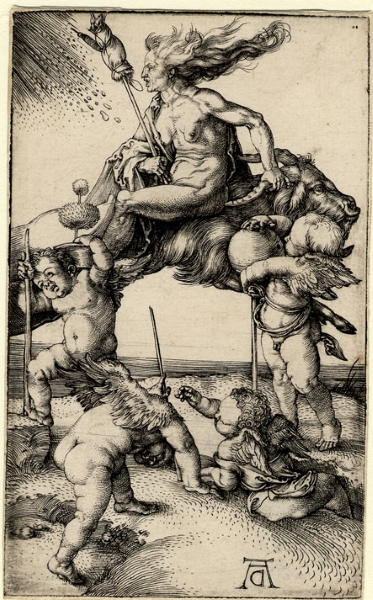
The Witches’ Procession was produced at some point during the early sixteenth century. The exact date is unknown but witches had already been in the public imagination and they had been depicted in art by some of Musi’s contemporaries such as Albrecht Dürer, who also produced an engraving which depicts a witch as a nude hag-like figure with wild hair. Dürer’s witch has a broom but rides a goat, which is accompanied by putti. Musi’s Procession bears some similarities to Dürer’s print in that the skeletal beast Musi’s hag rides is also accompanied by male figures, although some of his male figures may be controlling the motion of the strange skeleton.
There were also depictions of witches and witchcraft in classical Greek and Roman literature, as well as figures such as the Witch of Endor (a figure which would be a subject of debate for some authors) in the Old Testament. Men who wrote about demonology and witchcraft in early modern Europe would have been familiar with these tales of ‘witches’.
The Malleus Maleficarum, a book usually credited to the inquisitors Heinrich Kramer and Jacob Sprenger (although historians agree it was Kramer’s work), took shape around 1486. We often assume that everyone always took these men seriously because of how notorious the Malleus has become in the popular imagination. Dig a little deeper, however, and you’ll find that this ‘hammer of the witches’ was published after Kramer, also known as Institoris, managed to raise the ire of a bishop’s representative and others with his line of questioning during a trial in Innsbruck.[1] His focus on the supposed promiscuity of one Helena Scheuberin was considered irrelevant in determining whether or not she was a witch.[2] This and instances in which he neglected to follow the usual procedures proved to be his undoing in this case. Ultimately the legality of the trial was questioned by a legal representative appointed by the accused and the suspects were released.[3] This embarrassment in 1485 is thought to have at least partially motivated him to write the Malleus Maleficarum.[4]
For Kramer, there was no question that witches were evil heretics in the service of the Devil, who might harm the community through magical means with the assistance of evil spirits (when allowed by God). However, the notion that witches had certain powers which enabled them to affect the physical world and the people around them was not always universally accepted in Europe, even during what we now refer to as the ‘witch craze’ of the 16th and 17thcenturies. Johann Weyer, a physician and a demonologist, wrote the treatise De Praestigiis Daemonum, first published in 1563, which was one of the first treatises to criticise the ideas behind accusations of witchcraft. According to Weyer, witches ‘believe and confess what that they have done that which it was quite impossible to have done‘ because of melancholy or a feeble mind, which allows the Devil to ‘confound their minds with various images‘.[5]
Reginald Scot (d.1599) believed that there were no witches, stating in his The Discovery of Witchcraft (first published in 1584) that ‘Christ himselfe in his gospell never mentioned the name of a witch. And that he, nor Moses ever spake anie one word of the witches bargaine with the diuell, their hagging, their riding in the aire…‘[6] In other words, Scot believed that the absence of the term ‘witch’ from scripture was evidence that witches, those with magical powers to do harm, did not really exist. According to him, ‘women which be commonly old, lame…superstitious, and papists; or such as knowe no religion; in whose drousie minds the diuell hath gotten a fine seat‘ and who were not liked by their neighbours were easily convinced they had powers, as were others in the communities they lived in.[7] Scot had a distaste for the ideas promoted by Heinrich Kramer, Johannes Nider, Jean Bodin and others who wrote about the dangers supposedly posed by witches.[8] Whether you believed in Kramer’s arguments or not, demonology in general was becoming increasingly important in early modern Europe with regard to potential witches.
Who could be a witch?
Medieval Europe had learned male figures who experimented with alchemy, divination (which was supposed to involve talking to spirits) and other things we today may class as ‘magic’ or pseudoscience. We can see that this continued into the early modern period with some figures, such as John Dee, who practised divination. There would also have been people who made use of charms, some of whom would have been women, which might combine folk beliefs with elements of Christian prayers. The line between magic, medicine and science in general in the past can be a bit blurry but it’s worth remembering that there are still plenty of people who believe in astrology today and it’s not unusual for some people to be a bit superstitious. In some ways, we haven’t changed that much. Those who claimed they had dealings with spirits, located lost property or healed people with charms, practised divination or other things we might view as magic became more potentially wrapped up with the diabolical as the 16th century progressed.
If we look at accusations of witchcraft in medieval and early modern Europe and the people they were levelled at, then really the list of potential ‘witches’ gets longer than many would think- in the right circumstances. Unsurprisingly, whether they were commoners or nobility (even those tied to royalty) and regardless of their age (despite the trend in art for often depicting witches as elderly women), women could be accused of consorting with alleged conjurors, people who created love potions or others who supposedly practised some form of magic. They could also be accused of more directly engaging in such activities themselves.
Perhaps more surprising for many today is the fact men and even children were also accused of witchcraft. Men might even constitute the majority of the accused in some areas. Men were also the suspects in werewolf trials in French and German-speaking territories. It’s also worth pointing out that people could be and were accused of witchcraft by others of a similar social status and of the same sex. Accusers were often known to suspected witches, they were often members of their own community and could even be members of their own family. In Augsburg, in 1723 a group of children stood accused of witchcraft. In some cases their own parents requested they be imprisoned, and although the children were eventually freed some were held in custody for six years.[9] There was an idea that if someone was a witch then other members of that family could also be led astray and inducted into the Devil’s service.
If you thought priests must have been safe from accusations of witchcraft, think again; a priest named Urbain Grandier was accused, and later found guilty, of witchcraft in 1634. He was believed to have caused the possession of Urusline nuns in Loudun and was burned at the stake.[10] Grandier was not the only priest in early modern Europe to be accused of witchcraft. Whilst we’re still on the the topic of male witches, Patricia Emison has suggested that the use of male figures in Lo Stregozzo ‘recalls the historical facts of the Mirandola case’, which took place in northern Italy in 1522-23 and ‘included a predominance of men’.[11]

Religious tensions could play a role in who stood accused in some investigations; if someone had or was suspected of having Catholic leanings in a territory which was mostly Protestant and vice versa, this could contribute to them being accused of witchcraft. Antisemitism also appears to have played a role in some accusations of witchcraft and a number of the accusations directed at witches, such as the ritual murder of babies and Devil worship, were also directed at Jewish people.
How were ‘witches’ handled?
How suspected ‘witches’ were handled depended on how witchcraft was classified in the territory they resided in, in addition to who was responsible for investigating accusations of witchcraft. Accusations of witchcraft were handled by ecclesiastical and secular courts in early modern Europe, with a move to secular courts from church courts in some territories. In England, the local JP (Justice of the Peace) would usually be the one to investigate any accusations brought to his attention and decide whether it was worth escalating the matter further. When people talk of ‘witches’ being executed in early modern Europe, they usually talk of witches being burned at the stake. This was not the case in England or its colonies, where witchcraft was classed as a felony rather than heresy and ‘witches’ could be hanged.
Estimates as to how many people were executed as witches from the fifteenth century into the 18th century have changed over time, with the higher number of the more recent estimates at about 60,000 people in total- this figure includes English colonies in North America. As some trial records have been lost over time, we may never truly know exactly how many people were accused, condemned and executed as witches. The same can be said of the lesser-known and apparently less numerous werewolf trials, which occurred in French and German speaking territories. What has become apparent is that there does not appear to be a single, simple explanation as to why people were accused of being witches in early modern Europe, instead many factors appear to have been involved.
Being questioned on suspicion of being a witch or werewolf didn’t necessarily mean the end for a person; despite what you may think, people could be acquitted if those investigating felt that the ‘evidence’ presented to them was insufficient. Even if one was found guilty of having used magic for nefarious means, the punishment could depend on the nature of the offence. In England, for example, during the reign of Elizabeth I legislation was passed which stated first and minor offences could be punished by some time in gaol (jail) and the pillory (that’s the one where a person’s head and hands were restrained, not the stocks).
As for the nature of the questioning of suspects, in England those investigating witch trials were not supposed to torture the accused as part of the investigation. We know torture was used in some cases, however, including methods which we would view as torture but at the time were not necessarily forbidden. A notable example of this would be Matthew Hopkins (d.1647), the ‘Witch-finder General’, who is known to have used sleep deprivation. ‘Swimming’ or ‘ducking’ suspected witches was a technique also used in some cases to find out if someone was a witch, although it seems it was eventually banned in England and, from what I could find based on the resources available to me, I don’t think it was used much in Scotland.
The conditions in gaol would have perhaps been inducement enough to coax a confession from some people. There are examples from English witch trials of people having died in gaol, perhaps of a disease or infection contracted in gaol, before they could stand trial. Repeated questioning, with leading questions, could also wear a person down. There was also the matter of searching the body for a witch’s mark (also known as the Devil’s mark, this should not be confused with the ‘witch marks’ some people carved to ward off supernatural threats), the site from which a familiar spirit was said to suckle the witch’s blood. The searching of the body was likely both humiliating for the accused and potentially painful; pricking these marks to see if they bled and were sensitive was a technique sometimes employed to determine if someone was a witch. A lack of blood and sensitivity could be bad news for the accused but not everyone believed in the idea that this would indicate the mark must be diabolical in origin.
Familiars
Familiars frequently appear alongside witches in popular culture today, often in the guise of a cat. We can probably thank the importance of the familiar to witch trails in England and its colonies for this. The familiar was believed to be an imp or devil which could disguise itself in various forms, often appearing as an animal. Some stories featured witches themselves being able to change their form into that of an animal. Familiars can also be found in records of Scottish witch trials.
Legislation passed during the reigns of Henry VII and Elizabeth I addressed the conjuring of spirits as well as other practises, as did an act passed at the beginning of the reign of James I in England; An Act against Conjuration, Witchcraft, and dealing with evil and wicked Spirits (1603). Such legislation would have applied to the figure of the familiar. During the reign of Elizabeth I, John Dee (1527-1609), the astrologer and mathematician, was accused of ‘calculating the nativities’ of the royal family and ‘later of conjuring and witchcraft’ in 1555, ‘with rumours of a familiar spirit’ after the child of one of his accusers died and another child of that same accuser lost their sight.[12] John Dee did start trying to communicate with supernatural entities, with the aid of mediums, later on but it’s doubtful that he would have seen himself as someone who conjured up familiar spirits; he believed he was communicating with angels, one of whom he thought to be the archangel Uriel.[13]
Although pamphlets and trial records detailing the supposed deeds of witches in England did indeed talk about familiars appearing in the form of a cat, they were believed to be able to take on a variety of forms. Dogs, ferrets, moles, polecats (the wild cousin of the domesticated ferret), rats, toads and even foals and bears are just some of the animal forms they were thought to be able to assume and some were even thought to take on the appearance of a human.[14] Familiars were not necessarily thought to be tied to any one form. Pamphlets and trial records talk of familiars which consistently appeared as one kind of animal as well as familiars which apparently changed form at will. Some ‘witches’ are supposed to have had multiple familiars.
During some of the initial encounters with prospective witches, a sort of recruitment process in which a familiar might appear to the witch and effectively seal a diabolical pact by receiving the witch’s blood or soul, a spirit (often in animal form) might claim to be the Devil or Satan. Sometimes it might be said to be the Devil himself. Once the forces of evil had what they wanted (the witch now in the service of the Devil), the familiar that first appeared to a ‘witch’ might go by another name. The place from which the familiar suckled blood, like a demonic child, could be any kind of mark which naturally occurs on the body, such as skin tags etc. By allowing the familiar to suckle blood the witch, who was often but not always a woman, was seen to become the opposite of the feminine ideal; a woman who nurtured devils rather than children. The discovery of a mark on the body of a suspected witch might be used as evidence against the accused but such marks could also be dismissed by those with some medical knowledge. The familiar wasn’t exclusive to the female witch; at least some male witches like James Device, grandson of Demdike and one of the Pendle/ Lancashire witches of 1612, were also believed to have familiars, which potentially raises some interesting questions about the masculinity of male witches- although the confessions of James Device merely mentioned the giving away of his soul to his familiar. Dandy, according to James, appeared to him as a brown dog and as a black dog but during their first encounter had appeared as a hare and threatened to tear him to pieces.
The favours performed by the familiar could involve helping the witch to get revenge on someone who had slighted or mistreated them. Alizon Device of the Pendle/ Lancashire witches of 1612, sister to James Device and one of Demdike’s granddaughters, supposedly instructed a black dog to lame the pedlar who refused to open his pack for her. This spirit in the guise of a dog was said to have appeared to her shortly after the encounter with the pedlar. The Wonderfull Discoverie of Witches in the Countie of Lancaster, one of the most detailed records we have of some English witch trials, would have us believe that Alizon’s command to this familiar resulted in the pedlar being struck down with symptoms of what we would today probably identify as a stroke.
Joan Prentice, tried in Essex in 1589, said in her confession that she had been visited by the Devil in the guise of a ferret of a ‘dunnish‘ colour with ‘fiery eyes‘, and during another visit the said spirit sucked some of her blood and called itself ‘Satan’ and later ‘Bidd’.[15] The names of some familiars seemed simple or silly, like some names given to pets, whereas others were consistently diabolical; Elizabeth Francis in Chelmsford, Essex in 1566 was said to have a familiar in the guise of a cat known only as ‘Sathan‘ (Satan).[16]
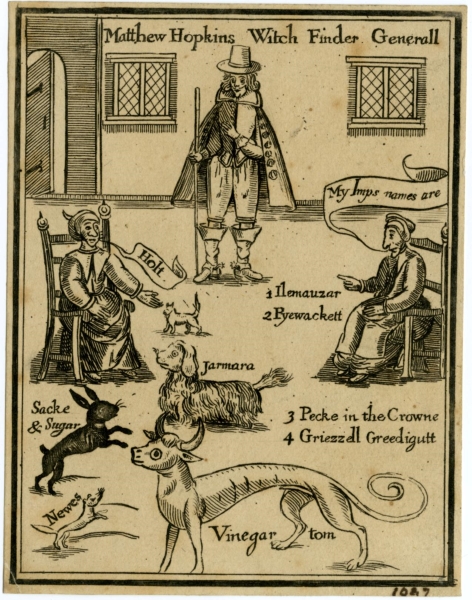
Regardless of the name assigned to them, the idea that the familiar was given to the witch by the Devil (or sometimes by another witch) to assist them in harming others did not necessarily indicate that the relationship between witch and familiar was thought to be a harmonious one. The confessions of ‘witches’, who at the point of confession may have been willing to say anything to put an end to their ordeal, featured tales of sometimes troublesome and violent familiars.
Demdike of the Pendle/ Lancashire Witches of 1612 said in her confession that her familiar Tibb once ‘shoved or pushed her into the ditch‘ for refusing to help Chattox and her daughter Anne Redferne make ‘pictures of clay‘ of people in the community.[17] These ‘pictures’ were effigies which were, it was thought, used to inflict harm on a person. According to Thomas Potts, a clerk to the court at the assizes in Lancaster in 1612, Demdike had claimed that the ‘speedyest way to take a man’s life by witchcraft‘ was to use such a picture.[18] Demdike died in gaol before she could hang alongside her daughter and two of her grandchildren.
Joan Prentice’s ferret was disobedient; she confessed that she had ordered him to bite a neighbour’s child but do no real harm. Instead, she said, Bidd had bitten the child and then claimed the little girl would die as a result.[19] It was possible for familiars to sound both vicious and silly in a witch’s confession. One toad ‘familiar’ of Joan Upney of Dagenham, who was tried as a witch in Essex in 1589, was said to have ‘pinched‘ the wife of a neighbour and ‘sucked her til she dyed‘.[20] As nasty as Joan’s toads were supposed to be, two of them apparently wasted away in her absence.[21]
There are various theories as to the origins of the familiar, with Emma Wilby suggesting that the figure of the familiar was not merely constructed from or influenced by the demonology of educated men but likely also born from the folklore surrounding fairies. Wilby cites similarities between the folklore surrounding fairies and the supposed characteristics of familiars, which she states ‘possessed far more in common with the ambivalent fairies than with the purely malevolent ones’.[22]
Animals were portrayed as being present at the witches’ sabbath in continental Europe, even serving as a mode of transport to the sabbath. However, although some of the imagery of the witches sabbath was later adopted in accounts of witch trials in England, the figure of the familiar appears to have been largely absent from witch trials in other parts of Western Europe.
Good Witches?
Those who believed they had certain abilities did not necessarily view themselves as witches or at least not as ‘bad’ witches. There was a distinction in their minds between the kind of magic or magical abilities people believed they themselves practised or possessed and that which was more within the territory of harmful magic or maleficium and therefore witches- or at least room for both good and potentially harmful magic without being a ‘witch’ and servant of the Devil. The authorities, whether ecclesiastical or secular in nature, didn’t always see it that way but neither did they unanimously condemn everyone who was said to possess magical abilities.

In Friuli, in north-east Italy, the benandanti (‘good walkers’) became a topic of investigation for inquisitors during the late sixteenth century. Paolo Gasparutto, when questioned by a priest in 1575, is supposed to have stated that the benandanti would ‘”on Thursdays, during the Ember days”‘ have their spirits leave their bodies at night and ride animals to gatherings where they wielded fennel stalks against witches who would harm others.[23] Gasparutto apparently claimed to be one of the benandanti during this round of questioning. He described the benandanti as those who tried to heal people and aimed to prevent witches from harming people, entering houses and spoiling wine and destroying crops.[24] The language surrounding the benandanti may have given rise to some confusion, with local dialect and understanding of the concept of the benandanti not necessarily being understood in the same way by priests and inquisitors. The priest Sgabarizza thought the term ‘benandanti’ described ‘good witches’.[25]
The stories of the benandanti were dismissed by an inquisitor in 1575 but another inquisitor would investigate these claims years later. Fra Felice, the new inquisitor, questioned Gasparutto and others at length in 1580. He concluded that the gatherings Gasparutto had described were in fact tales of the witches’ sabbath and there was something diabolical going on, despite Gasparutto’s protestations.[26] In 1581 Gasparutto had to confess and denounce his ‘heresy’, in addition to this he was sentenced to imprisonment for a period of six months.[27]
Starting in the 1960s, historian Carlo Ginzburg began to examine the benandanti with an approach focused on the similarities he perceived between the activities described by those who claimed they were members of benandanti and practices originating in shamanism.[28] In response to some of the criticism his approach has received, Ginzburg suggests we ‘acknowledge the “kernel of truth”‘ in Margaret Murray’s thesis in the context of what he calls ‘an indisputable connection between the benandanti and fertility cults’, however he notes that we cannot prove that the benandanti actually gathered in groups to engage in rituals.[29] The theory proposed by Margaret Murray (1863-1963), an Egyptologist and folklorist, suggested that beliefs in witchcraft had in fact been a surviving pagan fertility cult.[30] Murray’s thesis is now widely rejected among historians who study witch trials.
What else did ‘witches’ do?
We have seen already that witches in early modern Europe were thought to go about maiming and murdering people by magic, with or without the help of a familiar depending on where one called home. Other malicious deeds attributed to witches, such as; destroying crops, spoiling food and harming livestock, meant they were presented as threats to lives and livelihoods in other ways and the presence of supposed witches could serve a a possible explanation for a variety of misfortunes.
Witches were also thought to be able to raise storms. In fact, ‘witches’ were said to have caused a storm which sank a ship carrying jewels for Anne of Denmark, bride of James VI of Scotland (later James I of England), and then caused the ship carrying the king to have had difficulty in returning to Scotland.[31] Regicide was the suggested aim of these witches, who had supposedly been commanded to kill the king by the Devil himself. James VI became personally involved in the North Berwick trials and he even questioned one of the accused, a woman called Agnes Sampson, himself. It was she who confessed that a group of witches, including herself, had raised the storm at sea which had caused him so much trouble in returning home to Scotland.
James wrote Daemonologie (first published in 1597), a treatise which argued that witches and the threat they posed were very real. He saw himself as being concerned with making sure the ‘right’ sort of people ended up on trial. Although he eventually became convinced something wicked was going on when Sampson revealed her apparent knowledge of the words James had said to his bride on their wedding night, he initially met the tales of the North Berwick witches with scepticism. He would later become more sceptical and intervened on occasion in other trials when he believed there was cause to doubt the accusations and ‘evidence’ against the accused. His scepticism was different to that of Reginald Scot’s, however, as he still believed witchcraft was a reality whereas Scot dismissed it entirely.
Although the witch trials of the early modern period are a thing of the past, we’re still intrigued by witches. Witches remain a figure associated with evil for some but these days the figure of the witch also has much more positive connotations. You only have to walk into a bookshop to find stories featuring beloved fictional characters who happen to be witches. You’ll also see a very different kind of witchcraft, far removed from the idea of the witch as a servant of the Devil, being promoted by some authors as an alternative faith and way of life.
I hope you have enjoyed this overview of some of the beliefs surrounding witches in early modern Europe. Write your thoughts in the comments section if you were surprised by anything.
Happy Halloween! – Steph
References
[1] Eric Wilson, ‘Institors of Innsbruck: Heinrich Institoris, the Summis Desiderantes, and the Brixen Witch Trial of 1485′, in Brian P. Levack (editor), Demonology, Religion and Witchcraft, Volume 1: New Perspectives on Witchcraft, Magic and Demonology (London, 2001), pp. 95-96.
[2] Wilson, ‘Institors of Innsbruck: Heinrich Institoris, the Summis Desiderantes, and the Brixen Witch Trial of 1485′, in Levack (editor), Demonology, Religion and Witchcraft, Volume 1: New Perspectives on Witchcraft, Magic and Demonology (2001), p. 95.
[3] Hans Peter Broedel, The Malleus Maleficarum and the construction of witchcraft: Theology and popular belief (Manchester University Press, 2003), pp.2-3.
[4] Broedel, The Malleus Maleficarum and the construction of witchcraft: Theology and popular belief (2003), p.3.
[5] Johann Weyer, Extract from De Praestigiis Daemonum (1563) in Brian P. Levack, The Witchcraft Sourcebook (London, 2015), pp. 282-283.
[6] Reginald Scot, c. 1584. The discouerie of witchcraft wherein the lewde dealing of witches and witchmongers is notablie detected, the knauerie of coniurors, the impietie of inchantors, the follie of soothsaiers, the impudent falshood of cousenors, the infidelitie of atheists, the pestilent practises of pythonists, the curiositie of figurecasters, the vanitie of dreamers, the beggerlie art of alcumystrie, the abhomination of idolatrie, the horrible art of poisoning, the vertue and power of naturall magike, and all the conueiances of legierdemaine and iuggling are deciphered: and many other things opened, which have long lien hidden, howbeit verie necessarie to be knowne. Heerevnto is added a treatise vpon the nature and substance of spirits and diuels, &c: all latelie written by Reginald Scot Esquire. London, Epistle to the Readers.
[7] Scot, c. 1584. The discouerie of witchcraft, Chapter Three, p.7.
[8] Scot, c. 1584. The discouerie of witchcraft, Chapter Four, p.10.
[9] Lyndal Roper, ”Evil Imaginings and Fantasies’: Child-Witches and the End of the Witch Craze’, Past and Present 167 (2000), pp. 107-108.
[10] Brian P. Levack, The Devil Within: Possession and Exorcism in the Christian West (Yale University Press, 2013), pp. 218-219.
[11] Patricia Emison, ‘Truth and Bizzarria in an Engraving of Lo Stregozzo‘, The Art Bulletin 81:4 (1999), pp. 630-631.
[12] Roberts, R. Julian. “Dee, John (1527–1609), mathematician, astrologer, and antiquary.” Oxford Dictionary of National Biography. 25 May, 2006. Oxford University Press. Date of access 15 Jul. 2024, <https://www.oxforddnb.com/view/10.1093/ref:odnb/9780198614128.001.0001/odnb-9780198614128-e-7418>
[13] Julian. “Dee, John (1527–1609), mathematician, astrologer, and antiquary.” Oxford Dictionary of National Biography. 25 May, 2006. Oxford University Press. Date of access 15 Jul. 2024, <https://www.oxforddnb.com/view/10.1093/ref:odnb/9780198614128.001.0001/odnb-9780198614128-e-7418>
[14] Thomas Potts (author) modernised by Robert Poole (editor), The Wonderful Discovery of Witches in the County of Lancaster With the Arraignement and Trial of Nineteen notorious Witches, at the Assizes and general Gaol delivery, holden at the Castle of Lancaster, upon Monday, the seventeenth of August last, 1612 (Lancaster, 2011), pp.116-117.
[15] The Examination of Joan Prentice in The Apprehension and Confession of Three Notorious Witches. Arreigned and by Iustice Condemned and Executed at Chelmes-Forde, in the Countye of Essex, the 5. Day of Iulye, Last Past. 1589 with the Manner of their Diuelish Practices and Keeping of Thier Spirits, Whose Fourmes are Heerein Truelye Proportioned. , 1589. ProQuest, https://manchester.idm.oclc.org/login?url=https://www.proquest.com/books/apprehension-confession-three-notorious-witches/docview/2240899371/se-2
[16] The Examination and Confession of Certaine Wytches at Chensforde in the Countie of Essex : Before the Quenes Maiesties Judges, the Xxvi Daye of July, Anno 1566, at the Assise Holden there as then, and One of them Put to Death for the Same Offence, as their Examination Declareth More at Large. , 1566. ProQuest, https://manchester.idm.oclc.org/login?url=https://www.proquest.com/books/examination-confession-certaine-wytches-at/docview/2240906300/se-2.
[17] Potts (author) modernised by Robert Poole (editor), The Wonderful Discovery of Witches in the County of Lancaster With the Arraignement and Trial of Nineteen notorious Witches, at the Assizes and general Gaol delivery, holden at the Castle of Lancaster, upon Monday, the seventeenth of August last, 1612 (2011), p.116.
[18] Potts (author) and Poole (editor), The Wonderful Discovery of Witches in the County of Lancaster With the Arraignement and Trial of Nineteen notorious Witches, at the Assizes and general Gaol delivery, holden at the Castle of Lancaster, upon Monday, the seventeenth of August last, 1612 (2011), p.104.
[19] The Apprehension and Confession of Three Notorious Witches. Arreigned and by Iustice Condemned and Executed at Chelmes-Forde, in the Countye of Essex, the 5. Day of Iulye, Last Past. 1589 with the Manner of their Diuelish Practices and Keeping of Thier Spirits, Whose Fourmes are Heerein Truelye Proportioned. , 1589.
[20] The Apprehension and Confession of Three Notorious Witches. Arreigned and by Iustice Condemned and Executed at Chelmes-Forde, in the Countye of Essex, the 5. Day of Iulye, Last Past. 1589 with the Manner of their Diuelish Practices and Keeping of Thier Spirits, Whose Fourmes are Heerein Truelye Proportioned. , 1589.
[21] The Apprehension and Confession of Three Notorious Witches. Arreigned and by Iustice Condemned and Executed at Chelmes-Forde, in the Countye of Essex, the 5. Day of Iulye, Last Past. 1589 with the Manner of their Diuelish Practices and Keeping of Thier Spirits, Whose Fourmes are Heerein Truelye Proportioned. , 1589.
[22] Emma Wilby, ‘The Witch’s Familiar and the Fairy in Early Modern England and Scotland’, Folklore Vol.11, No.2 (2000), pp.299-300.
[23] Carlo Ginzburg, The Night Battles: Witchcraft and Agrarian Cults in the Sixteenth and Seventeenth Centuries (The Johns Hopkins University Press, 2013), pp.1-3.
[24] Ginzburg, The Night Battles (2013), p.3.
[25] Ginzburg, The Night Battles (2013), p.3.
[26] Ginzburg, The Night Battles (2013), p.11.
[27] Ginzburg, The Night Battles (2013), p.164.
[28] Ronald Hutton, The Witch: A History of Fear, from Ancient Times to the Present (Yale University Press, 2017), pp.75-76.
[29] Ginzburg, The Night Battles (2013), p.xvii.
[30] Hutton, The Witch: A History of Fear, from Ancient Times to the Present (2017), p.121.
[31] “Newes from Scotland, declaring the damnable life and death of Doctor Fian a notable sorcerer, who was burned at Edenbrough in Ianuary last. 1591. Which doctor was regester to the diuell that sundry times preached at North Barrick Kirke, to a number of notorious witches. With the true examination of the saide doctor and witches, as they vttered them in the presence of the Scottish king. Discouering how they pretended to bewitch and drowne his Maiestie in the sea comming from Denmarke, with such other wonderfull matters as the like hath not been heard of at any time. Published according to the Scottish coppie.” In the digital collection Early English Books Online Collections. https://name.umdl.umich.edu/A00710.0001.001. University of Michigan Library Digital Collections. Accessed October 2, 2024.
Bibliography
Primary Sources
Anonymous, The Errors of the Gazarri, or Those Who Are Proven to Ride on a Broom or Staff, Basel version, in Michael D. Bailey, Origins of the Witches’ Sabbath (The Pennsylvania State University Press, 2021).
The Examination and Confession of Certaine Wytches at Chensforde in the Countie of Essex : Before the Quenes Maiesties Judges, the Xxvi Daye of July, Anno 1566, at the Assise Holden there as then, and One of them Put to Death for the Same Offence, as their Examination Declareth More at Large. , 1566. ProQuest, https://manchester.idm.oclc.org/login?url=https://www.proquest.com/books/examination-confession-certaine-wytches-at/docview/2240906300/se-2, accessed 15 July 2024.
The Apprehension and Confession of Three Notorious Witches. Arreigned and by Iustice Condemned and Executed at Chelmes-Forde, in the Countye of Essex, the 5. Day of Iulye, Last Past. 1589 with the Manner of their Diuelish Practices and Keeping of Thier Spirits, Whose Fourmes are Heerein Truelye Proportioned. , 1589. ProQuest, https://manchester.idm.oclc.org/login?url=https://www.proquest.com/books/apprehension-confession-three-notorious-witches/docview/2240899371/se-2, accessed 15 July 2024.
“Newes from Scotland, declaring the damnable life and death of Doctor Fian a notable sorcerer, who was burned at Edenbrough in Ianuary last. 1591. Which doctor was regester to the diuell that sundry times preached at North Barrick Kirke, to a number of notorious witches. With the true examination of the saide doctor and witches, as they vttered them in the presence of the Scottish king. Discouering how they pretended to bewitch and drowne his Maiestie in the sea comming from Denmarke, with such other wonderfull matters as the like hath not been heard of at any time. Published according to the Scottish coppie.” In the digital collection Early English Books Online Collections. https://name.umdl.umich.edu/A00710.0001.001. University of Michigan Library Digital Collections. Accessed October 2, 2024.
Jean Bodin (author) and Randy A. Scott (translator), On the Demon–Mania of Witches (De la démonmanie des sorciers), (University of Toronto Press, 1995).
James VI (1566-1625) King of Scotland/ James I King of England, Daemonologie in Forme of a Dialogue, Diuided into Three Bookes. Edinburgh:, 1597. ProQuest. https://www.proquest.com/eebo/docview/2240857109/99843273/B4A654E7D7A44EA5PQ/1?accountid=12253&sourcetype=Books, accessed 15 July 2024.
Heinrich Kramer (author), Jacob Sprenger (author) and P.G. Maxwell-Stuart (editor and translator), The Malleus Maleficarum (University of Manchester Press, 2007).
Matthew Hopkins (d.1647), The Discovery of Vvitches: In Answer to Severall Queries, Lately Delivered to the Judges of the Assize for the County of Norfolk. / and Now Published by Matthevv Hopkins, Witch-Finder. for the Benefit of the Whole Kingdome. , 1647. ProQuest, https://manchester.idm.oclc.org/login?url=https://www.proquest.com/books/discovery-vvitches-answer-severall-queries-lately/docview/2240952672/se-2, accessed 15 July 2024.
Thomas Potts (author) modernised by Robert Poole (editor), The Wonderful Discovery of Witches in the County of Lancaster With the Arraignement and Trial of Nineteen notorious Witches, at the Assizes and general Gaol delivery, holden at the Castle of Lancaster, upon Monday, the seventeenth of August last, 1612 (Lancaster, 2011).
SCOT, R., 1538?-1599., 1584. The discouerie of witchcraft wherein the lewde dealing of witches and witchmongers is notablie detected, the knauerie of coniurors, the impietie of inchantors, the follie of soothsaiers, the impudent falshood of cousenors, the infidelitie of atheists, the pestilent practises of pythonists, the curiositie of figurecasters, the vanitie of dreamers, the beggerlie art of alcumystrie, the abhomination of idolatrie, the horrible art of poisoning, the vertue and power of naturall magike, and all the conueiances of legierdemaine and iuggling are deciphered: and many other things opened, which have long lien hidden, howbeit verie necessarie to be knowne. Heerevnto is added a treatise vpon the nature and substance of spirits and diuels, &c: all latelie written by Reginald Scot Esquire. London: . ProQuest, https://www.proquest.com/eebo/docview/2240870409/244F27B40DFC46C8PQ/7?accountid=12253&imgSeq=10&sourcetype=Books, accessed 15 July 2024.
UK Parliamentary Archives: Public Act, 33 Henry VIII, c.8 https://archives.parliament.uk/collections/getrecord/GB61_HL_PO_PU_1_1541_33H8n8
UK Parliamentary Archives: Public Act, 5 Elizabeth I, c.16 https://archives.parliament.uk/collections/getrecord/GB61_HL_PO_PU_1_1562_5Eliz1n14
UK Parliamentary Archives: Public Act, 1 James I, c.12 https://archives.parliament.uk/collections/getrecord/GB61_HL_PO_PU_1_1603_1J1n12
Johann Weyer, Extract from De Praestigiis Daemonum (1563) in Brian P. Levack, The Witchcraft Sourcebook (London, 2015), pp. 277-284.
Further Reading
Bengt Ankarloo, ‘Witch Trials in Northern Europe, 1450-1700’, in Bengt Ankarloo, Stuart Clark and William Monter (editors), Witchcraft and Magic in Europe: The Period of the Witch Trials (London, 2002), pp. 53-93.
Lara Apps and Andrew Gow, Male witches in early modern Europe (Manchester University Press, 2003).
Hans Peter Broedel, The Malleus Maleficarum and the construction of witchcraft: Theology and popular belief (Manchester University Press, 2003).
Patricia Emison, ‘Truth and Bizzarria in an Engraving of Lo Stregozzo‘, The Art Bulletin 81:4 (1999), pp. 623-636.
Alison Findlay, ‘Sexual and spiritual politics in the events of 1633-34 and The Late Lancashire Witches’, in Robert Poole (editor), The Lancashire Witches: Histories and Stories (Manchester University Press, 2002), pp. 146-163.
Malcolm Gaskill, ‘The Pursuit of Reality: Recent Research into the History of Witchcraft’, The Historic Journal 51:4 (2008), pp. 1069-1088.
Marion Gibson, Witchcraft: A History in Thirteen Trials (New York, 2023).
Carlo Ginzburg (author) and John and Anne Tedeschi (translators), The Night Battles: Witchcraft and Agrarian Cults in the Sixteenth and Seventeenth Centuries (The Johns Hopkins University Press, 2013).
Julian Goodacre, ‘The Scottish witchcraft panic of 1597’ in Julian Goodacre (editor), The Scottish witch-hunt in context (Manchester University Press, 2002), pp. 51-72.
Ronald Hutton, ‘The Wild Hunt and the Witches’ Sabbath’, Folklore 125:2 (2014), pp. 161-178.
Ronald Hutton, The Witch: A History of Fear, from Ancient Times to the Present (Yale University Press, 2017).
Richard Kieckhefer, Magic in the Middle Ages (Cambridge University Press, 2014).
Brian P. Levack, The Witch-Hunt in Early Modern Europe (London, 2006).
Brian P. Levack, The Devil Within: Possession and Exorcism in the Christian West (Yale University Press, 2013).
Brian P. Levack, The Witchcraft Sourcebook (London, 2015).
Jonathan Lumby, The Lancashire Witch-Craze: Jennet Preston and the Lancashire Witches, 1612 (Lancaster, 1995).
Jonathan Lumby, ‘”To Those whom evil is done”: family dynamics in the Pendle Witch Trials’ in Robert Poole (editor), The Lancashire Witches: Histories and Stories (Manchester University Press, 2002), pp. 58-70.
Alan Macfarlane, Witchcraft in Tudor and Stuart England: A Regional and Comparative Study (Abingdon, 2002).
P.G. Maxwell-Stuart, ‘King James’s Experience of Witches, and the 1604 English Witchcraft Act’, in John Newton and Jo Bath (editors), Witchcraft and the Act of 1604 (Leiden, 2008), pp. 31-46.
Edward Muir, Ritual in Early Modern Europe (Cambridge University Press, 2005).
Marko Nenonen, ‘The Dubious History of the Witch-Hunts’, in Marko Nenonen and Raisa Maria Toivo, Writing Witch-Hunt Histories: Challenging the Paradigm (Leiden, 2014),pp. 17-40.
Roberts, R. Julian. “Dee, John (1527–1609), mathematician, astrologer, and antiquary.” Oxford Dictionary of National Biography. 25 May, 2006. Oxford University Press. Date of access 15 Jul. 2024, <https://www.oxforddnb.com/view/10.1093/ref:odnb/9780198614128.001.0001/odnb-9780198614128-e-7418>
Dianne Purkiss, ‘Charming Witches: The “Old Religion” and the Pendle Trial’, Preternature: Critical and Historical Studies on the Preternatural, Vol 3, No.1, Special Issue: Capturing Witches (2014), pp. 13-31.
Lyndal Roper, ”Evil Imaginings and Fantasies’: Child-Witches and the End of the Witch Craze’, Past and Present 167 (2000), pp. 107-139.
Lyndal Roper, Witch Craze: Terror and Fantasy in Baroque Germany (Yale University Press, 2004).
Alison Rowlands, ‘Witchcraft and Gender in Early Modern Europe’, in Brian P. Levack (editor), The Oxford Handbook of Witchcraft in Early Modern Europe and Colonial America (Oxford University Press, 2013), pp. 449-467.
James Sharpe, Witchcraft in Early Modern England (Abingdon, 2020).
Keith Thomas, Religion and the Decline of Magic: Studies in Popular Beliefs in Sixteenth- and Seventeenth-Century England (London, 1971).
Eric Wilson, ‘Institors of Innsbruck: Heinrich Institoris, the Summis Desiderantes, and the Brixen Witch Trial of 1485′, in Brian P. Levack (editor), Demonology, Religion and Witchcraft, Volume 1: New Perspectives on Witchcraft, Magic and Demonology (London, 2001), pp. 165-178.
Deborah Willis, Malevolent Nurture: Witch-Hunting and Maternal Power in Early Modern England (Cornell University Press, 1995).
Emma Wilby, ‘The Witch’s Familiar and the Fairy in Early Modern England and Scotland’, Folklore Vol.11, No.2 (2000), pp.282-305.
Emma Wilby, Cunning Folk and Familiar Spirits: Shamanistic Visionary Traditions in Early Modern British Witchcraft and Magic (Sussex Academic Press/ Liverpool University Press, 2005).
Bertram Wolffe, Henry VI (Yale University Press, 2001).
David Wootton, ‘Scott [Scot], Reginald (d.1599)’, Oxford Dictionary of National Biography, 23rd September 2004. Oxford University Press. Date of access 15 Jul, 2024. <https://www.oxforddnb.com/display/10.1093/ref:odnb/9780198614128.001.0001/odnb-9780198614128-e-24905>
Charles Zika, ‘Images of Witchcraft in Early Modern Europe’ in Brian P. Levack (editor), The Oxford Handbook of Witchcraft in Early Modern Europe and Colonial America (Oxford University Press, 2013), pp. 141-158.
Charles Zika, ‘Images and Witchcraft Studies: A Short History’, in Marko Nenonen and Raisa Maria Toivo, Writing Witch-Hunt Histories: Challenging the Paradigm (Leiden, 2014), pp. 41-86.
UK Parliament: Witchcraft: https://www.parliament.uk/about/living-heritage/transformingsociety/private-lives/religion/overview/witchcraft/
 A Place Between The Trees
One thought on “Entry from the #WhitworthBestiary: The Witch”