
Debra tells us about a beautiful ‘snowball’ patchwork piece in the Whitworth’s collections. Read all about the intricate details of this Regency period gem and learn about the history of patchwork coverlets and quilts at the same time!
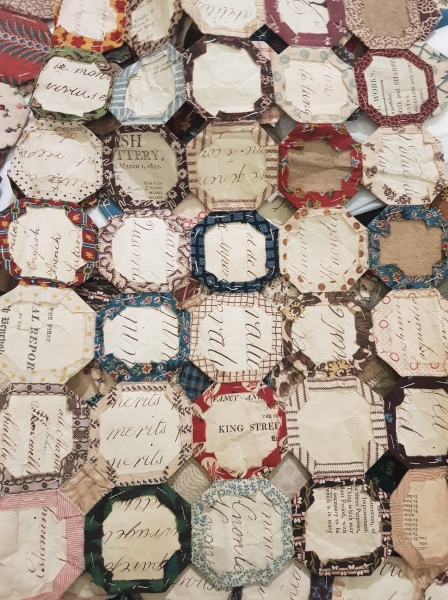
The Whitworth has many different types of patchwork and quilt items in our collections from different parts of the world. When I was looking through the textile collection for inspiration, I came across this beautiful British patchwork from the regency period and recognised the pattern as a ’snowball’ block*. Also known as cobble stones, this is a traditional design that is made from an octagon and corner squares which when sewn together give the illusion of a circular shape. Snowballing a block is also a way of reshaping a rectangular or square fabric piece and creating new patterns by adding corner blocks. This can be done to create a pattern block like flying geese, which is where two square corner blocks are added to a rectangle to make a triangle.
*The term ‘snowball’ block is an American nineteenth-century pattern name, which is now widely used to refer to an octagon shape in a patchwork block.
Patchwork quilts give a fascinating insight into the social and personal histories of the maker and the times they were living in. The type of fabrics and the needlework skills can often tell us something about the social class of the person who made the patchwork. Education, resources and time are a factor in what could be produced- alongside functionality and complexity of designs, type of fabrics, fabric quality. The decorative nature of the piece also comes into play.
This unfinished patchwork is made mainly from quality printed cotton fabrics, which were relatively expensive at this time, with some pieces of silk used for the smaller squares (those that are in pastel colours).

The sewing skills of whoever pieced together the patchwork are also exquisite; the stitches that piece together the tessellating shapes are so tiny and neat they are hardly seen on the front. The patchwork technique uses paper templates for the octagons and squares to create accurate piecing.

In the image above, the middle red fabric looks like it has a fir / Christmas tree design (but the pattern may be upside down!). It is more likely to be a palm leaf, which also features in other prints from this period. The large white stitches are the temporary baste / tacking stitches, holding the papers in place. These stitches are usually removed at the end stage.
This technique of using paper templates is often now referred to as English Paper Piecing. (EPP). Paper was a luxury commodity in the Regency era; so access to a lot of paper would depend on being of a higher social class. Because the patchwork is unfinished it is lovely to see what type of paper they reused, and helps with dating the work. It includes printed paper, which in one section shows a date of 1802, and spelling and handwriting exercises.

Included in the archive box for this unfinished patchwork piece, are still some of the cut-out shapes of octagons and a sheet of handwriting which was used for the templates – there are even small hole marks in this paper, which look like pins were placed there. Also, there is a name at the bottom; ‘Jane Handford May’- but she may or may not have been the person who worked on the patchwork. It is fascinating looking at the marks of the maker (or makers) in this piece as it is very possible more than one person in the household worked on the patchwork. The papers would not have likely been removed, they were often left in as a layer to add stability, paper was so precious after all. The patchwork would have been made into a fashionable decorative ‘coverlet’ (rather than a quilt). A coverlet is more lightweight because it doesn’t have a central layer of wadding like a warm and cozy quilted cover.

The fabrics used for patchwork would have come from the family’s furnishing textiles and clothing, some fabrics may have been purchased specifically from haberdasheries and saved from any pieces left over from dressmaking and tailoring projects from family and friends. It is interesting to see the variety of patterns and design. A few pieces have glazed shiny coating, and some are simple fabrics with small woven stripes and plaids. There was also a mixture of different printing techniques used, including roller printing, copper plate printing, and traditional hand block printing. One fabric looks to be out of place in its age and style and looks like it is resist / wax dyed. There are also fabrics which have an interesting gradient look; to achieve this, a pattern is normally printed on the warp before weaving, this was a fashionable technique and style of fabric in the eighteenth century and early nineteenth century.
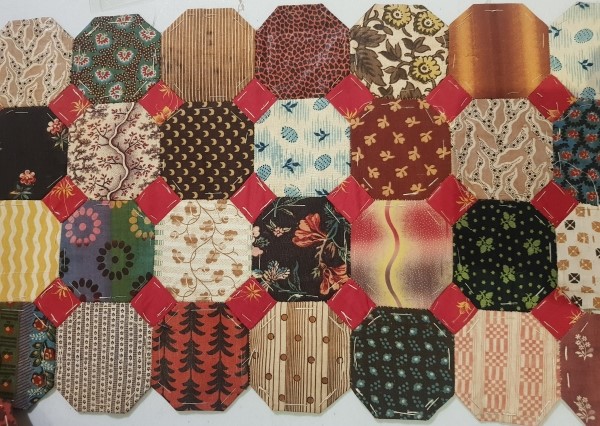
The patchwork has been sewn into strips, of four octagons across, with some strips having a red fabric square and some using a pale silk. Others are missing this part completely. I wonder if the pieces with the small red sections were pieced together at a much later date, or were they intended to be borders? In the era the patchwork was identified as belonging to, frame quilts were popular. These were quilts where borders of patchwork were arranged sometimes with a larger printed central fabric, which could commemorate an event and could be purchased especially for a patchwork quilt / coverlet from haberdasheries.
The fabric remnants are likely to have been collected and saved over a long time. Fabrics such as those used here were costly materials but they could also hold a lot of memories and may have been from cherished items. Fabric pieces may have been passed from one generation to the next, from family member to family member, from friend to friend. It is amazing that this is a nearly 200-year-old patchwork that has been saved despite being unfinished.
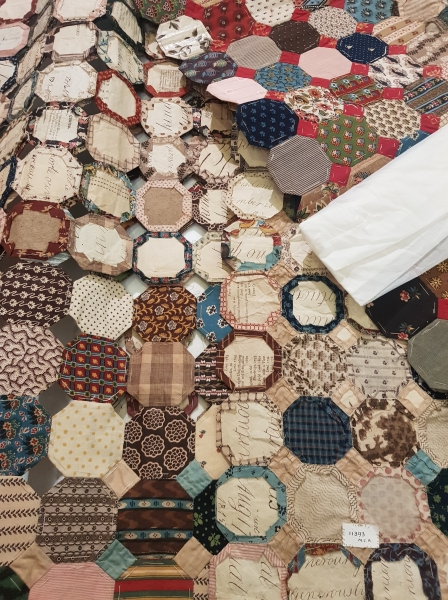
A beautiful collection of fabrics have been used for the patchwork; including pieces of silk, featuring colours typical for the regency period (dyed only using natural dyes at this time) in warm browns, creams, blues, olive greens, reds and pinks, with some yellow accents. Some of the colours would have possibly faded over the years. The patchwork has been designed so that a lighter fabric alternates with a darker tonal colour. Geometric patchwork, featuring shapes like hexagons and rarer octagon shapes first became a popular design in the late eighteenth early nineteenth centuries. This type of patchwork required a lot of time and skill to produce, making it a piece to be admired throughout the centuries.
–Debra
References
History of patchwork (18th and 19th Century), Epworth Old Rectory, Quilters Guild Curator Heather Audin, Online Talk Oct 2022
A History of British Frame Quilts, Carloyn Gibbs Quilters Guild Online Talk, February 2023
https://www.vam.ac.uk/articles/an-introduction-to-quilting-and-patchwork
 A Place Between The Trees