
Oliver has created a colouring sheet featuring a pair of liturgical knitted gloves in the Whitworth’s collections, which date back to the seventeenth century. Read all about the origins of such gloves, the history of knitting and don’t forget to download your free colouring sheet!
Do you want to see other posts from our Whitworth Advent calendar? Click here.
If you want more information about the Colour Our Collections project at the Whitworth or you wish to download more of our free colouring sheets, click here.
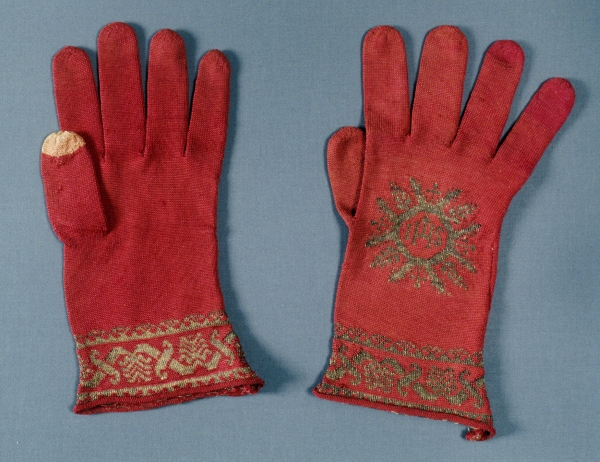
The artefact depicted in today’s colouring sheet combines several things associated with Christmas – Christian tradition, the colour red, and knitted clothing. In today’s post, you will learn about liturgical gloves, their uses and how they were made, and get to know a little about the history of knitting and knit fabrics since the invention of the knitting machine. What I particularly enjoyed about tracing this image was trying to capture the intricacy of the design and the quality of the knitted fabric.
Liturgical gloves are a garment historically used in the Catholic church by bishops and cardinals. Their use dates back to around the tenth century in Rome, and possibly earlier elsewhere, believed to have first been used in France and then spread to other places. Highly specialised in their purpose, they were worn at a Pontifical Mass until the washing of the hands before the Sacrifice. They are very rarely used in the present day.
Writing for the Catholic Encyclopedia in 1909, Joseph Braun states that such gloves would have at that point in time been “knitted by machine or hand from silk thread”, and “ornamented on the back with a cross; the border of the opening for the hand is also, as a rule, embellished”. “The colour of the gloves must correspond with the liturgical colour of the feast or day in the services of which they are worn”, Braun notes. Up until the sixteenth century, liturgical gloves were often white, and might previously have been decorated with tassels, bells, embroidery, or metal ornamentation in the form of religious imagery such as the Lamb of God, a cross, or the likenesses of saints.1
This particular pair of gloves is knitted in multi-stranded crimson silk and patterned in silver thread, with an IHS monogram on the centre back of each glove and an ornamented band at each wrist. The tip of the left thumb is knitted in white silk. I couldn’t figure out the reason for the latter other than their maker running out of red yarn, which seems extremely unlikely for an item of such importance in the church – if you have any ideas, please leave a comment below!
Made from a thin silk yarn, they have a soft and fine texture, distinct from the chunky knit you might expect from a pair of winter gloves worn for warmth. While these days we often associate knitted clothing with winterwear, knitted fabrics are far more ubiquitous across all types of garments, referring to any cloth constructed through the process of interlocking yarn together with long needles. Alongside woven fabrics, they are one of the most common fabric types. Knitted fabrics are comparatively stretchier than woven ones, which makes them perfectly suitable for items including socks, leggings, sportswear and – like in this case – gloves. Knitting machines are the primary producers of modern knit fabrics, making the knitting process much faster in an automated or semi-automated fashion. While in hand knitting, each stitch is manipulated individually across the row, knitting machines can work an entire row of loops in a single movement.
Around the time these gloves were produced, the task of framework knitting would be performed largely at home, often with entire families participating. This was the case right up until the mid-19th century, when machine knitting moved to factories to accommodate larger steam-powered knitting looms. Around this time, the proliferation of hand knitting as a hobby began to increase, while its use in western industry progressively declined; of course, it still remains a popular pastime today. During World War I, a knitting craze swept over Britain and other parts of Europe in an initiative to support the war effort, and the popularity of knitwear in western fashion began to increase. Previously, knitted garments were largely practical, used in occupations such as fishing as well as for undergarments and hosiery, rather than fashion clothing. This began to change in the late 1910s and 20s, when knitwear began to be associated with stylish leisure and sportswear, especially for sports such as golf, tennis and cricket. It has remained a popular clothing staple since, although it became less omnipresent around the 1980s due to the widening availability of alternatives such as tracksuits and sweatshirts.
The twenty-first century, however, has seen a major revival of knitting – the Internet has been particularly useful for accessing a wide range of patterns, materials and instructional videos, making knitting a highly accessible hobby taken up by many fashionable and climate-conscious people across generations. Greater consciousness about the environmental impact of fast fashion and the popularity of second-hand clothing have also contributed to the resurgence of vintage knits, and the slow fashion movement has encouraged many of us to care more about where our pieces come from and who makes them. Every year, when an autumn chill arrives in Manchester, I can’t help but treat myself to a new vintage sweater which I practically live in for the next two seasons. I always intend to take up knitting and make one instead, but every year I find myself once again too busy to pick up a new hobby. Conducting research for this post finally gave me the perfect opportunity to research knitting techniques and have a go myself. So far, I’ve discovered that it’s a lot of fun, but also requires real patience (I can see why the knitting machine was invented all the way back in the 1500s!).
Earlier this month, I found a lot of peace in getting to know this new-to-me process while watching films and listening to audiobooks at home – activities which I sometimes struggle to focus on without something else to occupy my body or hands. At a time when the world seems to always be going so fast, there’s real value in taking the time to slow down, rest and enjoy something for the process, without an instant pay-off. I have gained a real appreciation for the amount of precision it takes. If you are just starting out, make sure you use a thick yarn so you can see what you’re doing (even if like me, you’re not a huge fan of the “chunky” look, it will make your life a whole lot easier before you move on to other projects). My first creations were a scarf and hat:

Perhaps this year I will embark on a slightly less ambitious project than a whole sweater, as I know I have a long way to go yet, and I’m in no rush – but my next project might as well be a pair of gloves to complete the set.
–Oliver
Download your free colouring sheet below:
References
Braun, J. (1909). Episcopal Gloves. In The Catholic Encyclopaedia. New York: Robert Appleton Company. Available at http://www.newadvent.org/cathen/06589a.htm (accessed 2/11/24).
 A Place Between The Trees