
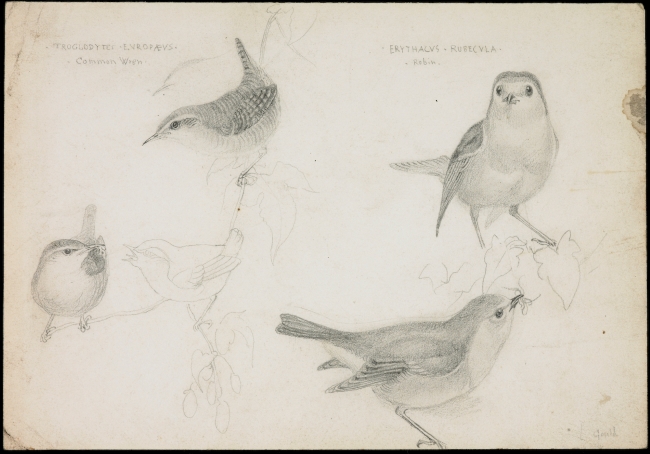
Steph discusses the folk customs and stories surrounding the robin and the wren. Learn about the inspiration for Crane’s ‘Study of wrens and robins’ and don’t forget to download your free colouring sheet featuring these charismatic little birds.
The robin and the wren have long been associated with winter throughout these isles.
Wrens are both hard to miss and easily missed; their diminutive size means they may not be spotted before they disappear into a hedgerow but their voice is surprisingly loud for such as small creature. The tradition of hunting the wren, which became known the ‘king of birds’ due to its clever ways in folktales, took place on St Stephen’s Day (26th December). In Ireland Wren Day or Lá an Dreoilín involves ‘wren boys’ dressing up in costumes, traditionally constructed of straw, and singing a traditional song about the capture of the wren as they collect money. In the past, a dead wren would be held aloft on a pole but real birds are no longer used in the Wren Day celebrations. Although the tradition seems to have briefly died out in some parts of Ireland, there have been some successful revivals of local Wren Day celebrations.[1]
On the Isle of Man, the ‘Hunt the Wren’ tradition is known as Shelg yn Dreean in Manx- which is related to Irish and Scottish Gaelic. Manx people who take part in the celebrations dance and sing around a wren pole, which would have been decorated with a real wren in centuries past.[2] The idea of the wren as a cunning creature can be found in Manx folklore too; one tale tells of an enchantress called Tehi Tegi who either turned herself into a wren to escape punishment after seducing the men of the island and leading them to their doom or was turned into a wren as punishment for her misdeeds.[3]
Everyone can easily identify the robin, with its red breast and bold nature. In Britain the robin is often viewed as a gardener’s friend and its song can be heard frequently throughout winter, when many other songbirds sing less. Despite their rather charming appearance, they are in fact quite territorial- which is thought to be why they sing throughout winter. Various stories discuss how the robin acquired his red breast, with these tales usually involving the robin performing an act of kindness which then leaves a mark on his physical appearance. If you’re interested in learning more about the stories surrounding robins, you can find out more in a Whitworth Advent post from 2022.
When tracing Walter Crane’s drawing of robins and wrens I noticed ‘Gould’ was written at the bottom of the drawing. This, combined with the inclusion of the scientific and common names for the wren and the robin, tipped me off to the possibility that Crane may have been using a book by John Gould as reference material. Any bird watchers among you will have heard the name before; John Gould (1804-1881) became a taxidermist for birds at the Zoological Society of London in 1828 and from there made connections with some of the most influential naturalists of the nineteenth century.[4] He became known for publishing folios of lithographs of bird species from around the world. The drawings for many of these were produced by Elizabeth Gould, who he married in 1829.[5] Artists Edward Lear and John Wolf also produced illustrations for works published by John Gould.[6]
Those of you who know about the history of the unfortunate Franklin expedition (1845-1848) or have read or watched The Terror may be interested to hear that John and Elizabeth Gould stayed with the Franklins for a while during Sir John Franklin’s time as Lieutenant Governor of Tasmania, which was referred to as ‘Van Dieman’s Land’ at the time.[7] The Gould travelled to in Australia in 1838 so John could study Australian wildlife and collect specimens.[8]
I’m not sure if the illustrations Walter Crane seems to have used a reference for his ‘Study of wrens and robins’ were included in Gould’s The Birds of Europe, The Birds of Great Britain or both. I have found auction house listings attributing the illustrations of the wren, which Crane seems to have copied, to The Birds of Europe and others attributing it to The Birds of Great Britain. If anyone possesses any of these beautiful works and happens to know in which work one might find the images of wrens and robins Crane used as a reference, please drop me a line in the comments section of this post.
I hope you enjoy colouring in the plucky little birds which have inspired the human imagination so much. Don’t forget to download your free colouring sheet below!
–Steph
References
[1] Ireland’s National Inventory of Intangible Cultural Heritage, Lá an Dreoilín/Wren’s Day
[2] Culture Vannin, Shelg yn Dreean (Hunt the Wren), 2021, music by the Manx Folk Dance Society.
[3] Lily Buckley, Hunt the Wren: The origin of a unique tradition saved by the Isle of Man, Isle of Man Today, Tuesday 19th December 2023
[4] Gordon C. Sauer. “Gould, John (1804–1881), ornithologist and publisher.” Oxford Dictionary of National Biography. September 23, 2004. Oxford University Press. Date of access 18 Nov. 2024, <https://www.oxforddnb.com/view/10.1093/ref:odnb/9780198614128.001.0001/odnb-9780198614128-e-11154>
[5] Sauer. “Gould, John (1804–1881), ornithologist and publisher.” Oxford Dictionary of National Biography. September 23, 2004. Oxford University Press.
[6] Sauer. “Gould, John (1804–1881), ornithologist and publisher.” Oxford Dictionary of National Biography. September 23, 2004. Oxford University Press.
[7] Sauer. “Gould, John (1804–1881), ornithologist and publisher.” Oxford Dictionary of National Biography. September 23, 2004. Oxford University Press.
Bibliography
BBC News: Hunt the Wren: Ancient Manx tradition grows in popularity, 26 December 2021
Culture Vannin, Shelg yn Dreean (Hunt the Wren), 2021, music by the Manx Folk Dance Society.
Ireland’s National Inventory of Intangible Cultural Heritage, Lá an Dreoilín/Wren’s Day,
Tyne & Wear Archives and Museums, The Story of Elizabeth Gould- An Extraordinary Bird Woman, 5th May 2020.
Lily Buckley, Hunt the Wren: The origin of a unique tradition saved by the Isle of Man, Isle of Man Today, Tuesday 19th December 2023
A. H. Chisholm, ‘Elizabeth Gould (1804–1841)’, Australian Dictionary of National Biography, Australian National University, 2006. Date of access 18 Nov.2024, <https://adb.anu.edu.au/biography/gould-elizabeth-2112>
B. A. Riffenburgh. “Franklin, Sir John (1786–1847), naval officer and Arctic explorer.” Oxford Dictionary of National Biography. September 08, 2022. Oxford University Press. Date of access 18 Nov. 2024, <https://www.oxforddnb.com/view/10.1093/ref:odnb/9780198614128.001.0001/odnb-9780198614128-e-10090>
Gordon C. Sauer. “Gould, John (1804–1881), ornithologist and publisher.” Oxford Dictionary of National Biography. September 23, 2004. Oxford University Press. Date of access 18 Nov. 2024, <https://www.oxforddnb.com/view/10.1093/ref:odnb/9780198614128.001.0001/odnb-9780198614128-e-11154>
Matthew Wills, Wren Folklore and St. Stephen’s Day, JSTOR Daily, 26 December 2020
 A Place Between The Trees