
With February 14th fast approaching, Oliver provides us with a short history of Valentine’s Day. He has also chosen to recreate a design by Walter Crane as a colouring sheet to celebrate the occasion. Don’t forget to download your free Valentine’s colouring sheet below. Who will be your valentine?
February always seems to be a strange month. Not much ever happens, and I find that despite its short trajectory it can feel rather long, impatiently awaiting spring. The exciting part of winter is over (getting cosy in the run up to Christmas, the excitement of tiny lights puncturing the darkness with their warm glow, not yet feeling sick of incessant mince pies), and the winter blues begin to properly kick in. If you’re more of a summer person like me, the wait until spring can really wear you down – particularly in Manchester where this time of year feels quite miserable. One of the most notable of February’s events is Valentine’s Day; a celebration which I enjoy despite the connotations it has taken on in contemporary consumer society. Although like Christmas, it has become yet another opportunity for mass production and consumption to boom with a proliferation of cheap, tacky nick-nacks and mass-produced cards, you can still make the most of it. Even if you’re not in a romantic relationship, it can be a great opportunity to brighten up the bleakness of winter by celebrating your loved ones in whatever way feels right for you. I personally enjoy taking a little time to reflect on the most meaningful relationships in my life and why I appreciate them.
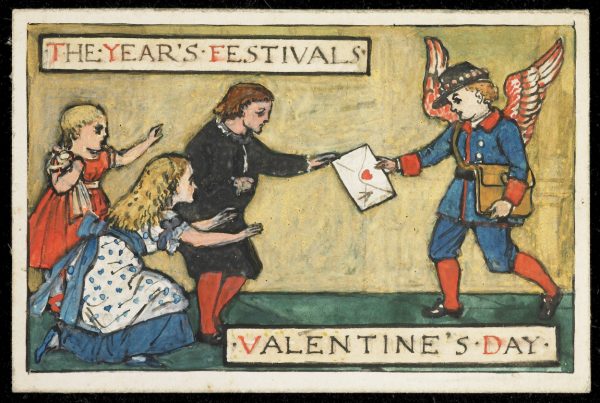
Today’s post is a colouring sheet I traced from a print by Walter Crane, produced in 1873. It is the design for the front cover of “The Year and its Festivals”, published in 1874. This print appears to be not the final version of the image, but a rough draft for a more detailed version; in our collection we have other images from this series in the form of greeting cards, also produced by Crane and depicting different festivals. Though we know little about the book, it is possible it incorporated some greetings cards. On the ‘Christmas Day’ piece, we can see a reference to the publisher Marcus Ward & Co, who seem to have been known for publishing calendars, toy books and greeting cards; these come up in other collections, such as this Walter Crane calendar at the V&A:
https://collections.vam.ac.uk/item/O703265/marcus-ward-calendar-print-walter-crane/
Here are the other cards from our collection – my personal favourite is the one for May Day.
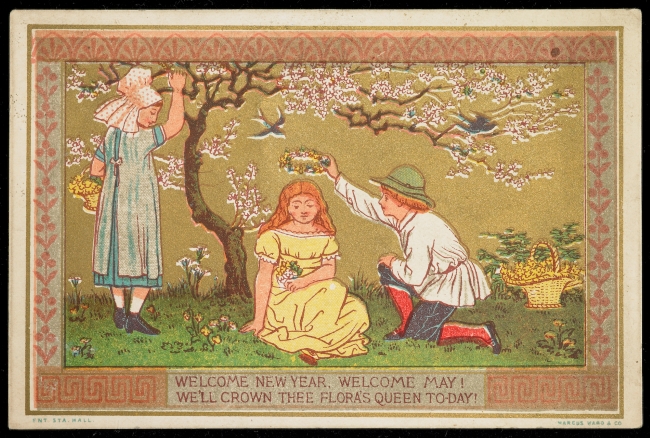
Walter Crane, Greetings card with illustration from ‘The Year and its Festivals’: ‘May Day’. Accession number: WCA.1.2.5.85 
Walter Crane, Calendar for 1874: ‘The Year and its Festivals’. Year: Latest c.1873. Accession number: WCA.1.2.5.87 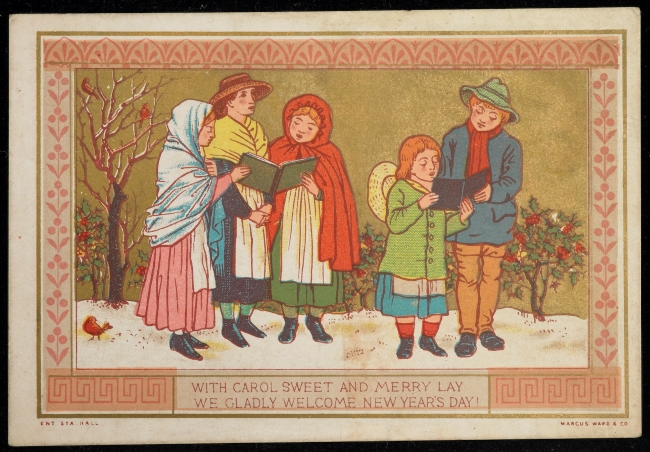
Walter Crane, Greetings card with illustration from ‘The Year and its Festivals’: ‘Christmas Day’. Accession number: WCA.1.2.5.84
As today’s colouring sheet is a design for Valentine’s Day, I thought you might like to know a little bit of seasonal history. While the holiday we observe today is named after the 3rd century Roman saint, did you know that February takes its name from an ancient Roman feast which took place on the same day? This festival, known across different sources as Lupercalia and Dies Februatus, was held around the 14th and 15th of the month. During this festival of purification, which intended to promote health and fertility for the new year, people were ritually washed using instruments collectively referred to as februum from which the latter derives. The festival also honoured Faunus, the Roman god of agriculture, and the brothers Romulus and Remus who founded the city of Rome. It is possible that the Christian church placed its own festival at the same time to decentre this pagan tradition, which was eventually outlawed at the end of the 5th century by Pope Gelasius. It was not until the Middle Ages, however, when Valentine’s Day became strongly associated with love and romance.
To begin the festival of Lupercalia, priests of the Luperci (“brothers of the wolf”) would gather at the sacred Lupercal cave. This was a group of young men, usually between the ages of 20 and 40, who led the festival proceedings across several sites throughout the city central to Rome’s foundation myth. In this cave, where Romulus and Remus were believed to have been cared for by a female wolf (“lupa”), the priests would sacrifice a goat for fertility, and a dog for purification. They would then strip the goat’s hide into strips, dip them into the sacrificial blood and run along the old Palatine boundary, naked or near-naked, gently slapping both women and crop fields with the goat hide; this was believed to make them more fertile in the coming year. Near the cave stood a sanctuary of Rumina, goddess of breastfeeding, which might also have played a part in the rituals. Some sources suggest that later in the day, young women would place their names in a large urn; the city’s bachelors would then select a name and become paired for the duration of the festival, sometimes leading to longer relationships. I thought this felt surprisingly reminiscent of contemporary match-making conventions such as speed dating. While reading about the festival, I was also interested to discover that William Shakespeare’s play Julius Caesar begins during the Lupercalia.
While the idea of Valentine’s Day as a celebration of love undoubtedly draws on these origins, it was possibly consolidated by the writings of Geoffrey Chaucer at the end of the 14th century. Written Valentines began to appear in the 15th century, and throughout the Victorian era printed cards became increasingly popular due to improvements in printing technology and cheaper postage rates.
We hope you enjoy colouring this design and do keep an eye on our colouring sheets as more from this series might pop up over the course of the next few seasons! – Oliver
 A Place Between The Trees
One thought on “A Short History of Valentine’s Day”