
Explore the glaciers of the Alps as depicted by Turner and find out how they changed over the course of the 19th century with Steph. Don’t forget to download your free colouring sheet of Turner’s ‘Mer de Glace’ at the bottom of the page!
Tourism around the Mer de Glace (‘sea of ice’) and other glaciers in the valley of Chamonix-Mont-Blanc seems to have begun in earnest during the 18th century. After Richard Pococke, William Windham and company explored the Mer de Glace and other glaciers in the Chamonix-Mont-Blanc valley in 1741, interest in the glaciers started to increase. This and other explorations into the more dangerous parts of the landscape of Chamonix-Mont-Blanc inspired others to explore the mountains and glaciers more. Scientific interest in glaciers and how they were formed was increasing but interest in these bodies of ice was not just scientific curiosity alone; a mixture of scientific curiosity and more Romantic ideas about sublime landscapes might encourage people to go and see the glaciers. Plenty of artists, poets and novelists found inspiration in the glaciers as well as being fascinated with the science of how these bodies of ice behaved. Johann Wolfgang von Goethe (1749-1832), a poet, playwright and a man of science, visited the Mer de Glace during the late 18th century. Artist Francis Towne (1739-1816) produced watercolours of glaciers in the Alps.
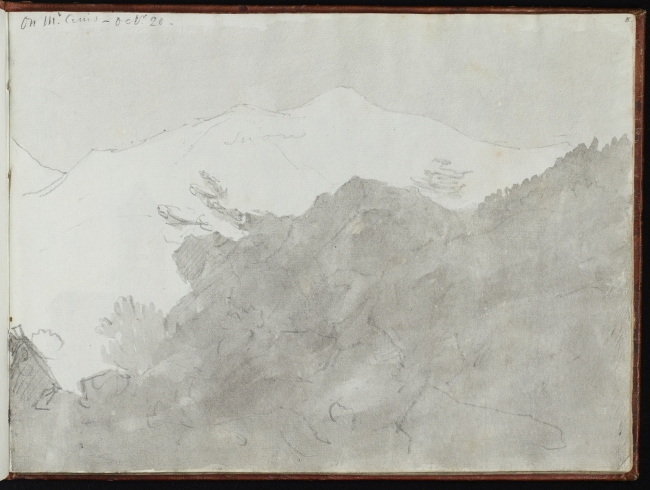
John Robert Cozens (1752-1797), whose work was admired by and served as a source of learning for J.M.W Turner (1775-1851), had travelled through the Alps in 1776. He had produced watercolours of the glaciers of Savoy, which Turner would do himself later. When his mental health declined in the 1790s, John Robert Cozens was cared for by Dr Thomas Monro (1759-1833). Monro was a patron of the arts but is probably best known for his role as physician to Bethlam Royal Hospital, better known as Bedlam, and to Bridewell hospital. In the 1790s Turner, his friend Thomas Girtin (1775-1802) and other young artists attended drawing sessions arranged by Thomas Monro, who paid them to copy works created by John Robert Cozens and other artists. He also provided them with a meal during these winter evening sessions. Turner’s own mother, who also experienced poor mental health, was admitted to Bedlam in 1801, possibly because of Turner’s acquaintance with Monro.
Now back to the mountains; J.M.W. Turner would record the sights of the Alps multiple times, recreating what he saw across a variety of mediums. The icy hazards of the Alps would find their way into poems, prints, watercolours and one of the most famous Gothic novels. I’ll start with Turner’s depictions of the glaciers of Chamonix-Mont-Blanc.
Turner’s Glaciers
In the summer of 1802 Joseph Mallord William Turner travelled through France and Switzerland, sketching as he went. Following the Treaty of Amiens that same year, he was now able to travel through the continent and the Alps would provide him with plenty of dramatic views. Some of the sketches in one of the sketchbooks he carried with him at this time, known as the ‘St Gothard and Mt Blanc’ sketchbook, would be used as references for the creation of some of the prints in the Liber Studiorum.
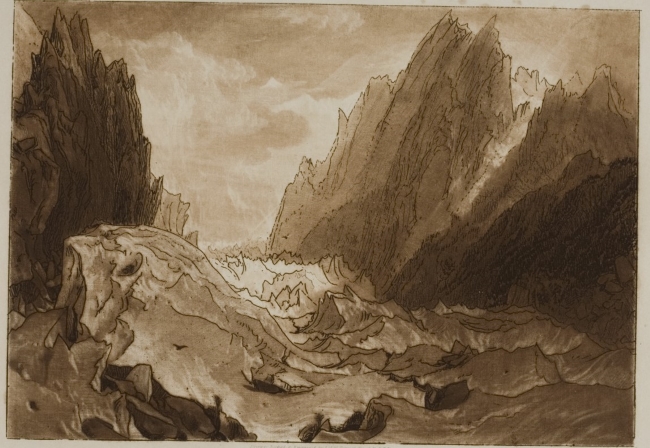
Turner’s Liber Studiorum is a series of etching and mezzotint prints, which were published in fourteen parts between 1807-1819. Two of the mountainous scenes from the Liber Studiorum, Mer de Glace (1819) and The Source of the Arveron (1816), depict a glacier from different perspectives. In Mer de Glace, the glacier is the main subject landscape, whereas in Liber Studiorum, No 60: The Source of the Arveron we see a glacier from the side, obscured by the trees in the foreground.
The Source of the Arveron shows the source of the Arveyron, which used to flow from an ice cave under part of the Mer de Glace known as the Glacier des Bois. Someone made a spelling mistake in the title of the print. It may have been Turner himself. In the 19th century sources I have looked at, ‘Arveyron’ is often spelled ‘Arveiron’. In Turner’s depiction of the source of the Arveyron, it is possible to see tiny ridges and furrows in fields. Parts of the Mer de Glace, such as the Glacier des Bois, came very close to houses when they advanced at various points during the 18th and 19th centuries.

The Glacier des Bois seems to have expanded and then retreated during the 19th century, before eventually disappearing for good. A new edition of Bradshaw’s Illustrated Hand-Book to Switzerland and the Tyrol published in 1894 stated that part of the Glacier des Bois, from which the Arveyron emerged, had caved in earlier that century and warned travellers to be careful:
‘Before 1841, the head of the river was in a kind of icy cavern, which fell in during that year. Care should be observed about here, as a Miss Stevens was killed in August, 1868, by a small stone, loosened by glacier action. [1]
Maybe this cavern, if it was the same cavern from which the Arveyron emerged under the Glacier des Bois, had not disappeared completely after the 1841 cave-in described in the guide. However, this was a travel guide and could have already been outdated by 1894. It was not a scientific paper.
An account written by Ralph Richardson (a member of the Meteorological Society of Scotland) following a tour of Switzerland and Savoy in autumn 1873, read at a meeting of the Edinburgh Geological Society on the 3rd December 1874, contains more detailed observations of the Glacier des Bois and the Mer de Glace in the 1870s. Richardson said that ‘…whatever may have been seen in ancient days, one sees nothing now of its famous Mer de Glace. Perched in its lofty rocky cradle, it remains hidden from the sight of those in the valley; the little river Arveiron issuing from the rocks beneath the only sign of its existence.’ [2]
Alarmed that the Mer de Glace seemed to have disappeared from view when earlier in the 19th century it had been visible from lower down in the valley, Richardson followed the path of the Arveyron and found ‘that although evidences appeared everywhere around of a huge glacier having once occupied the ground adjacent to the source of the Arveiron, a glacier which must have formed a conspicuous object from the vale of Chamonix, yet now that great glacier was gone and only the hollow bed it occupied was left to view’. [3]
From Richardson’s observations, all that appears to have remained of what I think was the Glacier des Bois was, in 1873, ‘a small tongue of ice from beneath which the river issued.’ [4] The grotto from which the Arveyron had once emerged had, according to Richardson, still been intact five years before his tour of the glaciers. [5] Richardson, unlike the author of the guidebook, referred to maps and observations made by James David Forbes (1809-1868) and those of John Tyndall (1820-1893). Forbes and Tyndall were physicists (Forbes was also a geologist) in the 19th century. Their observations indicated that in the 1840s and the 1850s the Glacier des Bois and its grotto could still be seen.
So Turner’s glaciers provide us with a glimpse of a frozen landscape that rapidly changed after the artist’s death in 1851. How would he have viewed the retreat and, in some cases, loss of glaciers, which he had returned to repeatedly? Sublime landscapes, such as these large masses of ice which made apparent the power of nature and filled people with awe, held a lot of importance to Romantics like Turner. If he been around to see what later happened some of the landscapes he had viewed with his own eyes, then he maybe he would have regarded the disappearance of the Glacier des Bois with sadness or disappointment.
The Mer de Glace and The Source of the Arveron were far from the only works in which Turner recreated the glaciers of the Alps. The watercolour The Valley of Chamonix, Mont Blanc in the Distance or shows a white mass, perhaps another glacier, in the distance snaking its way down a slope. The figure of a woman is seated on a large rock in the foreground on our bottom left, surrounded by other large rocks which may have been moved there because of avalanches or glacial movement. This piece dates to 1809 and was commissioned by Walter Ramsden Hawkesworth Fawkes, a patron of Turner who apparently enjoyed Turner’s alpine landscapes. Fawkes and his family were also friends of Turner.

Turner’s watercolour drawing The Source of the Arveyron below the Glacier du Bois and Mer de Glace, an earlier work which is part of the Turner Bequest, dates to 1802 and shows the waters of the Arveyron running out from the ice cave at the bottom of the Glacier des Bois. This drawing is thought to have been used as the basis for another commission for Walter Fawkes. Chamonix and Mont Blanc, from the slopes of the Montenvers, another watercolour dating to 1802 and also part of the Turner Bequest at Tate Britain, has similarities with the later piece The Valley of Chamonix, Mont Blanc in the Distance in that there is a view of the valley of Chamonix-Mont-Blanc from the slopes of the Montanvert glacier, with large rocks and trees in the foreground and some tiny human figures.
There are a number of other watercolours produced by Turner which depict Alpine glaciers, many of which date back to 1836. One of these is Brenva Glacier from the slopes of Le Chetif, above Courmayeur, Val D’ Aosta, which is held by the National Galleries of Scotland. Brenva glacier, like the Mer de Glace, is also located within the Mont Blanc massif. During 1836 Turner embarked on another tour of the Alps. He would return to the Alps again as late as 1844.
The two prints Mer de Glace, The Source of the Arveron and the watercolour The Valley of Chamonix, Mont Blanc in the Distance can be found on display in the Whitworth’s Turner: In Light and Shade exhibition (7 February 2025 – 2 November 2025).
I hope you have enjoyed reading about the glaciers Turner visited. In part two of Turner, the Shelleys and the Glaciers of the Alps we’ll find out how another Romantic and the author of Frankenstein reacted to the glaciers of the Alps. We’ll also look at art critic’s interest in glaciers, which went beyond his admiration for Turner’s work. – Steph
Download our free colouring sheet of Turner’s Mer de Glace:
References
[1] W. J. Adams, Bradshaw’s Illustrated Hand-Book to Switzerland and the Tyrol (London, 1894), pp.25-26.
[2] Ralph Richardson, ‘On Phenomena of Weather Action and Glaciation exhibited by the Alps of Switzerland and Savoy; being Notes of a Recent Tour.’, read in December 1874 at a meeting of the Edinburgh Geological Society, printed in Transactions of the Edinburgh Geological Society Vol. III, (Edinburgh, 1880), pp. 18-19.
[3] Richardson, ‘On Phenomena of Weather Action and Glaciation exhibited by the Alps of Switzerland and Savoy’ printed in Transactions of the Edinburgh Geological Society Vol. III, (Edinburgh, 1880), p.18.
[4] Richardson, ‘On Phenomena of Weather Action and Glaciation exhibited by the Alps of Switzerland and Savoy’ printed in Transactions of the Edinburgh Geological Society Vol. III, (Edinburgh, 1880), p.18.
[5] Richardson, ‘On Phenomena of Weather Action and Glaciation exhibited by the Alps of Switzerland and Savoy’ printed in Transactions of the Edinburgh Geological Society Vol. III, (Edinburgh, 1880), p.19.
Bibliography
Turner Works
https://www.nationalgalleries.org/art-and-artists/19243
https://www.tate.org.uk/art/artworks/turner-among-the-glaciers-d35045
Primary Sources
W. J. Adams, Bradshaw’s Illustrated Hand-Book to Switzerland and the Tyrol (London, 1894).
John Ball, Ball’s Alpine Guide: The Western Alps (London, 1898).
William Cosmo Monkhouse, Illustrated Biographies of the Artists: Joseph Mallord William Turner (London, 1879).
George Downes, Guide Through Switzerland and Savoy or a new and complete georgraphical, historical and picturesque Description of Every Remarkabble Place in these Countries (Paris, 1828).
James David Forbes, Travels Through the Alps of Savoy and Other Parts of the Pennine Chain with Observations on the Phenomena of Glaciers (Edinburgh, 1843).
Louis Rendu (author), Alfred Wills (English translation), P.G Tait and John Ruskin (memoirs and articles added to English edition), Theory of the Glaciers of Savoy (London, 1874).
Ralph Richardson, ‘On Phenomena of Weather Action and Glaciation exhibited by the Alps of Switzerland and Savoy; being Notes of a Recent Tour.’, read in December 1874 at a meeting of the Edinburgh Geological Society, printed in Transactions of the Edinburgh Geological Society Vol. III, (Edinburgh, 1880), pp. 11-22.
John Ruskin, Modern Painters, Parts I-II, Third Edition (New York, 1854).
John Ruskin, ‘James David Forbes: His Real Greatness’, 1874, published in John Ruskin Arrows of the Chase: Being A Collection of Scattered Letters Published in the Newspapers, 1840-1880 (Philadelphia, 1891).
Mary Shelley and Percy Bysshe Shelley, History of a Six Weeks’ Tour through a part of France, Switzerland, Germany, and Holland; with Letters Descriptive of a Sail Round the Lake of Geneva and of the Glaciers of Chamouni (London, 1817) accessed at Project Gutenberg, 08/02/2025 < https://www.gutenberg.org/ebooks/52790 >
Mary Shelley, Frankenstein or the Modern Prometheus
John Tyndall, The Glaciers of the Alps Being a Narrative of Excursions and Ascents, an Account of the Origin and Phenomena of Glaciers and an Exposition of the Physical Principles to which They are Related (London, 1860).
John Tyndall, The Forms of Water in Clouds and Rivers, Ice and Glaciers (London, 1872).
Further Reading
The National Gallery, The Turner Bequest: https://www.nationalgallery.org.uk/about-us/history/the-turner-bequest
Jonathan Andrews. “Monro, Thomas (1759–1833), physician and patron of art.” Oxford Dictionary of National Biography. January 07, 2010. Oxford University Press. Date of access 8 Feb. 2025, <https://www.oxforddnb.com/view/10.1093/ref:odnb/9780198614128.001.0001/odnb-9780198614128-e-18981>
Elizabeth Baigent. “Pococke, Richard (1704–1765), traveller and Church of Ireland bishop of Ossory, of Elphin, and of Meath.” Oxford Dictionary of National Biography. January 06, 2011. Oxford University Press. Date of access 10 Feb. 2025, <https://www.oxforddnb.com/view/10.1093/ref:odnb/9780198614128.001.0001/odnb-9780198614128-e-22432>
Andrew Beattie, The Alps: A Cultural History (Oxford University Press, 2006).
Wolfgang Behringer, Tambora and the Year Without a Summer: How a Volcano Plunged the World into Crisis (Cambridge, 2019).
Helgi Björnsson (author) and Julian Meldon D’Arcy (English translation), The Glaciers of Iceland: A Historical, Cultural and Scientific Overview (University of Iceland, 201).
G. C. Boase and Philip S. Bagwell. “Bradshaw, George (1801–1853), compiler of railway guides.” Oxford Dictionary of National Biography. October 03, 2013. Oxford University Press. Date of access 10 Feb. 2025, <https://www.oxforddnb.com/view/10.1093/ref:odnb/9780198614128.001.0001/odnb-9780198614128-e-3195>
W.H. Brock. “Tyndall, John (1820–1893), physicist and mountaineer.” Oxford Dictionary of National Biography. September 28, 2006. Oxford University Press. Date of access 17 Feb. 2025, <https://www.oxforddnb.com/view/10.1093/ref:odnb/9780198614128.001.0001/odnb-9780198614128-e-27948>
Serge Brunet, ‘”Mountain Priests”? Clergy Recruitment, Families, and Mountain Communities in 17th- and 18th-Century Europe’, Mountain Research and Development Vol 26, No. 4, Religion and Sacredness in Mountains: A Historical Perspective (Nov. 2006), pp.350-357.
Cian Duffy, The Landscapes of the Sublime, 1700-1830 (London, 2013).
Howell G. M. Edwards, The Farnley Hall Service: A Unique Survivor in Nantgarw Porcelain (University of Bradford, 2023).
Jean M. Grove, The Little Ice Age, (New York, 1988).
Peter H. Hansen. The Summits of Modern Man: Mountaineering After the Enlightenment (Harvard University Press, 2013).
Luke Herrmann. “Turner, Joseph Mallord William (1775–1851), landscape and history painter.” Oxford Dictionary of National Biography. September 28, 2006. Oxford University Press. Date of access 8 Feb. 2025, <https://www.oxforddnb.com/view/10.1093/ref:odnb/9780198614128.001.0001/odnb-9780198614128-e-27854>
Kathleen Kete, The Alpine Enlightenment: Horace Bénédict de Saussure and Nature’s Sensorium (University of Chicago Press, 2024).
Richard Lansdown, The Cambridge Introduction to Byron (Cambridge University Press, 2012).
Jon Mathieu, The Alps: An Environmental History (Cambridge, 2019).
Olivier Mesley, J.M.W Turner: The Man Who Set Painting on Fire (London, 2005).
Michael O’Neill. “Shelley, Percy Bysshe (1792–1822), poet.” Oxford Dictionary of National Biography. May 26, 2016. Oxford University Press. Date of access 10 Feb. 2025, <https://www.oxforddnb.com/view/10.1093/ref:odnb/9780198614128.001.0001/odnb-9780198614128-e-25312>
Clive Oppenheimer, Eruptions that Shook the World (Cambridge University Press, 2011).
Graham Reynold and David Blyaney Brown, Turner (World of Art), (London, 2020).
J.S Rowlinson, ”Our Common Room in Geneva” and the Early Exploration of the Alps of Savoy’, Notes and Records of the Royal Society of London Vol 52, No.2 (1998), pp.221-235.
Kim Sloan. “Cozens, John Robert (1752–1797), landscape watercolour painter.” Oxford Dictionary of National Biography. January 06, 2011. Oxford University Press. Date of access 19 Feb. 2025, <https://www.oxforddnb.com/view/10.1093/ref:odnb/9780198614128.001.0001/odnb-9780198614128-e-6547>
R.N. Smart. “Forbes, James David (1809–1868), physicist and geologist.” Oxford Dictionary of National Biography. January 05, 2012. Oxford University Press. Date of access 17 Feb. 2025, <https://www.oxforddnb.com/view/10.1093/ref:odnb/9780198614128.001.0001/odnb-9780198614128-e-9832>
Marion Kingston Stocking. “Clairmont, Clara Mary Jane [Claire] (1798–1879), a member of the Shelley–Byron circle.” Oxford Dictionary of National Biography. September 25, 2014. Oxford University Press. Date of access 10 Feb. 2025, <https://www.oxforddnb.com/view/10.1093/ref:odnb/9780198614128.001.0001/odnb-9780198614128-e-5428>
Patrick Vincent, ‘Alpine Sublimes’, in Cian Duffy (editor) The Cambridge Companion to the Romantic Sublime (Cambridge University Press, 2023), pp. 92-103.
 A Place Between The Trees