
In this post from Steph, we explore how some of Turner’s contemporaries reacted to glaciers and what resulted from their interest in these bodies of ice.
Turner recreated the glaciers he had seen with his own eyes in various mediums but, whatever the medium, the beauty of these works often went hand in hand with the danger posed by these landscapes. The Mer de Glace rises in needle-like points and fractured wave-like formations and the Glacier des Bois advances on a tiny settlement. The Montanvert glacier, creeping down a slope in the distance, is the backdrop to a woman seated on a large boulder, transported down the valley by an avalanche or maybe another glacier.
Others would recreate the glaciers of the Alps in writing, from a place of admiration equal to Turner’s and from a place of scientific curiosity. Glaciers would become a setting to explore human nature in fiction, and new theories and discoveries arising around glaciers would become the subject of disagreements over who should get the credit among some men of science.
The Shelleys and the Year Without a Summer
In 1816, Mary Wollstonecraft Shelley (1797-1851), who was then still Mary Wollstonecraft Godwin, her lover Percy Bysshe Shelley (1792-1822), and her stepsister Claire Clairmont (1798-1879) embarked on a tour of the Alps. Mount Tambora had erupted in 1815 and, in addition to thousands of people dying on the island of Sumbawa, the amount of volcanic ash released into the stratosphere would result in changing weather patterns. The summer of 1816 would be full of rain. During their stay in Geneva what has been called the ‘year without a summer’ led to the group spending more time at the Villa Diodati with Lord Byron (1788-1824) and his doctor John Pollidori (1795-1821) than walking the shores of Lake Geneva. When Byron challenged the group to write a ghost story, a new fictional monster made his first appearance. Shelley, Godwin and Clairmont would go on to see the valley of Chamonix-Mont-Blanc. Percy Bysshe Shelley described the movement of its glaciers and the potential dangers and difficulties this posed for humans when he recalled his visit to the Glacier des Bossons:
‘This glacier, like that of Montanvert, comes close to the vale, overhanging the green meadows and the dark woods with the dazzling whiteness of its precipices and pinnacles, which are like spires of radiant crystal, covered with a net-work of frosted silver. These glaciers flow perpetually into the valley, ravaging in their slow but irresistible progress the pastures and the forests which surround them, performing a work of desolation in ages, which a river of lava might accomplish in an hour, but far more irretrievably; for where the ice has once descended, the hardiest plant refuses to grow; if even, as in some extraordinary instances, it should recede after its progress has once commenced. The glaciers perpetually move onward, at the rate of a foot each day, with a motion that commences at the spot where, on the boundaries of perpetual congelation, they are produced by the freezing of the waters which arise from the partial melting of the eternal snows. They drag with them from the regions whence they derive their origin, all the ruins of the mountain, enormous rocks, and immense accumulations of sand and stones. These are driven onwards by the irresistible stream of solid ice; and when they arrive at a declivity of the mountain, sufficiently rapid, roll down, scattering ruin. I saw one of these rocks which had descended in the spring, (winter here is the season of silence and safety) which measured forty feet in every direction.’- July 25th [1]
The Glacier des Bossons was depicted by Turner in two watercolour studies, one showing a view of the glacier at dawn and the other of the glacier in the evening. These date back to his 1836 travels in the Alps. The Glaciers des Bossons is another large glacier in the Mont Blanc massif, which also once extended close to human settlements. According to a Guide Through Switzerland and Savoy (1828) by George Downes, the ‘Glacier des Bossons (a corruption of Buissons)’ was, during the early 19th century, ‘perhaps, one of the most beautiful existing and probably the least dangerous’.[2] From this guide, we can also learn how some people made it up the Montanvert glacier; Downes wrote that ‘ladies were usually conveyed in chaises-à-porteur, a sort of vehicles still in use, although not so frequently as formerly.’ [3]
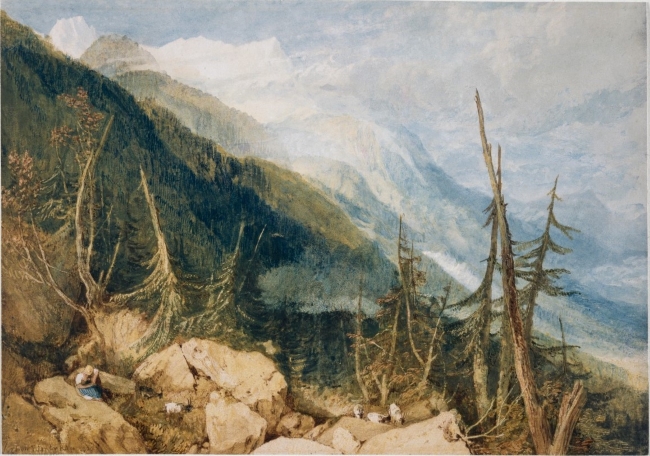
The ‘Montanvert’ glacier is part of the Mer de Glace, which is formed from different ice streams or minor glaciers. Percy Bysshe Shelley described it as follows:
‘On the other side rises the immense glacier of Montanvert, fifty miles in extent, occupying a chasm among mountains of inconceivable height, and of forms so pointed and abrupt, that they seem to pierce the sky. From this glacier we saw as we sat on a rock, close to one of the streams of the Arveiron, masses of ice detach themselves from on high, and rush with a loud dull noise into the vale. The violence of their fall turned them into powder, which flowed over the rocks in imitation of waterfalls, whose ravines they usurped and filled.’ – July 25th, 1816. [4]
Romantic artists and poets alike were inspired by the landscape of Chamonix-Mont-Blanc. Turner had produced sketches, prints and watercolours showcasing the beauty and dangers of Chamonix. He also composed a bit of poetry himself. Percy Bysshe Shelley penned the poem Mont Blanc: Lines Written in the Vale of Chamouni. It was included in History of a Six Weeks’ Tour through a part of France, Switzerland, Germany, and Holland, an account of the Shelley’s travels.
In the fourth stanza of the poem, the power of nature as a deadly force is described. The glaciers themselves sound as though they are alive:
‘The glaciers creep
Like snakes that watch their prey, from their far fountains,
Slow rolling on; there, many a precipice,
Frost and the Sun in scorn of mortal power
Have piled: dome, pyramid, and pinnacle,
A city of death, distinct with many a tower
And wall impregnable of beaming ice.’ [5]
Mary Shelley, who wrote most of the History of a Six Weeks’ Tour through a part of France, Switzerland, Germany, and Holland, also drew some literary inspiration from her travels.
In Chapter 10 of her novel Frankenstein or the Modern Prometheus, first published in 1818, Victor Frankenstein is approached by his creation on the Mer de Glace. Following the death of his younger brother William at the hands of the creature he himself created, Frankenstein journeys through the landscapes of the Alps as he grieves. He seeks comfort in the beauty of his surroundings, until he realises that he is not alone:
‘The sea, or rather the vast river of ice, wound among its dependent mountains, whose aerial summits hung over its recesses. Their icy and glittering peaks shone in the sunlight over the clouds. My heart, which was before sorrowful, now swelled with something like joy; I exclaimed, “Wandering spirits, if indeed ye wander, and do not rest in your narrow beds, allow me this faint happiness, or take me, as your companion, away from the joys of life.”

As I said this I suddenly beheld the figure of a man, at some distance, advancing towards me with superhuman speed. He bounded over the crevices in the ice, among which I had walked with caution; his stature, also, as he approached, seemed to exceed that of man. I was troubled; a mist came over my eyes, and I felt a faintness seize me, but I was quickly restored by the cold gale of the mountains. I perceived, as the shape came nearer (sight tremendous and abhorred!) that it was the wretch whom I had created. I trembled with rage and horror, resolving to wait his approach and then close with him in mortal combat.’ [6]
In the novel, the Mer de Glace becomes the setting for an exchange of words between Frankenstein and his creation. Frankenstein’s creature seeks peace in this landscape too; he says that ‘desert mountains and dreary glaciers are my refuge. I have wandered here many days; the caves of ice, which I only do not fear, are a dwelling to me, and the only one which man does not grudge. These bleak skies I hail, for they are kinder to me than your fellow beings.’ [7] The creature requests that Frankenstein accompany him to a hut on the mountainside and listen to his tale where, he says, Frankenstein is to decide if the creature will leave “for ever the neighbourhood of man and lead a harmless life, or become the scourge of your fellow creatures and the author of your own speedy ruin.” [8]
The Witch of the Alps

Turner and Percy Bysshe Shelley may have recorded the actual dangers of alpine landscapes but, for another Romantic, the Alps were the domain of strange and powerful spirits. Lord Byron used the Alps as a setting for his Manfred: A Dramatic Poem, in which the protagonist is tormented by the death of his lover Astarte. Manfred was published in 1817, a year before Frankenstein. Artist John Martin created two watercolour paintings of scenes from Manfred, which were displayed for the first time at the Society of British Artists in 1838.
Martin’s Manfred and the Witch of the Alps depicts the moment when Manfred, unable to rest, summons the sprit known as the Witch of the Alps. The witch appears from under a waterfall to offer Manfred a deal; if he does as she wants, she will give him the rest he desires. Manfred, unwilling to serve the spirits he has commanded, refuses to do so.

Turner had a liking for poetry, including the poetry of Lord Byron; his painting The Field of Waterloo, first exhibited in 1818, drew upon Lord Byron’s Childe Harold’s Pilgrimage. It was accompanied by a verse from the poem. Turner’s 1832 painting, Childe Harold’s Pilgrimage took its name directly from the poem’s title. A piece from Turner’s Liber Studiorum, From Spenser’s Fairy Queen, currently on display at the Whitworth’s Turner: In Light and Shade exhibition until 2nd November 2025, depicts a scene from Edmund Spenser’s epic poem.
Superstitions
Lord Byron and Mary Shelley may have created literary creatures who lurked in a fictional alpine landscape, but the mountains had already been associated with spirits and monsters in the imaginations of local communities. Dragons or dragon-like creatures, witches and the demonic-looking krampus are just some of the entities the Alps had been said by some to harbour. Johann Jakob Scheuchzer (1672 – 1733) was interested enough in the tales of dragons lurking in the mountains that he included some of these stories in his Itinera per Helvetiae alpinas regiones facta annis 1702–11. Published in four volumes, this work documented the features of the Swiss Alps he had explored and the observations he had made but he didn’t claim to have seen a dragon himself.
As for the folklore and superstitions surrounding the glaciers of Chamonix-Mont-Blanc, I haven’t found much detailed information yet except for references to exorcisms. I have found references to a story about one of the glaciers of Chamonix-Mont-Blanc being exorcised by the Bishop of Geneva in 1645, after the advancement of a glacier. I also found references to later exorcisms being performed on the glaciers. Jean M. Grove, a geographer and glaciologist, looked through tithe lists and other documents from the early 17th century and found that the villages of Chastellard and Les Bois were abandoned, due to the advancement of the Glacier des Bois. [9] Grove also noted references to a series of earlier exorcisms performed on glaciers in Chamonix by the ‘administrator of the priory of Chamonix’ in a source written by Jean Duffong, the administrator. [10]
An Art Critic and a Controversy Concerning Glaciers
John Ruskin (1819-1900), art critic, artist, geologist and an admirer of Turner’s work also took an interest in glaciers, both as an artist following the footsteps of Turner and as a man of science. Below is an image of Ruskin’s Mer de Glace, which was created in pencil and watercolour in 1860.

Ruskin was a geologist and a friend to James David Forbes (1809-1868). Forbes found himself stuck in a long controversy over who had been the first to suggest certain theories about how glaciers are formed and how they move. In the 1840s Louis Agassiz (1807-1873) and Forbes became engaged in dispute over who deserved priority in terms of credit for their observations on glaciers.
We can see from a passage in John Tyndall’s (1820-1893) The Glaciers of the Alps (1860) that the question of who deserved credit for certain discoveries and ideas was brought up again in scientific publications years later. Tyndall also got involved in this controversy surrounding Forbes; he suggested that the credit for the idea that glaciers moved like rivers of ice belonged to Louis Rendu (1789-1859), not Forbes. Agassiz and Forbes he seems to have credited equally for their observations on the movement of the central parts of glaciers.
‘The idea of semi-fluid motion belongs entirely to Rendu; the proof of the quicker central belongs in part to Rendu, but almost wholly to Agassiz and Forbes; the proof of the retardation of the bed belongs to Forbes alone; while the discovery of the locus of the point of maximum notion belongs, I suppose, to me.’ – John Tyndall, The Glaciers of the Alps (1860). [11]
Forbes himself had said that ‘the idea of comparing a glacier to a river is anything but new’ in his Travels Through the Alps of Savoy in 1843 and stated that ‘something very like the conception of fluid motion seems to have been in the minds of several writers, though I was not aware of it at the time I made my theory’. [12] He thought the ideas of Rendu on the motion of glaciers were of value. After Forbes died, it seems that the claims of Rendu being wronged were repeated by Tyndall and others.
John Ruskin assisted Forbes’s son George in publishing a translation of Rendu’s Theory on the Glaciers of Savoy in 1874, which Forbes began before his death. In his introduction to the work, Ruskin defended the character of his friend and remarked ‘it seems to me that all these questions as to the priority of ideas or observations are beneath debate among noble persons.’ [13]
So, glaciers inspired great minds during the 19th century. They were immortalised by artists and writers, in ways that can help us to better visualise a landscape now much changed. Discoveries and theories connected to glaciers became a source of contention among scientists who were trying to understand them better, especially when it came to who got the credit. Some of the glaciers Turner and others who lived during the late 18th and early 19th centuries saw in person no longer exist, whilst others are still there but have retreated and shrunk quite a lot. Nevertheless, the Mer de Glace and other well-known glaciers continue to attract tourists today. Even as we learn more about glaciers, they are no less fascinating. – Steph
References
[1] Percy Bysshe Shelley, LETTER IV. To T. P. Esq. ST. MARTIN—SERVOZ—CHAMOUNI—MONTANVERT—MONT BLANC. July 25th,1816 in Mary Shelley and Percy Bryce Shelley, History of a Six Weeks’ Tour through a part of France, Switzerland, Germany, and Holland; with Letters Descriptive of a Sail Round the Lake of Geneva and of the Glaciers of Chamouni (London, 1817) accessed at Project Gutenberg, 08/02/2025 < https://www.gutenberg.org/ebooks/52790 >
[2] George Downes, Guide Through Switzerland and Savoy or a new and complete geographical, historical and picturesque Description of Every Remarkable Place in these Countries (Paris, 1828), pp. 94-95.
[3] Downes, Guide Through Switzerland and Savoy, (Paris, 1828), p.96.
[4] Percy Bysshe Shelley, LETTER IV. To T. P. Esq. ST. MARTIN—SERVOZ—CHAMOUNI—MONTANVERT—MONT BLANC. July 25th,1816 in Mary Shelley and Percy Bryce Shelley, History of a Six Weeks’ Tour through a part of France, Switzerland, Germany, and Holland; with Letters Descriptive of a Sail Round the Lake of Geneva and of the Glaciers of Chamouni (London, 1817) accessed at Project Gutenberg, 08/02/2025 < https://www.gutenberg.org/ebooks/52790 >
[5] Percy Bysshe Shelley, Mont Blanc: Lines Written in the Vale of Chamouni, June 23, 1816 in in Mary Shelley and Percy Bryce Shelley, History of a Six Weeks’ Tour through a part of France, Switzerland, Germany, and Holland; with Letters Descriptive of a Sail Round the Lake of Geneva and of the Glaciers of Chamouni (London, 1817) accessed at Project Gutenberg, 08/02/2025 < https://www.gutenberg.org/ebooks/52790 >
[6] Mary Shelley, Frankenstein or the Modern Prometheus, Chapter 10 (London, 1818) accessed at Project Gutenberg, 08/02/2025 < https://www.gutenberg.org/ebooks/84 >
[7]Mary Shelley, Frankenstein or the Modern Prometheus, Chapter 10 (London, 1818) accessed at Project Gutenberg, 08/02/2025 < https://www.gutenberg.org/ebooks/84 >
[8] Mary Shelley, Frankenstein, Chapter 10 (London, 1818), accessed at Project Gutenberg, 08/02/2025 < https://www.gutenberg.org/ebooks/84 >
[9] Jean M. Grove, ‘The Little Ice Age in the Massif of Mont Blanc’, Transactions of the Institute of British Geographers, No.40 (Dec. 1966), pp. 131-132.
[10] Grove, ‘The Little Ice Age in the Massif of Mont Blanc’, Transactions of the Institute of British Geographers, No.40 (Dec. 1966), p.132.
[11] John Tyndall, The Glaciers of the Alps Being a Narrative of Excursions and Ascents, an Account of the Origin and Phenomena of Glaciers and an Exposition of the Physical Principles to which They are Related (London, 1860), pp.310-311.
[12] James David Forbes, Travels Through the Alps of Savoy and Other Parts of the Pennine Chain with Observations on the Phenomena of Glaciers (Edinburgh, 1843), pp. 382-383.
[13] John Ruskin, ‘James David Forbes: His Real Greatness’, from Rendu’s Theory of the Glaciers of Savoy (1874), published in John Ruskin Arrows of the Chase: Being A Collection of Scattered Letters Published in the Newspapers, 1840-1880 (Philadelphia, 1891), pp. 182-183.
Bibliography
Turner Works
https://www.nationalgalleries.org/art-and-artists/19243
https://www.tate.org.uk/art/artworks/turner-among-the-glaciers-d35045
John Martin’s Manfred and the Witch of the Alps
Primary Sources
W. J. Adams, Bradshaw’s Illustrated Hand-Book to Switzerland and the Tyrol (London, 1894).
John Ball, Ball’s Alpine Guide: The Western Alps (London, 1898).
George Gordon Byron, Manfred: A Dramatic Poem (London, 1817), from Duke University Libraries, accessed at Internet Archive, 08/02/2025 <https://archive.org/details/manfreddramaticp00byro/mode/2up>
George Downes, Guide Through Switzerland and Savoy or a new and complete geographical, historical and picturesque Description of Every Remarkable Place in these Countries (Paris, 1828).
James David Forbes, Travels Through the Alps of Savoy and Other Parts of the Pennine Chain with Observations on the Phenomena of Glaciers (Edinburgh, 1843).
William Cosmo Monkhouse, Illustrated Biographies of the Artists: Joseph Mallord William Turner (London, 1879).
Louis Rendu (author), Alfred Wills (English translation), P.G Tait and John Ruskin (memoirs and articles added to English edition), Theory of the Glaciers of Savoy (London, 1874).
Ralph Richardson, ‘On Phenomena of Weather Action and Glaciation exhibited by the Alps of Switzerland and Savoy; being Notes of a Recent Tour.’, read in December 1874 at a meeting of the Edinburgh Geological Society, printed in Transactions of the Edinburgh Geological Society Vol. III, (Edinburgh, 1880), pp. 11-22.
John Ruskin, Modern Painters, Parts I-II, Third Edition (New York, 1854).
John Ruskin, ‘James David Forbes: His Real Greatness’, from Rendu’s Theory of the Glaciers of Savoy (1874), published in John Ruskin Arrows of the Chase: Being A Collection of Scattered Letters Published in the Newspapers, 1840-1880 (Philadelphia, 1891), pp. 182-183.
Johann Jakob Scheuchzer, and Pieter van der Aa. Ouresiphoitēs Helveticus, sive, Itinera per Helvetiae Alpinas regiones facta annis MDCCII, MDCCIII, MDCCIV, MDCCV, MDCCVI, MDCCVII, MDCCIX, MDCCX, MDCCXI : plurimis tabulis aeneis illustrata. Typis ac sumptibus Petri Vander Aa, 1723, https://doi.org/10.5962/bhl.title.112219.
Mary Shelley and Percy Bysshe Shelley, History of a Six Weeks’ Tour through a part of France, Switzerland, Germany, and Holland; with Letters Descriptive of a Sail Round the Lake of Geneva and of the Glaciers of Chamouni (London, 1817) accessed at Project Gutenberg, 08/02/2025< https://www.gutenberg.org/ebooks/52790 >
Mary Shelley, Frankenstein or the Modern Prometheus (London, 1818), accessed at Project Gutenberg, 08/02/2025 < https://www.gutenberg.org/ebooks/84 >
John Tyndall, The Glaciers of the Alps Being a Narrative of Excursions and Ascents, an Account of the Origin and Phenomena of Glaciers and an Exposition of the Physical Principles to which They are Related (London, 1860).
John Tyndall, The Forms of Water in Clouds and Rivers, Ice and Glaciers (London, 1872).
Further Reading
The National Gallery, The Turner Bequest: https://www.nationalgallery.org.uk/about-us/history/the-turner-bequest
Jonathan Andrews. “Monro, Thomas (1759–1833), physician and patron of art.” Oxford Dictionary of National Biography. January 07, 2010. Oxford University Press. Date of access 8 Feb. 2025, <https://www.oxforddnb.com/view/10.1093/ref:odnb/9780198614128.001.0001/odnb-9780198614128-e-18981>
Elizabeth Baigent. “Pococke, Richard (1704–1765), traveller and Church of Ireland bishop of Ossory, of Elphin, and of Meath.” Oxford Dictionary of National Biography. January 06, 2011. Oxford University Press. Date of access 10 Feb. 2025, <https://www.oxforddnb.com/view/10.1093/ref:odnb/9780198614128.001.0001/odnb-9780198614128-e-22432>
Andrew Beattie, The Alps: A Cultural History (Oxford University Press, 2006).
Wolfgang Behringer, Tambora and the Year Without a Summer: How a Volcano Plunged the World into Crisis (Cambridge, 2019).
Helgi Björnsson (author) and Julian Meldon D’Arcy (English translation), The Glaciers of Iceland: A Historical, Cultural and Scientific Overview (University of Iceland, 201).
G. C. Boase and Philip S. Bagwell. “Bradshaw, George (1801–1853), compiler of railway guides.” Oxford Dictionary of National Biography. October 03, 2013. Oxford University Press. Date of access 10 Feb. 2025, <https://www.oxforddnb.com/view/10.1093/ref:odnb/9780198614128.001.0001/odnb-9780198614128-e-3195>
W.H. Brock. “Tyndall, John (1820–1893), physicist and mountaineer.” Oxford Dictionary of National Biography. September 28, 2006. Oxford University Press. Date of access 17 Feb. 2025, <https://www.oxforddnb.com/view/10.1093/ref:odnb/9780198614128.001.0001/odnb-9780198614128-e-27948>
Serge Brunet, ‘”Mountain Priests”? Clergy Recruitment, Families, and Mountain Communities in 17th- and 18th-Century Europe’, Mountain Research and Development Vol 26, No. 4, Religion and Sacredness in Mountains: A Historical Perspective (Nov. 2006), pp.350-357.
Cian Duffy, The Landscapes of the Sublime, 1700-1830 (London, 2013).
Howell G. M. Edwards, The Farnley Hall Service: A Unique Survivor in Nantgarw Porcelain (University of Bradford, 2023).
Brian Fagan, The Little Ice Age: How Climate Made History, 1300-1850 (New York, 2019).
Jean M. Grove, ‘The Little Ice Age in the Massif of Mont Blanc’, Transactions of the Institute of British Geographers, No.40 (Dec. 1966), pp. 129-143.
Jean M. Grove, The Little Ice Age, (New York, 1988).
Peter H. Hansen. The Summits of Modern Man: Mountaineering After the Enlightenment (Harvard University Press, 2013).
Luke Herrmann. “Turner, Joseph Mallord William (1775–1851), landscape and history painter.” Oxford Dictionary of National Biography. September 28, 2006. Oxford University Press. Date of access 8 Feb. 2025, <https://www.oxforddnb.com/view/10.1093/ref:odnb/9780198614128.001.0001/odnb-9780198614128-e-27854>
Anita and John Hollier, ‘The Glacier Theory of Louis Rendu (1789–1859) and The Forbes-Tyndall Controversy’, Earth Sciences History, 35 (2) (2016), pp. 346–353.
Martin Korenjak, ‘Why Mountains Matter’, Renaissance Quarterly Vol. 70, No. 1 (2017), pp. 179-219.
Kathleen Kete, The Alpine Enlightenment: Horace Bénédict de Saussure and Nature’s Sensorium (University of Chicago Press, 2024).
Richard Lansdown, The Cambridge Introduction to Byron (Cambridge University Press, 2012).
Jon Mathieu, The Alps: An Environmental History (Cambridge, 2019).
Olivier Mesley, J.M.W Turner: The Man Who Set Painting on Fire (London, 2005).
Thomas Munck, Seventeenth-Century Europe (London, 2017).
Michael O’Neill. “Shelley, Percy Bysshe (1792–1822), poet.” Oxford Dictionary of National Biography. May 26, 2016. Oxford University Press. Date of access 10 Feb. 2025, <https://www.oxforddnb.com/view/10.1093/ref:odnb/9780198614128.001.0001/odnb-9780198614128-e-25312>
Clive Oppenheimer, Eruptions that Shook the World (Cambridge University Press, 2011).
Graham Reynold and David Blyaney Brown, Turner (World of Art), (London, 2020).
J.S Rowlinson, ”Our Common Room in Geneva” and the Early Exploration of the Alps of Savoy’, Notes and Records of the Royal Society of London Vol 52, No.2 (1998), pp.221-235.
Caroline Schaumann, Peak Pursuits: The Emergence of Mountaineering in the Nineteenth Century (Yale University Press, 2020).
Kim Sloan. “Cozens, John Robert (1752–1797), landscape watercolour painter.” Oxford Dictionary of National Biography. January 06, 2011. Oxford University Press. Date of access 19 Feb. 2025, <https://www.oxforddnb.com/view/10.1093/ref:odnb/9780198614128.001.0001/odnb-9780198614128-e-6547>
R.N. Smart. “Forbes, James David (1809–1868), physicist and geologist.” Oxford Dictionary of National Biography. January 05, 2012. Oxford University Press. Date of access 17 Feb. 2025, <https://www.oxforddnb.com/view/10.1093/ref:odnb/9780198614128.001.0001/odnb-9780198614128-e-9832>
Marion Kingston Stocking. “Clairmont, Clara Mary Jane [Claire] (1798–1879), a member of the Shelley–Byron circle.” Oxford Dictionary of National Biography. September 25, 2014. Oxford University Press. Date of access 10 Feb. 2025, <https://www.oxforddnb.com/view/10.1093/ref:odnb/9780198614128.001.0001/odnb-9780198614128-e-5428>
 A Place Between The Trees