
Find out about the (mostly) not-so-romantic history of mistletoe in this post by Steph.
For more information about the Art, Health and History project visit this page.
The association of mistletoe with winter and Christmas has featured in festive books, cards conveying season’s greetings and well wishes, decorations, films and songs. Mistletoe has even been incorporated into designs for textiles, such as the very stylised ‘Mistletoe’ design below. Using mistletoe as anything other than a decoration during the winter months isn’t something that occurs to most of us today, but this plant has had some interesting uses in the past, both real and imagined.

An Unflattering Name
Britain’s native mistletoe species is Viscum album, also known as European mistletoe. The common name for this plant is thought to derive from the Old English mistletan, mistle apparently meaning ‘dung’ and ‘tan’ meaning ‘twig’. The connection with bird droppings isn’t an imagined one; birds enable the spread of this partially parasitic plant by dispersing the seeds to other trees via their droppings. The berries have sadly been used to create birdlime; a sticky substance used for trapping birds, which was used in centuries past and is unfortunately still used by poachers. If that hasn’t chased away all thoughts of romance, then I’m afraid things are about to get worse.
Mistletoe in Mythology
Mistletoe would probably be the furthest thing from your mind if someone asked you to imagine a murder weapon. It’s not going to pop up in a game of Cluedo. In Norse mythology, however, it was Loki’s weapon of choice in a tale that would transform him from a trickster who usually fixes whatever he causes to go awry into an outright malicious being who sets the events which lead up to Ragnarok into motion.
The story goes that the death of Baldr, son of Odin and Frigg, the fairest of all gods, had dreamt of his own death. His mother set out on a journey to make everything swear an oath not to harm her son, but the mistletoe was exempt from taking the oath. The usual explanations given for this revolve around Frigg having thought it was harmless enough or too young to swear the oath.
When news of Baldr’s supposed invulnerability spread in Asgard, the gods made a game of throwing things at him to celebrate. Loki, however, set his mind to finding out if Baldr had a weakness. He changed his form to that of a woman and gained the trust of Frigg- who confided that she hadn’t asked the mistletoe to swear an oath not to harm her son.
Loki fashioned a weapon from the only thing Baldr was vulnerable to. Baldr’s blind brother, Hodr, hadn’t joined in the game with the other gods. He stood apart from the others, until Loki talked his way into Hodr letting him assist him in joining in the fun. Loki guided Hodr’s hand and the mistletoe passed through Baldr’s body, killing him instantly.
Loki’s lethal use of mistletoe is probably the most well-known instance of mistletoe featuring in mythology in a significant way.
Mythological murders aside, mistletoe had other associations with the supernatural; it is said to have been sacred to the Druids, who are said to have used it in their rituals. The written material we have relating to the Druids comes from Greek and Roman sources, in addition to some medieval Irish sources. [1] These sources frequently, with perhaps the exception of Julius Caesar, relied on information they had acquired from accounts they had heard from elsewhere, rather than first-hand encounters, and were sometimes written long after the events they described had supposedly taken place. [2] The authors of these sources would have had their own agenda and could easily have misinterpreted the role of Druids or even invented details for their audience.
Pliny the Elder (23/24–79 CE) in his Natural History stated that Druids ‘held nothing more sacred than the mistletoe and the tree that bears it, supposing always that tree to be the robur’. [3] ‘Robur’, in this context, is the Latin word for ‘oak’, but European mistletoe is rarely found on oak trees. In Book 16, Chapter 93 of his Natural History Pliny claimed that there were varieties of mistletoe, with the ‘hyphear of Arcadia’ being found on oak trees. [4] He stated ‘that which grows upon the trees which lose their leaves, loses its leaves as well; while, on the other hand, that which grows upon evergreens always retains its leaves’. [5]
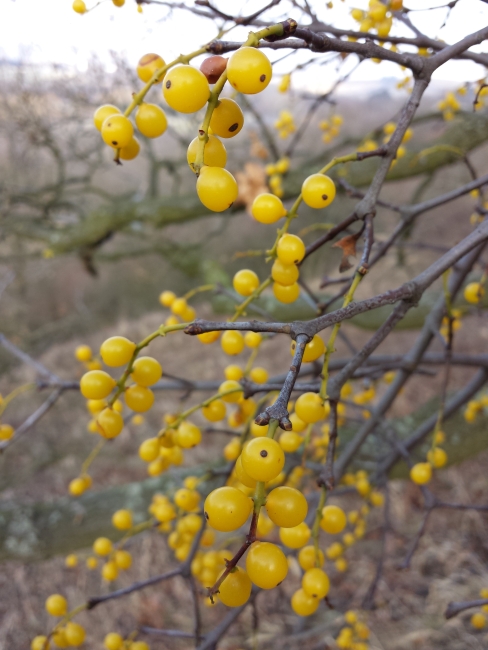
Yellow-berried mistletoe (Loranthus europeaus), found in central and southern Europe, is not evergreen like European mistletoe and can indeed be found growing on oak trees. European mistletoe has a wide range, as the name suggests, so there may have been some confusion as to which species was meant by the common name ‘mistletoe’ at any given point in time. Perhaps they were credited with similar properties because they are both parasitic.
In the translation of Pliny’s Natural History that I have quoted from, there appears to have been no clarification as to which species of plant referred to as ‘mistletoe’ was being used to create birdlime. Nor could I find any clarification as to which species was used in the process of creating birdlime in another translation. In the translation I have used, it is stated that the berries would be ‘gathered at harvest’ but the berries of both European mistletoe and yellow-berried mistletoe apparently ripen around the same time of year (autumn – late winter) and a number of plants have been utilised to make birdlime, so I am still not sure which species Pliny was talking about. [6] If anyone knows, please leave a comment at the bottom of this post.
Mistletoe in Medicine
In Book 16, Chapter 95 of his Natural History, Pliny stated that the mistletoe used by the Druids was ‘but rarely found upon the robur; and when found, is gathered with rites replete with religious awe’. [7] European mistletoe tends to be found more on apple, blackthorn, hawthorn, poplar and willow trees but is less frequently found on oak trees. Yellow-berried mistletoe can also be found on oak trees. Pliny claimed that the Druids also credited the mistletoe they used with increasing fertility and with curative powers, stating ‘It is the belief with them that the mistletoe, taken in drink, will impart fecundity to all animals that are barren, and that it is an antidote for all poisons’. [8]
If you have read any of my previous Art, Health and History project posts then you’ll know that ingesting a plant just because people used it for medicinal purposes in the past is a bad idea. Some plants employed in medicine in the past are toxic to humans and other animals, and Viscum album is no exception. People in the past weren’t stupid; they knew that risks came with ingesting many of the substances they used for medicinal purposes but, due to their ideas about how the human body worked, they believed that any supposed benefits were worth the risk. Vomiting and diarrhoea are some of the symptoms of Viscum album poisoning, so don’t ruin Christmas by snacking on your decorations.

You may have heard of mistletoe, specifically European mistletoe, being used by some as a treatment for cancer. However, there haven’t been enough clinical trials which suggest there is any strong evidence for the efficacy of mistletoe as a cancer treatment- so beware anyone making claims about it being a cure. The idea that mistletoe may be employed as a treatment for tumours, cancerous or not, isn’t new, though. During the early modern period in England, mistletoe was recommended as a remedy for tumours and a whole host of other things.
I think it’s likely that the doctrine of signatures had a role to play in giving rise to the belief that mistletoe could be useful in the treatment of tumours in the past. The doctrine of signatures promoted the idea that something which was somehow like an ailment in terms of its physical characteristics might be an effective treatment against said ailment. In the case of European mistletoe and yellow-berried mistletoe, both are semi-parasitic and grow on trees, so in some respects they could be said to bear a superficial similarity to growths like tumours.
In part two of Mistletoe: ‘Medicine’, Murder and the Festive Season, we will continue to look at how mistletoe was used in medicine in early modern England and in ancient Rome. We’ll also look at how this plant became intertwined with Christmas imagery and search for the origins of the custom of kissing under the mistletoe. – Steph
References
[1] Ronald Hutton, ‘Under the Spell of the Druids’, 13th June 2019, History Today: https://www.historytoday.com/miscellanies/under-spell-druids, accessed online 25/11/2025.
[2] Hutton, ‘Under the Spell of the Druids’, 13th June 2019, History Today: https://www.historytoday.com/miscellanies/under-spell-druids, accessed online 25/11/2025.
[3] Pliny the Elder, Natural History, Book XVI, Chapter 95 from The Natural History. Pliny the Elder. John Bostock, M.D., F.R.S. H.T. Riley, Esq., B.A. London. Taylor and Francis, Red Lion Court, Fleet Street. 1855. Accessed online at Gregory R. Crane, Perseus Digital Library, Tufts University on 24/11/2025.
[4] Pliny the Elder, Natural History, Book XVI, Chapter 93 from The Natural History. Pliny the Elder. John Bostock, M.D., F.R.S. H.T. Riley, Esq., B.A. London. Taylor and Francis, Red Lion Court, Fleet Street. 1855. Accessed online at Gregory R. Crane, Perseus Digital Library, Tufts University on 24/11/2025.
[5] Pliny the Elder, Natural History, Book XVI, Chapter 93 from The Natural History. Pliny the Elder. John Bostock, M.D., F.R.S. H.T. Riley, Esq., B.A. London. Taylor and Francis, Red Lion Court, Fleet Street. 1855. Accessed online at Gregory R. Crane, Perseus Digital Library, Tufts University on 24/11/2025.
[6] Pliny the Elder, Natural History, Book XVI, Chapter 94 from The Natural History. Pliny the Elder. John Bostock, M.D., F.R.S. H.T. Riley, Esq., B.A. London. Taylor and Francis, Red Lion Court, Fleet Street. 1855. Accessed online at Gregory R. Crane, Perseus Digital Library, Tufts University on 24/11/2025.
[7] Pliny the Elder, Natural History, Book XVI, Chapter 95 from The Natural History. Pliny the Elder. John Bostock, M.D., F.R.S. H.T. Riley, Esq., B.A. London. Taylor and Francis, Red Lion Court, Fleet Street. 1855. Accessed online at Gregory R. Crane, Perseus Digital Library, Tufts University on 24/11/2025.
[8] Pliny the Elder, Natural History, Book XVI, Chapter 95 from The Natural History. Pliny the Elder. John Bostock, M.D., F.R.S. H.T. Riley, Esq., B.A. London. Taylor and Francis, Red Lion Court, Fleet Street. 1855. Accessed online at Gregory R. Crane, Perseus Digital Library, Tufts University on 24/11/2025.
Bibliography
Primary Sources
Joseph Blagrave, (1610-1682). New Additions to the Art of Husbandry Comprizing a New Way of Enriching Meadows, Destroying of Moles, Making Tulips of any Colour : With an Approved Way for Ordering of Fish and Fish-Ponds … with Directions for Breeding and Ordering all Sorts of Singing-Birds : With Remedies for their several Maladies Not before Publickly made Known. , 1675. ProQuest, https://manchester.idm.oclc.org/login?url=https://www.proquest.com/books/new-additions-art-husbandry-comprizing-way/docview/2240893181/se-2.
Aulus Cornelius Celsus. De Medicina. W. G. Spencer. Cambridge, Massachusetts. Harvard University Press. 1971 (Republication of the 1935 edition), Accessed online at Perseus Digital Library, Tufts University, on 25/11/25
Nicholas Cox fl.1673-1721. The Gentleman’s Recreation in Four Parts, Viz. Hunting, Hawking, Fowling, Fishing : Wherein these Generous Exercises are Largely Treated of, and the Terms of Art for Hunting and Hawking More Amply Enlarged than Heretofore : Whereto is Prefixt a Large Sculpture, Giving Easie Directions for Blowing the Horn, and Other Sculptures Inserted Proper to each Recreation : With an Abstract at the End of each Subject of such Laws as Relate to the Same. , 1686. ProQuest, https://manchester.idm.oclc.org/login?url=https://www.proquest.com/books/gentlemans-recreation-four-parts-viz-hunting/docview/2240909545/se-2.
Nicholas Culpeper, 1616-1654. The English Physitian Enlarged with Three Hundred, Sixty, and Nine Medicines made of English Herbs that were Not in any Impression Until this … : Being an Astrologo-Physical Discourse of the Vulgar Herbs of this Nation : Containing a Compleat Method of Physick, Whereby a Man may Preserve His Body in Health, Or Cure Himself, being Sick, for Three Pence Charge, with such Things Only as Grow in England, they being most Fit for English Bodies … / by Nich. Culpeper, Gent. .. , 1653. ProQuest, https://manchester.idm.oclc.org/login?url=https://www.proquest.com/books/english-physitian-enlarged-with-three-hundred/docview/2240956895/se-2.
Andy Orchard (editor and translator), The Elder Edda (London, 2011). Penguin Classics Edition.
Gaius Plinius Secundus (Pliny the Elder), Natural History, Book XVI, Chapters 93, 94 and 95 from The Natural History. Pliny the Elder. John Bostock, M.D., F.R.S. H.T. Riley, Esq., B.A. London. Taylor and Francis, Red Lion Court, Fleet Street. 1855. Accessed online at Gregory R. Crane, Perseus Digital Library, Tufts University, accessed online 24/11/2025.
Snorri Sturluson (author) and Jesse Byock (translator), The Prose Edda, (London, 2005). Penguin Classics Edition.
Further Reading
Lucio Biancatelli from WWF Italy, “Save that Robin”: a day in the fight against poaching in Northern Italy, 30th November 2022, SWiPE: https://stopwildlifecrime.eu/save-that-robin-a-day-in-the-fight-against-poaching-in-northern-italy/
Judith Bonzol, ‘The Death of the Fifth Earl of Derby: Cunning Folk and Medicine in Early Modern England’, Renaissance and Reformation / Renaissance et Réforme Vol. 33, No.4 (2010), pp. 73-100.
John Box, ‘Oaks (Quercus spp.) parasitised by mistletoe Viscum album (Santalaceae) in Britain’, British and Irish Botany 1 (1): 2019, pp. 39-49.
C. H. Coote, and Patrick Curry. “Blagrave, Joseph (b. 1610, d. in or before 1682), astrologer.” Oxford Dictionary of National Biography. September 23, 2004. Oxford University Press. Date of access 24 Nov. 2025, <https://www.oxforddnb.com/view/10.1093/ref:odnb/9780198614128.001.0001/odnb-9780198614128-e-2558>
Patrick Curry. “Culpeper, Nicholas (1616–1654), physician and astrologer.” Oxford Dictionary of National Biography. September 23, 2004. Oxford University Press. Date of access 24 Nov. 2025, <https://www.oxforddnb.com/view/10.1093/ref:odnb/9780198614128.001.0001/odnb-9780198614128-e-6882>
A. I. Finall, S. A. McIntosh and W. D. Thompson, ‘Subcutaneous inflammation mimicking metastatic malignancy induced by injection of mistletoe extract’, BMJ 2006;333:1293
George R. Huntington and Megan L. Byrne, The holly and the ivy: a festive platter of plant hazards, BMJ 2021;375:BMJ-2021-066995
Ronald Hutton, Blood and Mistletoe: The History of the Druids in Britain (Yale University Press, 2009).
Ronald Hutton, ‘Under the Spell of the Druids’, 13th June 2019, History Today: https://www.historytoday.com/miscellanies/under-spell-druids, accessed online 25/11/2025.
Michael Moss, MD, FAACT, Medical Director, Utah Poison Control Center, ‘Are My Holiday Plants Poisonous?’, Nov 13 2023, University of Utah Healthcare.
Andrew Nixon, ‘Orchards & Mistletoe’, Tuesday 4th January 2002, Herefordshire Wildlife Trust: ‘https://www.herefordshirewt.org/blog/andrew-nixon/orchards-mistletoe
Alison Weir and Siobhan Clarke, A Tudor Christmas (London, 2018).
 A Place Between The Trees


One thought on “Mistletoe: ‘Medicine’, Murder and the Festive Season. Part One.”