
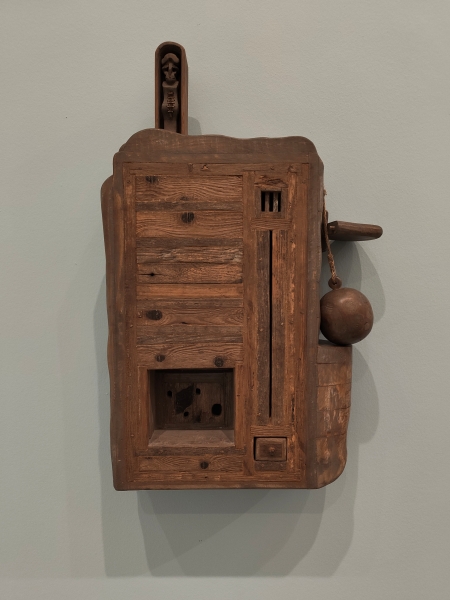
Take a closer look at Pascal Verbena’s Deserted House in this post by Sev.
Delaine Le Bas presents her exciting new exhibition, ‘Un-Fair-Ground’ alongside a significant portion of works from the Whitworth’s own collection and works from the award-winning non-profit organisation, Venture Arts. Each work was chosen by Le Bas to compliment her own works, either because they served as influences, or because they reflect and align with her own holistic and non-conformist views towards strictly curated spaces, in art and in life.
There are no labels on the walls in this exhibition. No signage to satiate the viewer’s curiosity or answer the questions: ‘Who made this item? When? Where?’ There is a booklet containing this information paired with a handy navigation guide, but it is generally expected that in art galleries such as the Whitworth, interpretations will be laid out for the viewer to soothe any questions regarding how the art came to be and, indeed, by whom.
Delaine Le Bas does not conform to this convention and instead invites audiences to meander through the space free of any pre-conceived biases attached to names, dates or pre-conceived meanings.
One of the works Le Bas chose to accompany her exhibition is eye-catching and curious in every respect and demands attention by how little information we are presented with on it.
This work is Pascal Verbena’s Deserted House.
A key theme in Delaine Le Bas’ work is recycling. Take, for instance, The Witch House.
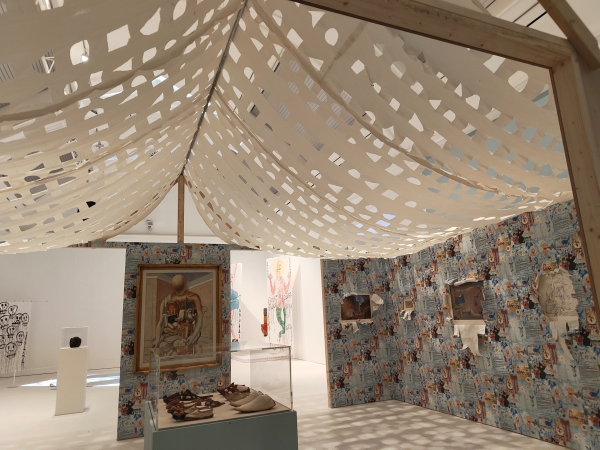
The roof of this structure is calico recycled from her exhibition, Witch Hunt, a solo exhibition she held back in 2009 at the Tramway in Glasgow and at Newcastle Contemporary Art. Pieces of the roof were cut out here at the Whitworth in the lead-up to Un-Fair-Ground. There are many instances in Le Bas’ work which use recycled or community-sourced materials. As a Romani woman who saw plenty of anti-Romani material in the press at the time of the 2005 election campaign, such as ‘Meet Your Neighbours’, an article printed in The Sun which undermined the rights and voices of British Traveller communities, Le Bas has spoken at length on the necessary resourcefulness of her own community. It was common for various objects to be passed down, transformed, and reused again and again in her home growing up.
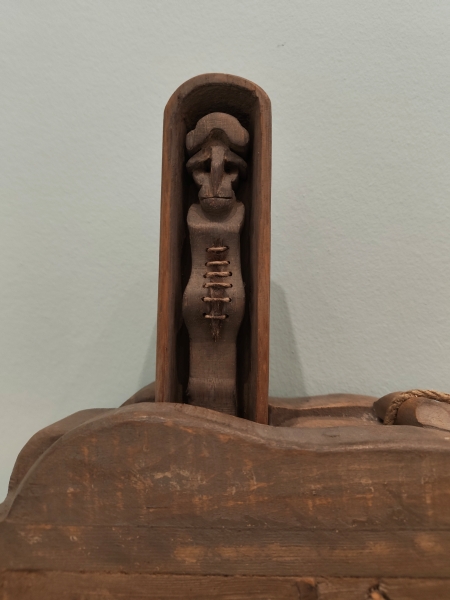
Pascal Verbena adopted a similar technique to create his sculptures which often take the form of structures akin to Deserted House. Hailing from Marseille in the early 1940s, Verbena was inspired by crypts in early Christian churches to create his sculptures. He first began carving whilst working on a freight ship off the coast of Africa in the late 1950s. Upon his return to Marseille, Verbena began working in a post office. But rather than deterring him from an artistic career, he was inspired once again to use the materials available to him and began transforming old desks from the post office into sculptures. He also set up a studio near the docks, and began collecting driftwood, bark, stones and other pieces of washed-up detritus from the Mediterranean Sea. As an enthusiastic fisherman, he was even able to recycle the bones of the fish he caught by grinding them into glue.
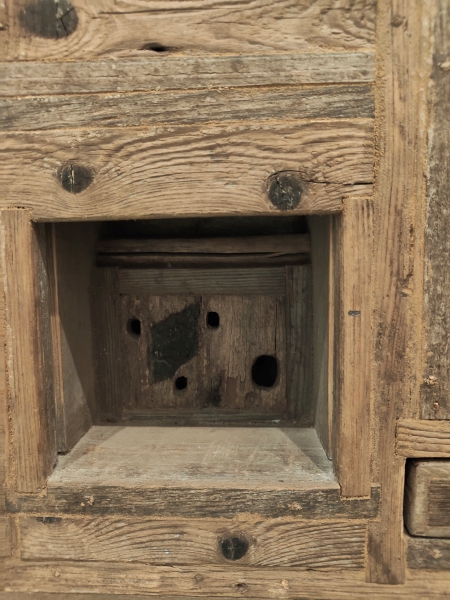
Using these found materials, he started creating these structures which he named: Habitacles. In Modern French, a habitacle refers to the passenger compartment of an automobile or aircraft. Historically, the word means a dwelling place or a small, habitable space. Whilst the nooks and structures Verbena creates are not habitable for humans, they could certainly house insects, rodents or other small creatures seeking shelter. Whether or not that is their purpose, however, remains up for debate.
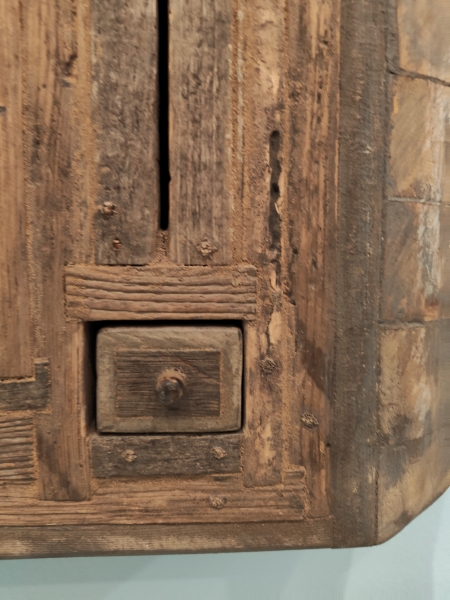
The thing is, Deserted House and Verbena’s other Habitacles seemingly have no discernible purpose. For the casual viewer, this may seem frustrating. Each object is lovingly carved, some even displaying intricate decoration alongside strange drawers and pulleys and, upon close inspection, hidden compartments and poetry. But these Habitacles are not in any way, shape or form for practical use. The drawers are too small. The nooks and crannies are too awkwardly shaped to store things sensibly. The eye is instead drawn to carvings of figures and words within the sculpture itself. Or to the odd, spherical wooden ball attached to it with rope which begs to be pulled. Would that open another, hidden drawer? Would it make a noise, or would it achieve nothing at all? Many questions like this arise the longer you look at this piece, and that is absolutely the point.
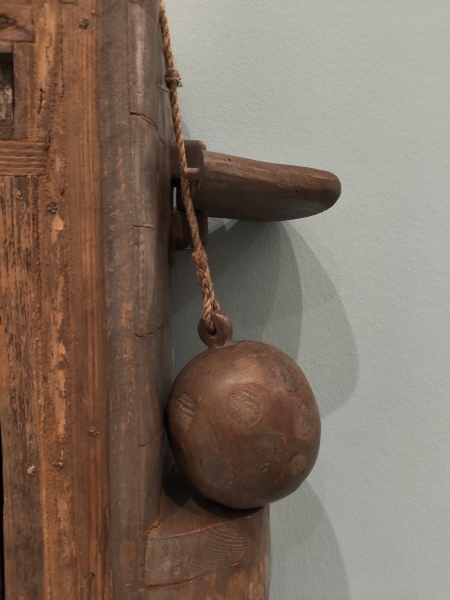
It is easy to see then why Le Bas was drawn to Deserted House. Its structure offers no practical use but is instead an invitation to play and discover. The object is, for all intents and purposes, ‘pointless’ as one visitor told me when discussing their reaction to the work. But that does not detract from the joy it brings its viewer, or indeed from the resourcefulness and craft Verbena employed to create it. – Sev
 A Place Between The Trees