
Feeling particularly bored and stressed? Looking for a new craft to take up ? In this post, Steph looks at the beauty, origins and uses of sashiko; a simple and relaxing form of embroidery created in centuries past by Japan’s rural poor.
Why not have a go at sashiko yourself? Visit our The Whitworth in Stitches project page for free sashiko patterns, tutorials and more!

Although I like the process of stitching things I have little talent when it comes to sewing or really any form of needlecraft. I discovered sashiko at a craft fair in 2019 and decided to give it a go. During lockdown in 2020, I started to practice the basics on a sashiko coaster kit I had bought. I eventually started to get the hang of sashiko about three coasters into the kit…
What is sashiko? Simply put, it’s a Japanese form of stitching, often employed in quilting and for mending. The stitch used is basically a running stitch. The sashiko most people will be familar with aims for a small, even stitch size throughout- with even spacing between stitches. Sashiko is usually done using cotton fabric, but it can be done on other kinds of fabric too. The most common explanation for the origin of sashiko you’ll encounter is that it originated in Japan centuries ago among the rural poor, who couldn’t afford to just throw cloth away and would instead have to mend and repurpose fabric. Its usefulness in helping to insulate fabric no doubt came in handy during the colder months. As to exactly how old the craft is, many authors point to the Edo era (around 1603 CE -1868 CE) as the period in which different forms of sashiko emerged. Like many other forms of folk art and embroidery, there are various regional styles of sashiko.
As in Europe in past centuries, sumptuary laws existed in Japan which dictated what people could own and wear based on their social status. During the Edo period, merchants and those lower down in the pecking order were prohibited from wearing more expensive fabrics as well as certain colours. In a world where increasing prosperity for some merchants made them wealthier than some samurai, the sumptuary laws were intended to help reinforce the social hierarchy.

Although there is evidence of people (wealthier merchants in particular) breaking the sumptuary laws, such as by lining what appeared to be a plain garment with a more luxurious fabric or wearing a more ornate garment underneath a plain one, those who were very poor wouldn’t have the means to afford more expensive dyes and fabrics or trinkets with which to flout these laws. At least, not without getting into debt. Indigo dyes tended to be more affordable, perhaps because the Japanese indigo plant itself was easy to grow, so sashiko was often done with a contrast of light-coloured thread, sometimes almost white, sometimes red, on indigo cloth. During the Edo period the production of indigo dye and clothing expanded, as did the production of cotton for clothing. Cotton was introduced to Japan during the 16th century, prior to the Edo period. Hemp, and later cotton, was used to create clothing for commoners. Today many fabrics used for sashiko are made of cotton, rather than hemp.
Sashiko is now gaining in popularity in countries like the USA and the UK but many of the books available on the subject in English do not delve too deeply into its history, often preferring to focus on the more practical aspects of how the craft is done. Authors who examine the history of the craft in more detail and collect sashiko pieces themselves point out that sashiko fell out of fashion for a while in the 20th century as fashion changed to incorporate even more Western styles of clothing, so some items may have been thrown away. They also note that some older pieces which were used as they were originally intended were probably worn out, so this may account for why some aspects of the history of the craft appear to be hazy. There’s also the fact that, originating among the poor as it did, some people may not have seen fit to record its history and those who created sashiko pieces may not have been able to document aspects of its history in written form. Perhaps for some, the fact that both sashiko and boro might be interpreted as markers of a lack of wealth may also have played a part in their decision to do away with any sashiko heirlooms or to stop practising sashiko.
The Ideal Stitch
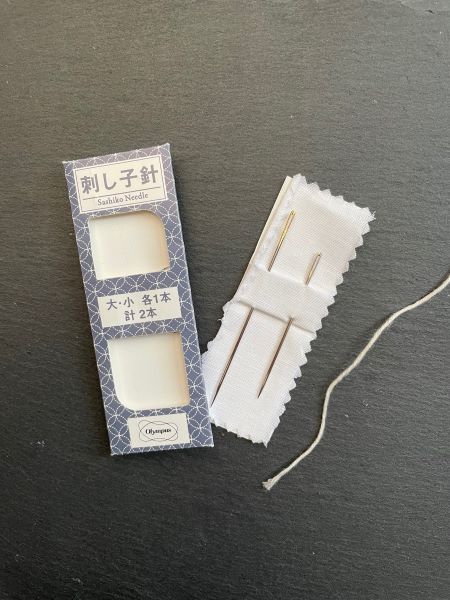
Sashiko was done quickly; the needles are long so they can pick up bits of fabric multiple times, to complete more than one stitch at a time. It’s convenient and even fun to do that now but I suspect that it was probably born out of a necessity to use your time as effectively as possible.
It is sometimes said that the ideal stitch size for sashiko is no bigger than a grain of rice; short grain rice, not long grain! In fact, the word ‘sashiko’ ( 刺し子) apparently translates to ‘little stabs’, which is thought to be a reference to the small stitch size.

Sashiko thread is very thick- the full strand of thread is used, rather than dividing it up as you would with embroidery floss. Indigo fabric with white or off-white thread is one of the more traditional colour combinations you’ll see but you can buy sashiko thread in all sorts of colours.

Some people put a knot at the end of their thread but another method of securing sashiko thread is to simply insert the needle a few stitches on into your pattern. You would then go back to the starting point of the pattern and then go over the stitches you have just made, leaving a small loop of thread on the back so you do not pull the thread all the way through and unravel your stitches. Once you start to come to the end of the thread, you would go back over your last few stitches – again leaving a small loop at the back. Loops of thread are also left on the back of a piece when you must change direction as you stitch a pattern. This means that, although some of the stitches may look thicker than others, there will be no unsightly bumps, and the back of the piece will also look beautiful.
Sashiko Patterns
Traditional geometric patterns are particularly popular in sashiko but one can also find patterns featuring animals and other aspects of the natural world, which are more easily recognisable to those who are not familiar with what Japanese geometric patterns are meant to represent.
The geometric patterns look complicated but the way sashiko patterns are stitched allows for the most efficient movement of the needle. The patterns are stitched in continuous lines, making complex looking patterns from simple steps. The patterns are stunning and, as well as the more utilitarian aspect of mending and adding insulation to clothing, they also provided an affordable way to make clothing more beautiful for those who were not able to afford or use certain fabrics. Garments adorned and made with sashiko could also be useful in helping to distinguish people belonging to some professions; fishermen in the late 19th and early 20th centuries wore sashiko no donza coats when they were not at sea.


The various traditional geometric patterns often found on sashiko pieces and other Japanese textiles each have their own significance. Before the expansion in the production of cotton in Japan in the Edo period, hemp was more commonly used for clothing. The asanoha or hemp leaf pattern is made up of small diamond shapes which are meant to represent the pointed shape of hemp leaves. It’s said to represent growth and good health, so the asanoha pattern was popular on some items of children’s clothing- but it was not limited to just children’s clothing.
Lots of designers have taken inspiration from traditional Japanese patterns and featured them on various products. The asanoha pattern appears to be popular on some home products you can buy in the UK but it’s not always sold as the asanoha/ hemp leaf pattern or with any links to its original context. You’ll sometimes find it or something similar on objects that are marketed for a Scandinavian or minimalist aesthetic or have the word ‘geometric’ in their product description.

The seigaiha pattern represents waves. Its simple elegance and reference to the sea makes it one of my favourite traditional Japanese patterns. It can often be found on summer garments and is also sometimes employed on family crests. This pattern has also become popular in the UK and in other countries. Like the asanoha pattern, it’s often not marketed under its Japanese name abroad, but it is immediately recognisable to many as a pattern representing waves.

The shippo tsunagi or ‘seven treasures’ pattern of layered rings is another popular pattern that appears to be frequently used and sold on products in the UK, again often without reference to its original context. It’s a reference to the treasures of gold, silver, agate or carnelian, coral, pearl, lapis lazuli and crystal or amber listed in Buddhist texts.
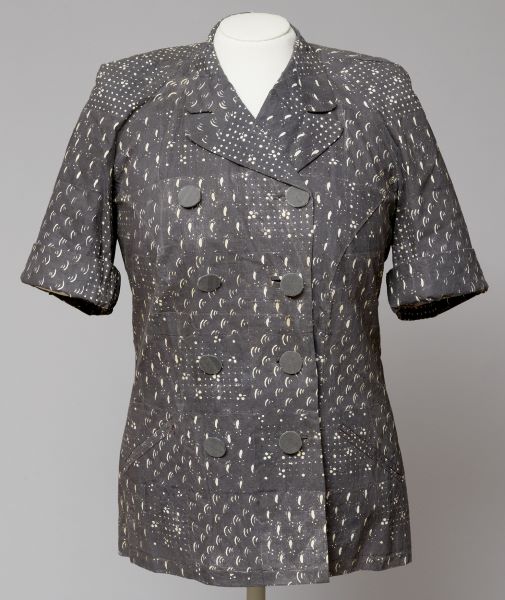
This patchwork jacket in the Whitworth’s collections has a recurring ‘grass’ pattern a bit similar to traditional Japanese patterns such as the nowaki pattern of wind-blown grass you’ll find on some sashiko pieces. It also looks like the shibakusa pattern of blades of grass and the tsuyu-shiba pattern of blades of grass interspersed with dew drops.

There is a sashiko piece in the Whitworth’s collections but, unfortunately, I was unable to locate an image of the piece. According to the entry for this piece (accession number T.2007.3) on our collections search, our sashiko piece is a furoshiki. A furoshiki is a type of wrapping cloth. Furoshiki are becoming more popular in the UK as people are trying to find more sustainable alternatives to wrapping paper.
Trending
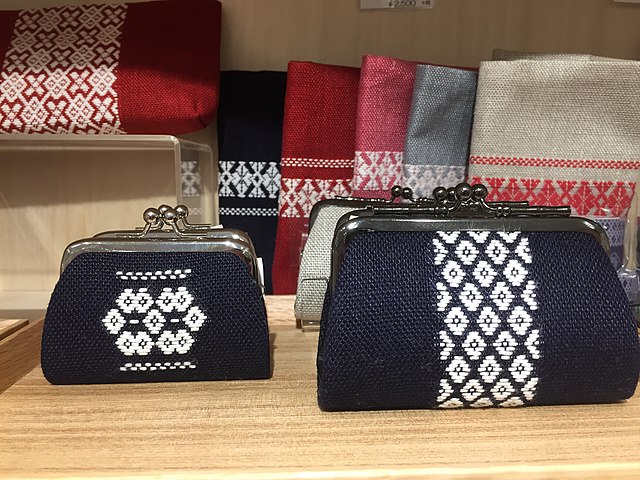
Boro, also known to many as ‘Japanese patchwork’, utilises scraps of fabric and sashiko stitching. It may be trendy enough now but in the past it too was done because the rural poor simply couldn’t afford to waste fabric. Hitomezashi is a form of sashiko that creates smaller patterns than the larger designs you see in regular sashiko, with the stitches often being closer together than in regular sashiko and the stitching being done on a grid marked out on the ‘wrong’ side of the fabric. Kogin, like sashiko, employs a running stitch. It is stitched from side to side and stitches are counted to help form intricate patterns.
Today boro, hitomezashi, kogin and sashiko are becoming quite popular in different countries, with larger craft stores starting to stock sashiko supplies and an increasing amount of books and kits being made available online. The appeal seems to not only be due to the beautiful simplicity of these crafts but also a desire to waste less; concerns about the waste produced by the textile industry and a desire to extend the life of garments also seem to be playing a role, coming full circle back to the humble origins of boro and sashiko.
Many of the popular sashiko books and tutorials that are available in English contain tips on mending clothing. As a result of the Covid-19 pandemic and the cost of living crisis, many people may find it necessary or wish to become more thrifty – at least in the short term. Sashiko and boro allow one to be thrifty with style and the process of creating such simple stitches encourages reflection and relaxation. In fact, some people seem to enjoy using sashiko for slow stitching projects and as a form of mindfulness.
In the first weeks of 2021, some companies were already stocking products in the UK inspired by sashiko. Perhaps this decade will be one in which this simple form of stitching becomes even more appreciated and widespread.
Resources
If you’d like to give any of these crafts a go and want to know where you can source sashiko supplies and support a small business in the process, I’d recommend Japan Crafts.
Visit our In Stitches project page for free sashiko patterns, tutorials and more.
Fancy trying your hand at boro? Check out this excellent tutorial from the V&A:
V&A- Make Your Own: Japanese ‘Boro’ Bag:
https://www.vam.ac.uk/articles/make-your-own-japanese-boro-bag
Bonnie F. Abiko. Arimatsu Shibori: A Japanese Tradition of Indigo Dyeing (New York, 1995).
Susan Briscoe, The Ultimate Sashiko Sourcebook (Exeter, 2005).
Nicolas Cambridge, ‘Cherry-Picking Sartorial Identities in Cherry-Blossom Land: Uniforms and Uniformity in Japan’, Journal of Design History 24:2 (2011), pp. 171-186.
Jenny Wilding Cardon, Visible Mending: Artful Stitchery to Repair and Refresh Your Favourite Things (New York, 2018).
Katsuya Hirano, ‘Regulating Excess: The Cultural Politics of Consumption in Tokugawa Japan’, in Giorgio Riello and Ulinka Rublack (eds.), The Right to Dress: Sumptuary Laws in a Global Perspective, C.1200- 1800. (Cambridge, 2019), pp.435-460.
Tatsuichi Horikiri (author) and Rieko Wagoner (editor and translator), The Stories Clothes Tell: Voices of Working-Class Japan, (London, 2016).
Catherine Amoroso Leslie, Needlework Through History: An Encyclopaedia, (Westport, 2007).
Jessica Marquez, Make and Mend: Sashiko-Inspired Embroidery Projects to Customize and Repair Textiles and Decorate Your Home (New York, 2018).
Keiko Nitani, Kimono Design: An Introduction to Textiles and Patterns (New York, 2017).
Manami Okazaki, Japanese Mingei Folk Crafts: An Illustrated Guide to the Folk Arts and Artisans of Japan (Vermont, 2024).
Katrina Rodabaugh, Mending Matters: Stitch, Patch and Repair Your Favourite Denim & More (New York, 2018).
Hiromitsu Takano, Japanese Quilting (New York, 1993).
Elise K Tipton, Modern Japan: A Social and Political History (London, 2002).
Claire Wellesley-Smith, Slow Stitch: Mindful and Contemplative Textile Art (2015).
Constantine Namikos Vaporis, Voices of Early Modern Japan: Contemporary Accounts of Daily Life During the Age of the Shoguns (Oxford, 2012).


Where can I buy sashiko thread and needle. I’m from Singapore.
Hope to hear from you.
Joanne
LikeLike
Hello!
Apologies for the late reply!
We have had a look around for you and think you may be able to source some sashiko supplies on Etsy or Shopee Singapore.
Happy stitching!
Steph
LikeLike
Enjoyed the article immensely so have purchased the coasters thread and needles looking forward to starting once I have re read instructions a few times
LikeLike
Hello!
We’re so glad you enjoyed it and want to have a go at sashiko yourself!
Happy stitching!
Steph
LikeLike
This was so interesting! I believe that I will try this in the future. First I have to finish all of my needlepoint projects. Thank you so much.
LikeLike