
Have you ever caught a fleeting glimpse of beautiful green plumage and wondered what that was? Read all about the UK’s population of Ring-necked parakeets in Lucy’s love letter to these beautiful, adaptable creatures.
Now I wouldn’t particularly call myself a massive bird fan. I mean I guess I like them as much as the next person. But the presence of parakeets in our vicinity has got me pretty psyched. I didn’t believe it to be true until I saw one for myself. Psittacula krameri (I had to throw in their scientific name somewhere) is native to Asia and sub-Saharan Africa, yet here they are, thriving in Whitworth Park in Manchester.
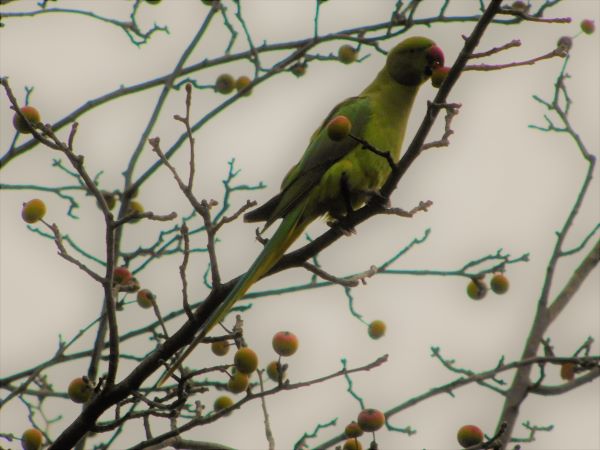
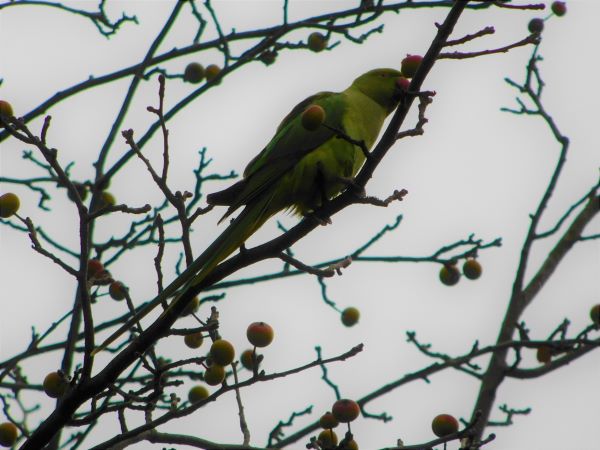
Working at Whitworth Art Gallery has provided me with a ringside seat in which to witness these pint-sized parrots in their, well, rather unnatural habitat. Even now as I sit with my laptop looking out to the gallery’s Art Garden, I have been treated to several sightings of these vivid, peridot green stunners. The season of Spring made them especially easy to spot when the trees were still half-bare and, like me, you may have thought to yourself how out of place they look with their gloriously green plumage piercing the backdrop of a grey British sky – well, that could be because they shouldn’t even be here. Commonly known as the Ring-necked (or Rose-ringed parakeets often used by orthinologists), which is in reference to the band around the male birds’ necks, both sexes possess the beautiful bright green plumage with a green-blue tail and a crimson hooked bill. Even the legs are greenish-grey in colour. The male differs from the female in that it has a noticeably longer tail and a distinct pink and black neck ring. He also has a blue nape. Juveniles look a lot like the females but are more yellow in hue and have a shorter tail.
Parakeet sightings have also been reported in nearby Fallowfield, Burnage, Didsbury and, nearer my neck of the woods, in Timperley. Clearly, they are a very adaptable species; they can adjust to urban environments and a climate most people would think too cold for them (the parakeets we have in the UK are thought to be a subspecies or possibly the result of the hybridisation of two subspecies which can be found in cooler areas, such as the foothills of the Himalayas.) They’ve even reached as far north as Glasgow and Edinburgh. London can boast a booming number of these tropical birds, in fact the capital city’s parakeet population is thriving to the extent that one could argue that you’re almost as likely to see a parakeet as you are a pigeon. Ok I might be exaggerating a little bit there, but I bet I’m not far off – I think it’s a nice thought at the very least. Colonies of these colourful characters can also be found in cities such as Birmingham, Nottingham and Sheffield. Parts of Wales have noted their presence too. Going back a decade or so, you wouldn’t have a chance of spotting a Ring-necked parakeet unless you lived in the South-East of England.
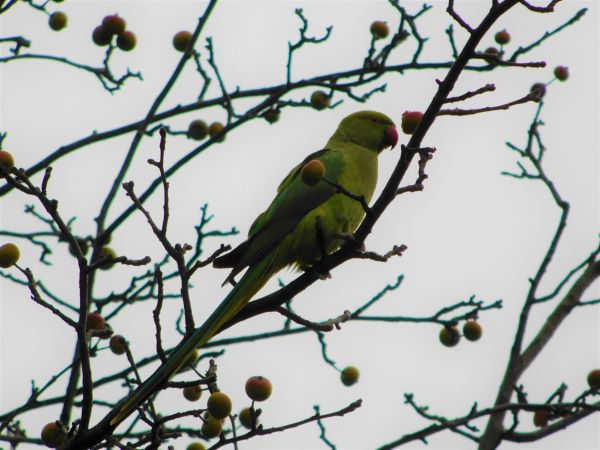
Their new UK home has made them the country’s only naturalised parrot and the most northerly breeding parrot in the world. So how has the United Kingdom come to have its own population of parakeets? There are more than a few theories, some rather fun and far-fetched- but I’ll get to those in a moment. Records of parakeets living wild in the UK date back to the mid-19th century, but it is only in the decade or two that the birds have been seen in significant numbers.
London is in fact linked to many of the theories regarding how our new feathered friends came to be here. One of the most popular tales involves legendary rock and blues guitarist Jimi Hendrix. So, what’s the deal? Well, the story is that he released his two pet parakeets in London’s Carnaby Street during the swinging sixties and these became the foundation stock of the population. Ok, not impossible- but it still seems a rather fantastical notion. Arguably more bizarre is the belief that burglars released Ring-necked parakeets from pop singer George Michael’s home during a break in. Hmm! I’m not so sure about that one either, nor am I convinced the reason for our parakeet population is down to a number of them being released at the African Queen movie wrap party, back in 1951 in Isleworth. Sounds like an amazing do, though. During that same year Humphrey Bogart and Katharine Hepburn visited the capital and some say the A-List couple are responsible for the UK’s influx of our newfound feathered friends. Each theory on their own seems extremely far-fetched, however when you consider it could be a consequence of some or all of them, well it seems way more plausible. That doesn’t mean to say we have the celebrities to thank, it could just as easily have been you or I releasing our own pet parakeets in to the wild (I haven’t, by the way!)
However these winged warriors came to be here, I for one am more than a little excited to be in the presence of parakeets. ‘Warriors’ seems apt when you contemplate how quickly they have adapted to our climate, and it seems they are fast becoming a dominant species of our British skies. Larger in size than many of our native birds and a bit nippy in nature, this has no doubt helped to secure their senior spot in the ranking. I imagine their screechy ear-splitting vocalisations, which can be heard all year round, must be a bit daunting too for our native birds- so it’s safe to say the Ring-necked parakeet has ruffled more than a few feathers.
There are worries and concerns over the potential impact of the species on native flora and fauna, as it’s possible they are out-competing local wildlife for food. Their diet consists of all sorts of seeds and fruit, flowers, and even tree bark, which is again, evidence of their adaptability. Our gardens no doubt provide the parakeets with further feeding opportunities. As a ‘bird-feeding’ nation how can it not? But it can’t just be well stocked bird feeders keeping them alive. With many Brits favouring exotic plant species in their outdoor spaces, it means the birds have even more variety on the menu. In my neighbourhood alone I’ve seen all kinds of hardy tropical greens, from varying species of palm trees to Japanese banana plants. I also hear parakeets are opportunistic feeders, so they’re no doubt muscling their way to the front of this free buffet.
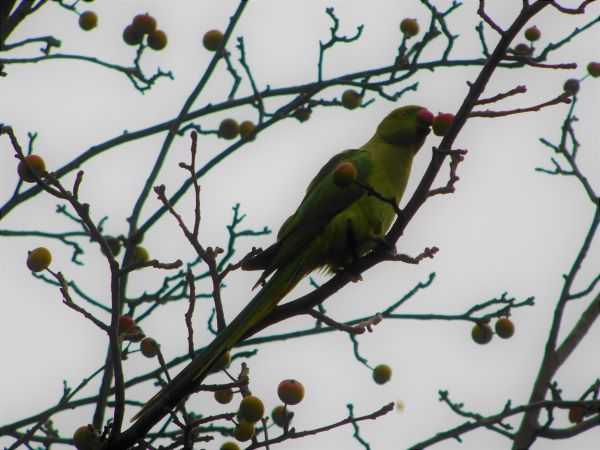
My husband and I are currently creating our own urban jungle in our back garden, and I’d love to think it’ll attract some parakeets our way soon. It seems promising as just the other day as I was walking down my street I glimpsed a bolt of brilliant green shooting across the sky, so it seems that the tropics have come to Timperley! Last week I went for a stroll in my local park when I heard the unmistakable screech of a parakeet. I found myself following the shrill trail of squawks until I pinpointed the tree it was perched on, though spotting them amongst the equally green foliage is anything but a walk in the park. The parakeets of Timperley seem far more elusive than those in Whitworth Park – newer residents perhaps and still getting acquainted with their surroundings? Who knows. I’ve also noticed they seem to favour residing on the higher sunbathed branches above the tree canopy, which again makes them trickier to spot.
Whilst gawping up into the sky I got into conversation with a gentleman walking his dog. “Were you the young lady who I saw admiring the trees yesterday?” “Yes that was probably me, but I wasn’t actually admiring the trees, I was admiring the parakeets.” “Oh…” He paused for a second, displaying a look of disappointment. I thought I had offended him. “They’re nothing but a blinking nuisance those blasted birds.” I didn’t ask what about them he was referring to, but I can only imagine he might’ve meant them muscling in on bird feeders and ‘stealing’ our native birds’ snacks. Or maybe they’ve been at his precious plants or fruit trees. Either way I wasn’t expecting such a negative remark so surprised at the man’s disapproval, I found myself backtracking and came back with a really lame response, “But just so you know I do admire the trees too!” He half-jokingly replied “Ah well that’s ok then, I’ll let you off.”
To be honest (up until that moment anyway) I believed us Brits to have a taste for the exotic, stemming from a constant yearning for warmer weather and beach holidays abroad – as a nation we seem to plan our lives around the summer. Given our temperate climate and the often miserably wet weather (though I’m mainly speaking for Manchester here) it should come as no surprise. One thing’s for sure though, you can’t please everyone.
But seriously though, there are concerns over how these beautiful birds may affect our eco-system, our native fauna for instance, as well as their potential impact on fruit-growers. As of yet, there haven’t been any major problems reported but it’s possible as their numbers increase this could change. I’m just hoping it won’t reach the stage where we have to resort to culling, that would be an awful shame. And I for one am happy they’re here (regardless of how our British birds feel – and the odd human too!)
Anyway, come Autumn I’m hoping our garden will be transformed into a tropical oasis and resemble something more befitting for a bunch of parakeets. In my mind I’m envisioning our own patch of jungle with my own personal flock – something tells me I might be getting a teeny-weeny bit carried away but basically if they want to set up shop in our back garden then I’m certainly not about to stop them as they definitely brighten up our British skies.
 A Place Between The Trees
I have just seen a parakeet flying past at my mother’s in Timperley on 21st December 2024 at 9.45am.
LikeLike