
Join Rebecca as she takes us on a reflective and vivid journey through Turner’s watercolour painting ‘Montanvert, Valley of Chamonix, France, Mont Blanc in the distance’.
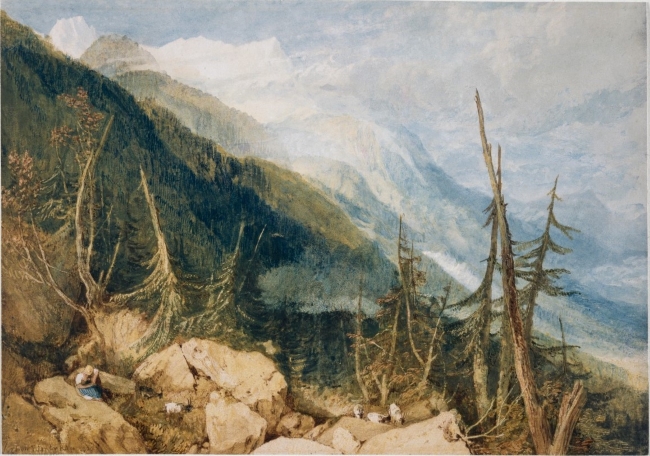
I stand before JMW Turner’s 1809 ‘Montanvert, Valley of Chamonix, France, Mont Blanc in the distance’. It’s a small-scale watercolour painting, barely bigger than A4 paper. A delicately atmospheric, yet astonishing landscape that really packs in the detail with an impressively realistic depiction of a wild and mountainous panorama of epic proportions. It may only be small, yet there is a sense one could step right into the frame. It’s quite a breath-catching visceral emotion as I am literally swallowed up by an expansively subliminal ‘Turner moment’.
I am reminded of childhood memories, buried deep, yet never forgotten; forays into similarly wild and expansive landscapes, a multitude of personal ‘Turner moments’; most notably a couple of late-Spring family road trips through the Alps enroute to Italy where I first encountered Michelangelo. Senses such as sound and smell and perception re-awakened in the recesses of memory. It is said that each geographical pinpoint on the earth’s hemisphere has an entirely different smell and ‘feel’ to it, in terms of the senses. I wonder then, how Turner’s Montanvert might feel, might smell? – if only one could quite literally step back in time to this time and place. To breath in the clean mountain air and smell the sweet alpine grass, to witness the striking aqua blue waterfalls spilling out of the melting Alpine glaciers? ~ how might this compare to 2025? Nowadays, Chamonix-Mont-Blanc (usually shortened to Chamonix) is a resort area renowned for its skiing, near the junction of France, Switzerland and Italy. At the base of Mont Blanc, it’s the highest summit in the Alps but step back into time again, circa 17thcentury, and this was a fashionably likely route wealthy young men might take on their Grand Tour, enroute to Italy.
Turner’s foreground depicts a bland and barren rocky outcrop; natural stone – the colour of dried river-mud. Its cracked and crazed pattern reveals how once mighty boulders have fallen due to avalanche and glacier migration, traversing from dizzy heights to lower climes, coming to rest in natural pockets together on broad mountain ledges. Now, boulders of varying size, nestle at awkward angles. Cradled between to the immediate left of the frame, it does seem likely, although difficult to make out that Turner painted a couple of people in an embrace. A shepherd in a white shirt with sleeves rolled up and a corn yellow straw hat, stands with his arms protectively around a shepherdess perched on the flat of the mountain ledge, wearing a Cornish blue and white striped smock over a crisp white short sleeved summer under dress or chemise. Their flock of black faced, white horned mountain goats, known for their sheer tenacity and sure-footed ability to climb near vertical rock faces and Alpine elevations – are oblivious to their fellow companions and contentedly graze nearby in small droves of two and three on the aridly scant and scrubby dry pastures that miraculously cling to this ledged and steep precipice.
Hugging the rocks, to the middle foreground, it is as if time has stood still, and I am reminded of a prehistoric time-scape. Seemingly half-dead European pine trees rise askew to one another, unkempt and broken – a stippling of khaki-green and taupe – in a ruggedly bedraggled and linear panorama. To the left of the line, this arid landscape is softened by a single beech tree that having retained only half its brittle and golden-brown winter leaves under the natural shelter of the sloped mountain side, looks oddly out of place next to these weathered and lightening battered alpine trees. Time has stood still for these trees and there is little growth left on them. Poor and un-majestic specimens, some branches cling on to life, resolutely green; still curiously handsome in their romantic, yet uninhabitable setting. These are the stragglers, clinging to the eroded mountainside in front of a densely deep, emerald-green pine forest that graces the mountainous middle ground, sweeping gentle slopes into the distance, far down into the Chamonix Valley and beyond to the hazy, grey-blue flecked remoteness of the Montanvert Glaciers.
My eye is suddenly drawn to the compositional frame, a subtly clever diagonal split right across the landscape from top left to bottom right. Turners’ happy knack for light and shade. Ruskin once said of Turner, “he paints in colour, but thinks in light and shade.” While the left, dark half houses the foreground and middle ground, as described, the whole of the right-side – the light – houses
Montanvert. The alps in their splendid entirety – one might imagine, recede far away, under a pale, shimmering sky flecked with scudding cotton white clouds, simultaneously broken and re-merging. Glimmers of lazuline sky threaten to break through, only to be banished by newly darkening storm clouds moving in fast, almost central to the frame, high above the mountains. Here is a vast and graceful silver-blue mountain range – impressive in its perfectly painted realism. Working from left to right I see spectacular pure snowy tips, treacherous gradients and compacted arctic-white glaciers dipping far down into opalescent greenery – the deep Chamonix Valley, paling kilometres into the distance; completely uninhabited and acutely romantic in its wilderness, just tipping through drifting pockets of dense white mist. Turner’s sublimely atmospheric topographical realism is proof of the past, yet to be touched by the Industrial Revolution and the inevitable slide to climate change.
– Rebecca
 A Place Between The Trees
Fabulous description and detail. Must re-look at this again when next in.
LikeLiked by 1 person