
Examine the finer details on an ornate Edo period bed cover held in the Whitworth’s collection, and enjoy a short history of the yogi, with Steph.
At a Glance
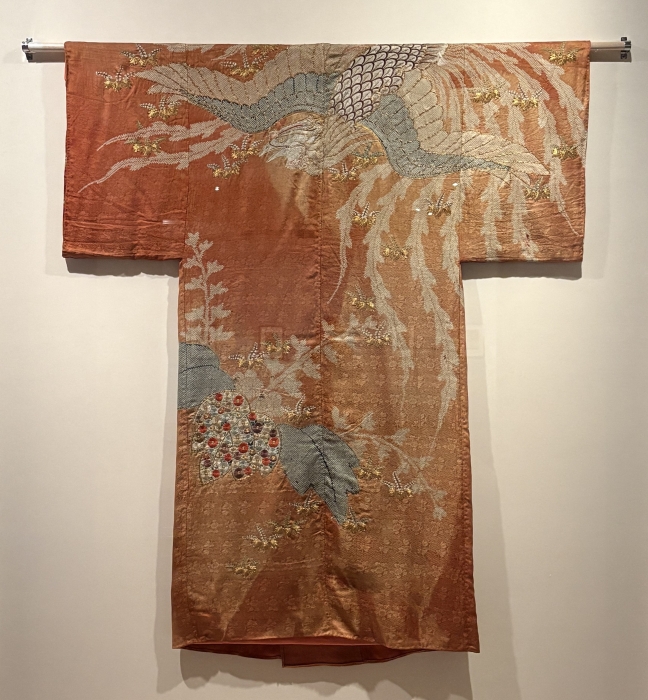
The beautiful embroidery on what, to my surprise, turned out to be a yogi and not a kimono (as it was termed on our collection search) in the Whitworth’s Beneath the Great Wave: Hokusai and Hiroshige exhibition immediately caught my attention when the piece was unveiled. Believed to have been created at some point during the 18th century, it was constructed during Japan’s Edo period (also known as the Tokugawa period). This was a time of relative peace for Japan, especially compared to the Sengoku Jidai period, so many arts and crafts flourished. Kabuki theatre, katagami, sashiko, shibori dyeing, and ukiyo-e are just some of the art forms and crafts to have enjoyed popularity during this period. Some of them, like shibori, pre-date the Edo period but were developed further during this time.
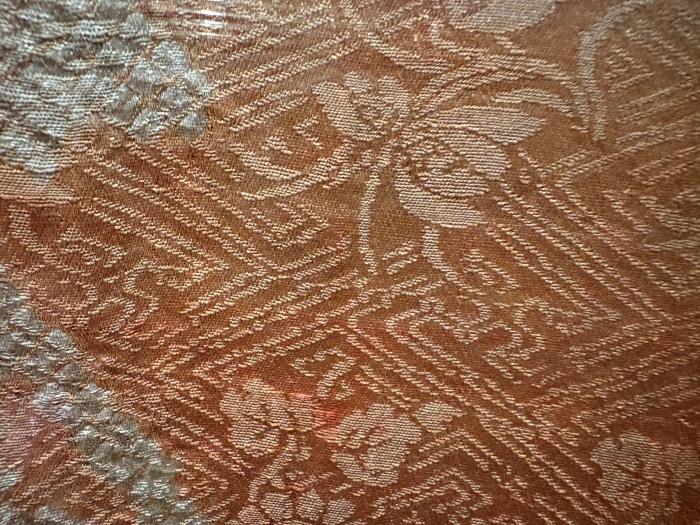
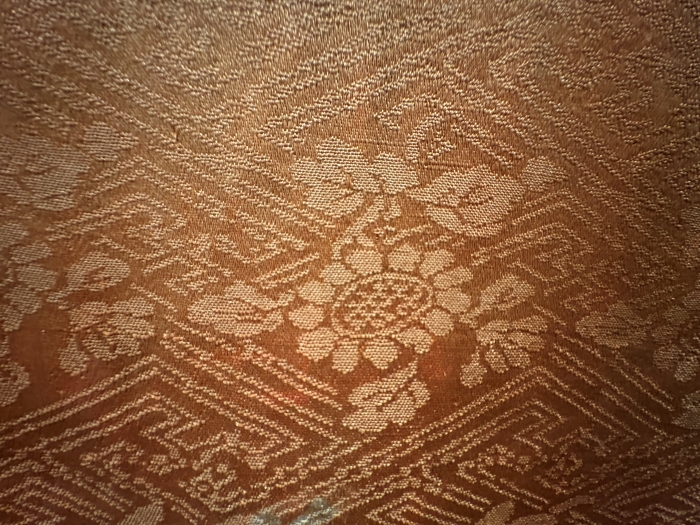
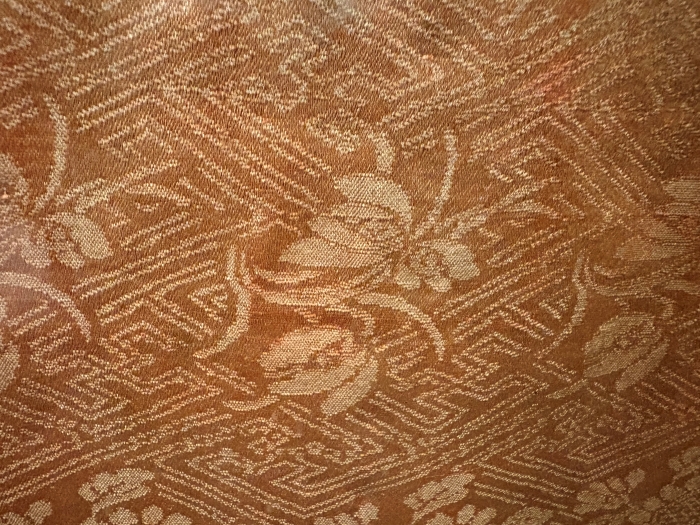
A yogi is a type of bed cover made in the shape of a garment, with sleeves and an opening for the neck and head. I have also seen yogi referred to as kaimaki in some publications, including the Ministry of Commerce and Industry Notification No. 58 published in the English edition of the Official Gazette in September 1947, but I am not sure exactly when the use of the word ‘kaimaki’ began and when the usage of ‘yogi’ and ‘kaimaki’ appears to have become somewhat interchangeable for some authors. Some publications refer to the thicker bedcovers in the shape of a garment specifically as kaimaki. If you can offer any clarification on this matter, please let me know in the comments. The yogi this post is concerned with is made of an orange silk damask bearing a pattern of flowers and what appear to be a sort of lattice pattern at first glance, but upon closer examination the lines are revealed to be interlocking Buddhist swastikas. The interlocking swastika pattern is known as sayagata. Yogi can be found in a variety of colours and have been decorated with various motifs.
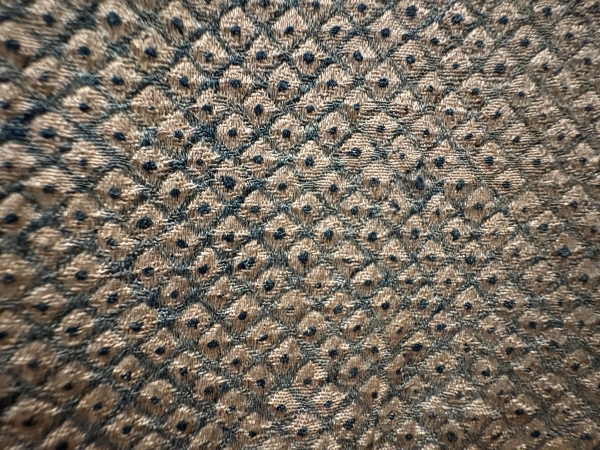
Some areas of our yogi have been dyed using shibori (a form of tie dyeing), leaving behind dots of a shape I think are reminiscent of Kyo Kanoko shibori, which results in a pattern of small diamond-shaped dots meant to represent the spots on a fawn’s back. [1]
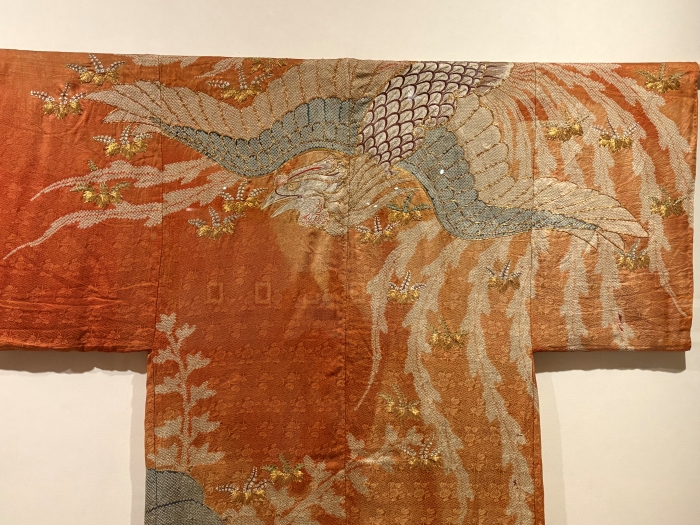
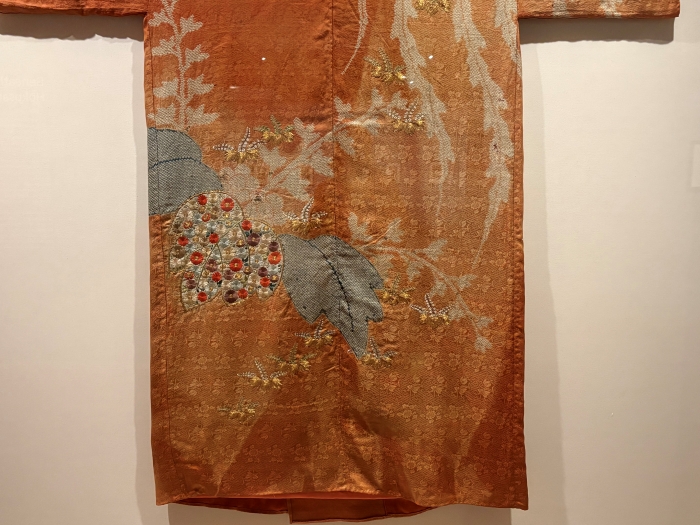
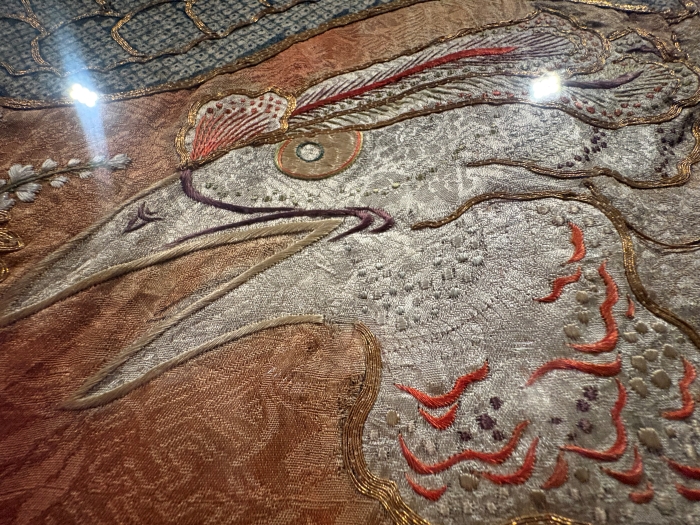
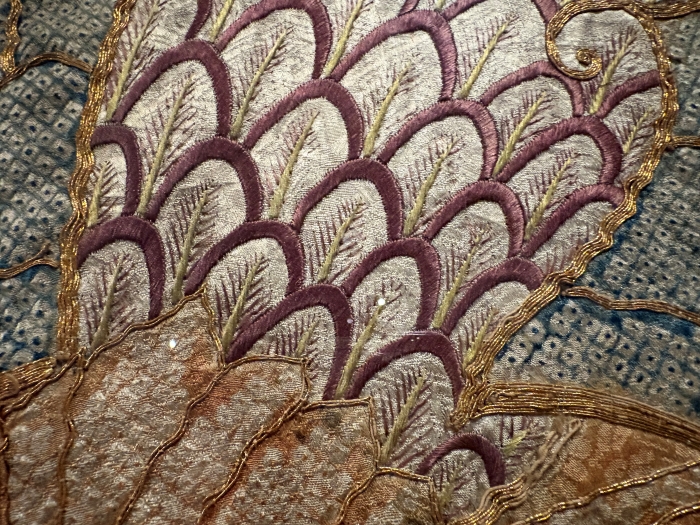
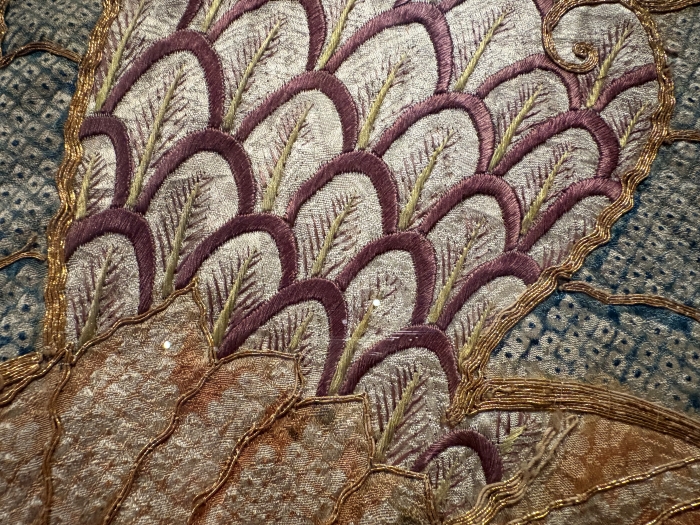
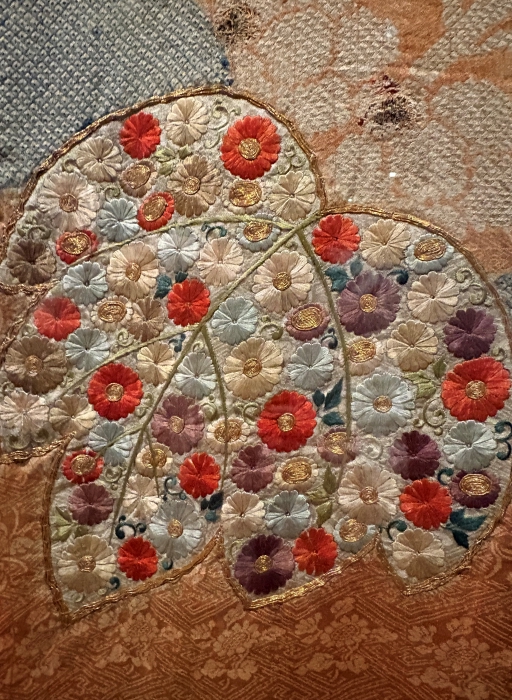
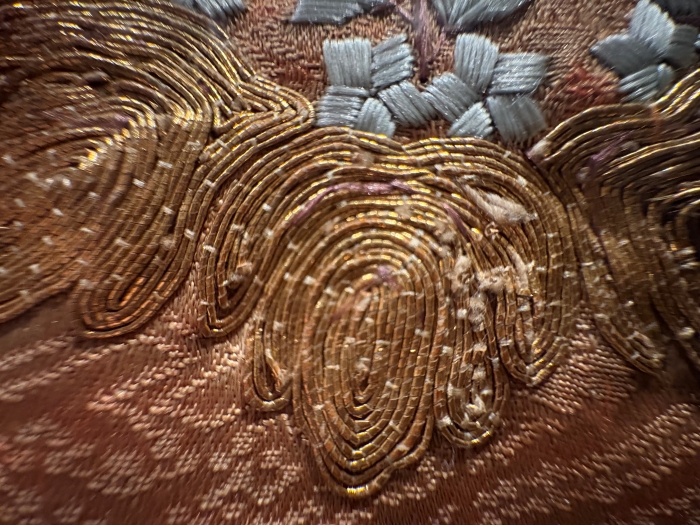
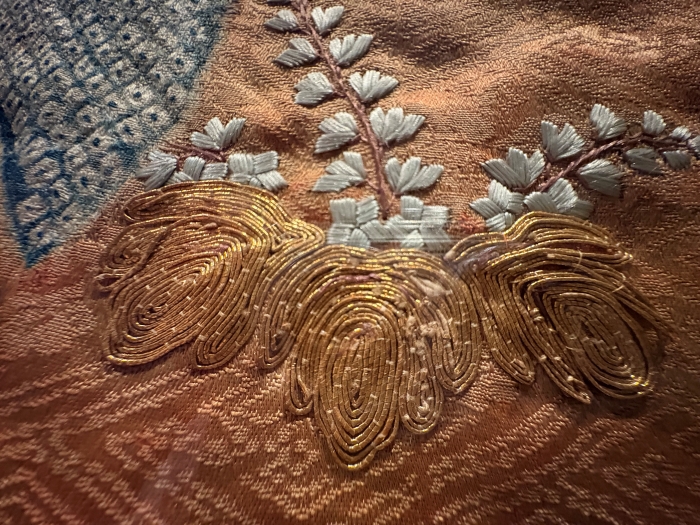
Tiny shibori dots trail along parts of the yogi to form the tail feathers and outer wing feathers of a phoenix, which trails across the upper back and down the sleeves. Shibori dots also create the flowers and two of the leaves of a large paulownia motif on the left-hand side of the yogi. The central leaf of the large paulownia motif has been outlined with couching in a gold-coloured metal thread, and the leaf has been filled with small, embroidered chrysanthemums. Elsewhere, the yogi has been embroidered with smaller motifs of paulownia leaves and flowers. These smaller motifs can also be glimpsed on what little of the front of the yogi is visible in its case in Gallery 4. Unfortunately, I have no clear photos of the front of the yogi to refer to, so this post is concerned with what is currently visible to visitors (the back) in the Beneath the Great Wave: Hokusai and Hiroshige exhibition, which is on display at the Whitworth until 15 November 2026.
A Brief History of Yogi
Most of the sources of information I have found regarding the yogi, when they discuss the origins of this kind of bedcover, explain its peculiar shape as a throwback to people layering clothing over themselves at night to keep warm. Whether the yogi as a concept truly was first created during the Edo period or if this kind of textile actually pre-dates it, like many aspects of what we now view as traditional Japanese material culture it seems to have enjoyed an increase in popularity during the Edo period. Most of the examples of yogi I have been able to find in other collections seem to date from the Edo (1603/1615-1868) and Meiji periods (1868-1912).
Our yogi is composed of pieces of narrow, rectangular pieces of fabric. The relatively narrow width of the silk fabric panels is typical of how bolts of silk cloth or tanmono (bolts of silk fabric for kimono) and other traditional forms of dress in Japan are produced due to the width of the looms that were traditionally used. This yogi is 1549mm in width at the widest point and 1701mm according to the Whitworth’s records on our collection search. I have measured the width of the individual fabric panels as best I can whilst it is on display inside its case and the two panels which form the back of the yogi measure roughly 15 inches or 381mm in width, which is similar to the usual width measurement of tanmono. The construction of a kimono was designed to minimise any fabric waste. [2] Yogi, however, were apparently often made wider than some kimono so that they could cover more than one person, I suspect this was achieved through the addition of extra panels (which is how it would have been done with some types of kimono). [3] These bedcovers could also be ‘worn’ to bed as they typically have an opening for the head and neck like a kimono. [4]
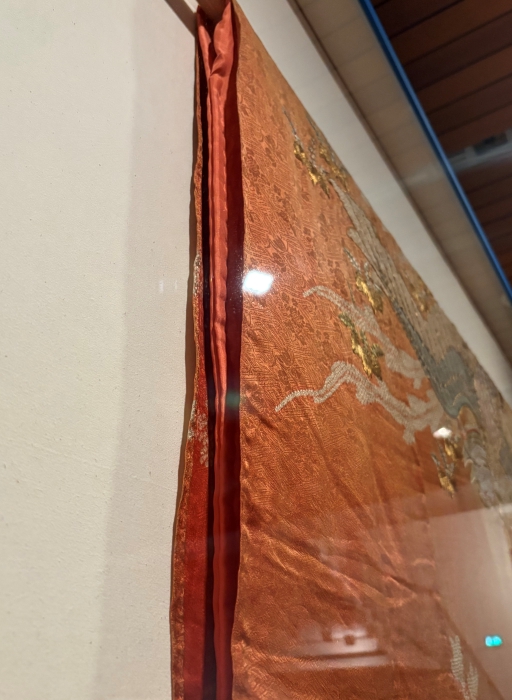
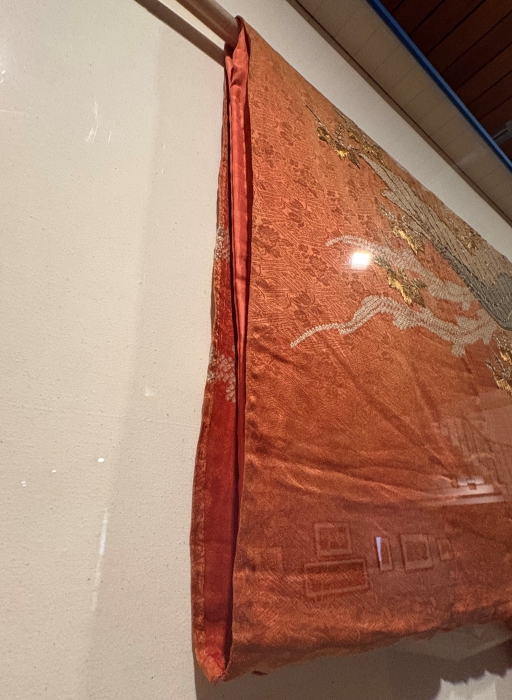
According to Mary M. Dusenbury, many yogi held in Western collections have ‘had their padding and linings removed’ because this makes them ‘heavy and cumbersome’. [5] Ours, however, has what appears to be a separate, inner padded inner layer to help insulate whoever was using this bedcover against cold nights. Other examples of yogi I have found appear to be constructed with no separate inner layer but are instead heavily padded kimono-shaped objects resembling a novelty shaped quilt. The padding in a yogi tends to consist of cotton, the cultivation of which began during the late 16th century in Japan with this fibre eventually becoming available to more people in the 18th century. Prior to cotton becoming more readily available in Japan, hemp was the fibre of choice for the clothing of those who were lower down in the class system.
Bearing in mind that some parts of Japan are much colder than others, perhaps some of the more heavily padded yogi or kaimaki were created with a more northerly climate in mind or for use later in the year. The inner layer of our yogi does not appear to be particularly thick, so perhaps it originated from an area of Japan with a milder climate or was intended for use before the coldest time of the year. There is also the possibility that our yogi was perhaps intended more for a display of wealth or for celebration than for function. As the Edo period went on, the yogi became an object which was often included as part of a woman’s wedding trousseau, with many of the yogi produced for weddings having been ‘decorated with auspicious motifs’ such as phoenixes and paulownia trees and displayed during a bridal procession ‘from the bride’s house to the groom’s’, then used during the first few nights of a marriage before finally being stored away and only being brought out ‘on special occasions’. [6]
Sumptuary laws during the Edo period did, in theory at least, dictate what a person could wear and the goods they could consume, with certain colours and kinds of cloth being subject to such restrictions. Such legislation, however, was not always actively enforced and might prove difficult to enforce- so just because a merchant wasn’t supposed to have a lavishly decorated home or dress in a certain way according to the bakufu, this did not mean that wealthy merchants did not enjoy various luxury goods.
Deconstructing Our Yogi
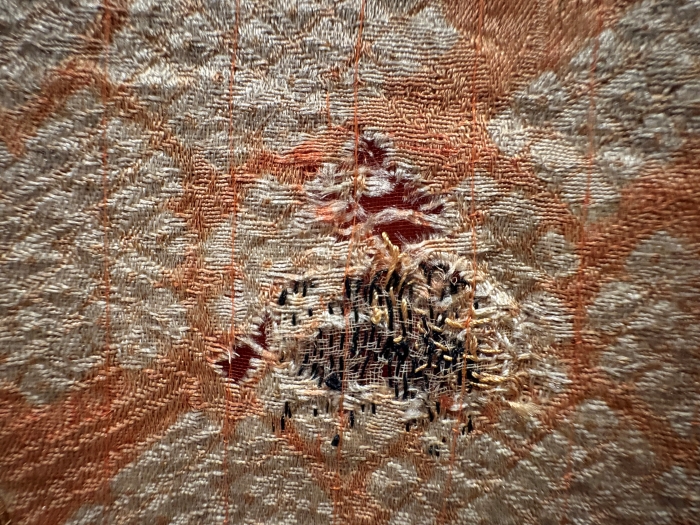
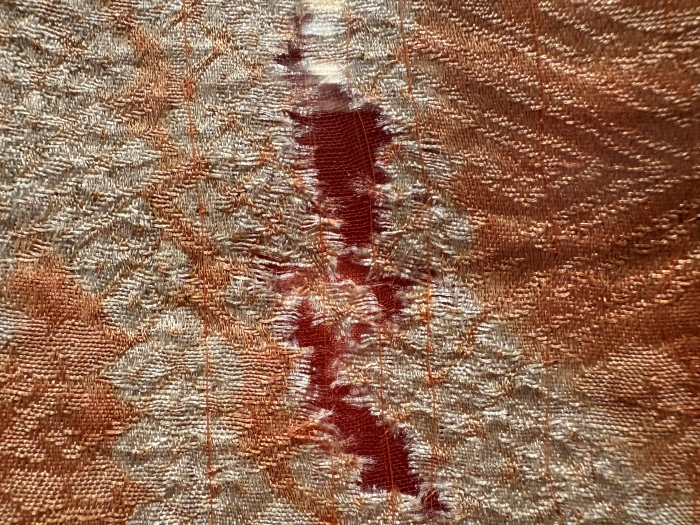
The yogi in the Whitworth’s collection shows signs of wear, possible fading and perhaps attempts at repairs in some places but it appears to be in otherwise good condition for its age. The condition of the object potentially highlights how such pieces were carefully looked after and passed down through generations and/ or that this yogi could have been produced for a ceremonial purpose and saw little practical usage. Its provenance, however, is untraced. We cannot be sure of who owned the piece at various points in the life of the object as a result, but the shibori dyeing and embroidery can give us clues as to the probable wealth of whoever may have originally owned it.
The shibori dyeing and embroidery, known as shishu in Japan, would have taken a lot of time, and both processes would have required the labour of skilled artisans. The amount of time and labour required to produce such beauty points towards the original owner perhaps being a person of wealth. This could perhaps have been someone from a well-off merchant family or someone from a samurai family that had managed to fare better than some other samurai families during this period. If any of you happen to be experts on Japanese textiles from the Edo period, then let me know what you think in the comments.
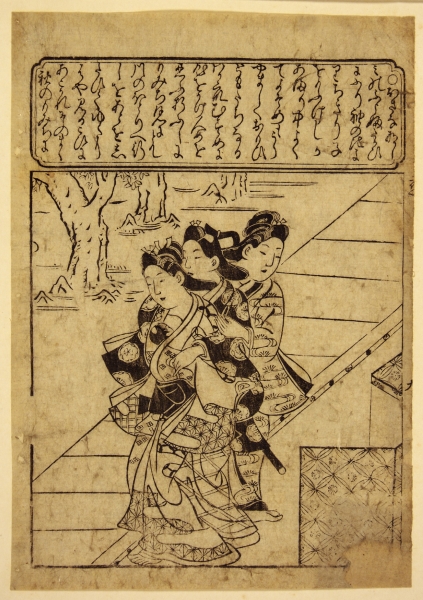
Hishikawa Moronobu (1618-1694), Types of Women: Three Ladies woodblock print from the book Sources of Love, c.1680. Accession number: P.5702.1 Source: the Whitworth. This print is also currently on display in the Whitworth’s Beneath the Great Wave: Hokusai and Hiroshige exhibition, which ends on 15 November 2026.
Slightly off topic but as an interesting aside, the father of ukiyo-e artist Hishikawa Moronobu (1618-1694) was an embroiderer. The artist’s first designs were for embroideries, not book illustrations or single sheet prints.
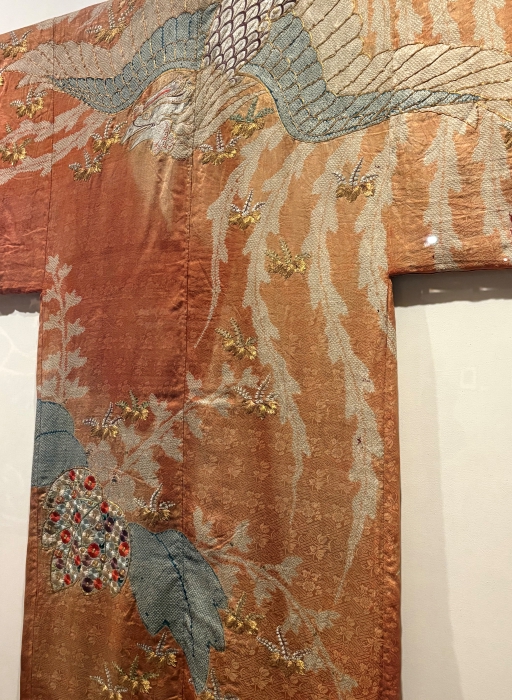
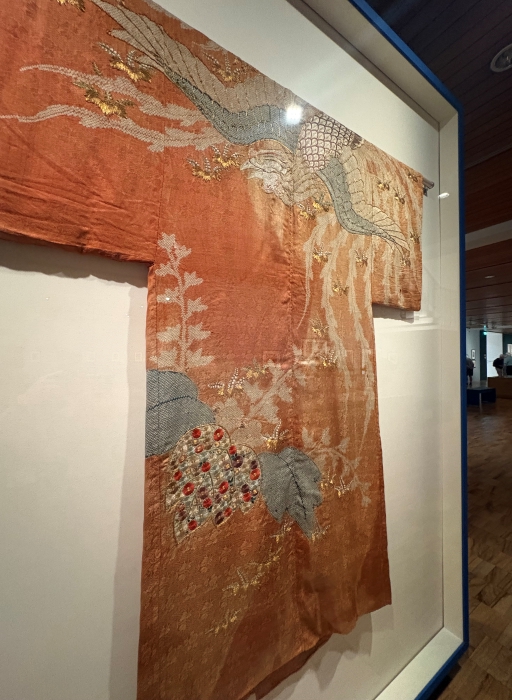
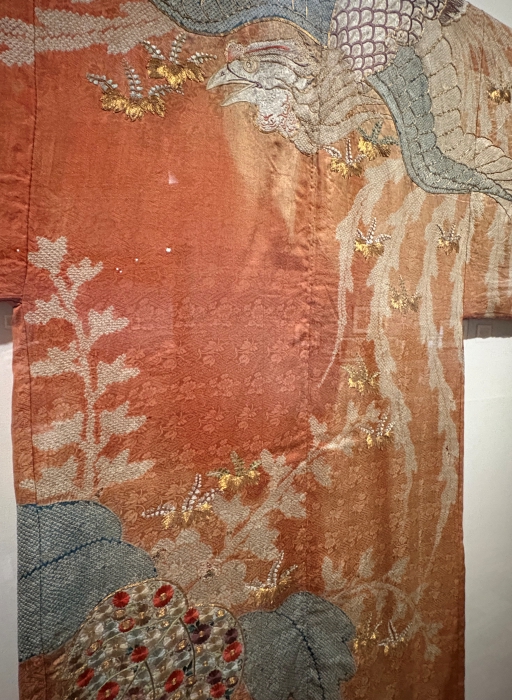
As our yogi has been dated to the 18th century, the beautiful orange colour (if this is indeed the original colour) would have been achieved using natural pigments, as many synthetic dyes were not created until the 19th century. Prussian blue, one of the first synthetic pigments, was not introduced to Japan until the late 18th century. A variety of natural pigments used for various purposes were available during the Edo period, with some being more expensive than others. Beni, a vermillion red derived from safflower, could be used to turn textiles orange (including a vivid orange like our yogi) or red. Its use was restricted for a while, at least in theory, by the bakufu during the Edo period despite the popularity of red garments for weddings but nevertheless the demand for this dye did not cease and people of lower social classes still found ways to enjoy this kind of red which circumvented the restrictions. [7] Some natural pigments are more prone to fading than others, with beni on its own being prone to fading.
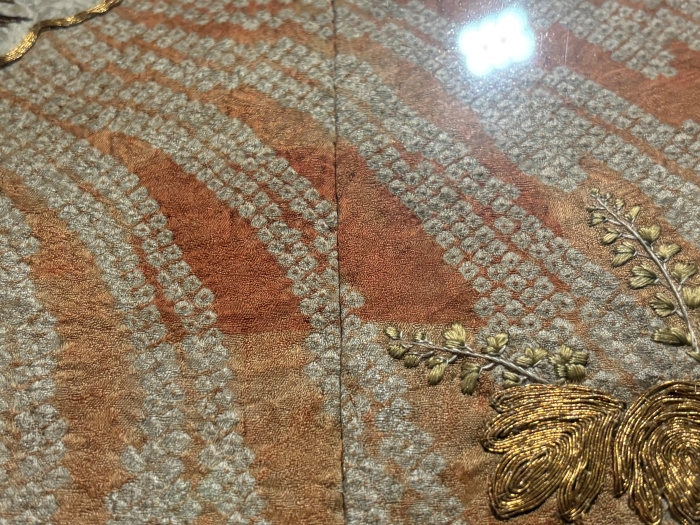
Parts of our yogi are more of a vivid orange colour than others, but I do not know if this is due to light exposure over time or something else. The rectangular area pictured above, one of darker orange positioned across the seam connecting one of the sleeves to the rest of the yogi and surrounded by lighter orange was particularly interesting to me. Was a label once placed there, which somehow protected that part from light exposure, or did something else happen?
I find myself being left with more questions than answers when it comes to this yogi. Were the more decorative elements of shibori and embroidery later additions due to an increase in the fortunes of the family that originally had the yogi in their possession? Was the piece deconstructed and these decorative elements added much later than its initial construction? Was it taken apart and sewn back together for some other purpose? Or was all the embroidery and shibori done prior to the construction of the yogi? Was this object always so ornate from the beginning of its life as a bed cover?
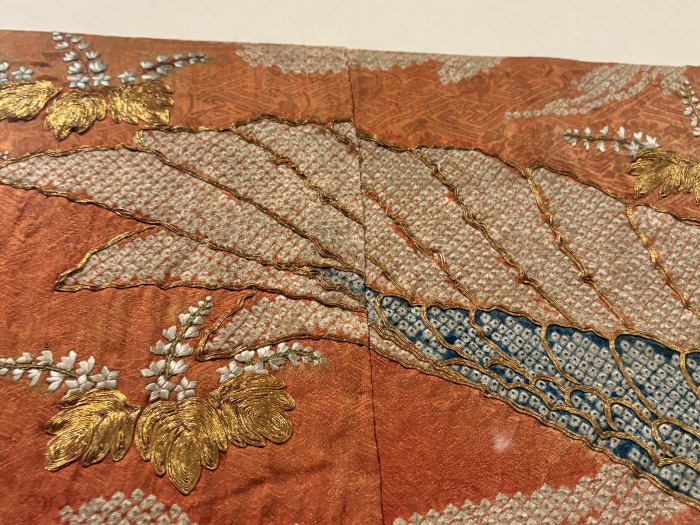
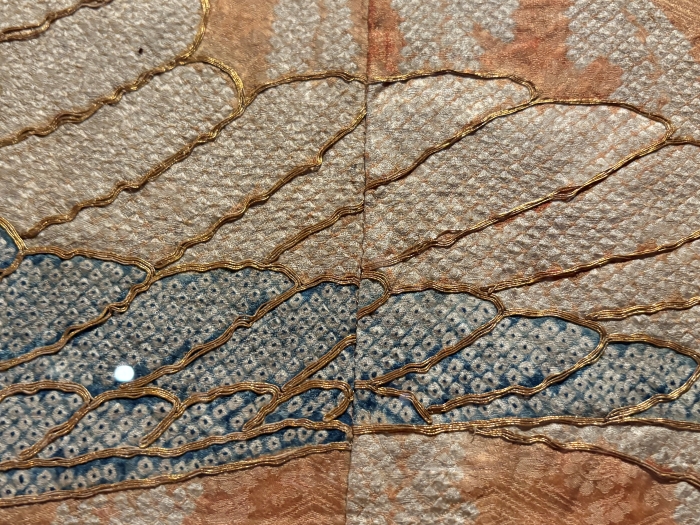
The embroidery and the shibori on some of the outer wing feathers don’t quite seem to line up exactly in some areas around the seams. Parts of the embroidery appear to disappear in between the seams, so perhaps the yogi was taken apart to be embroidered or taken apart for some other purpose and then sewn back together sometime after the phoenix had been embroidered. Or perhaps the fabric was embroidered prior to the construction of the yogi and whoever embroidered the fabric panels simply didn’t account for a seam margin very well (if at all).
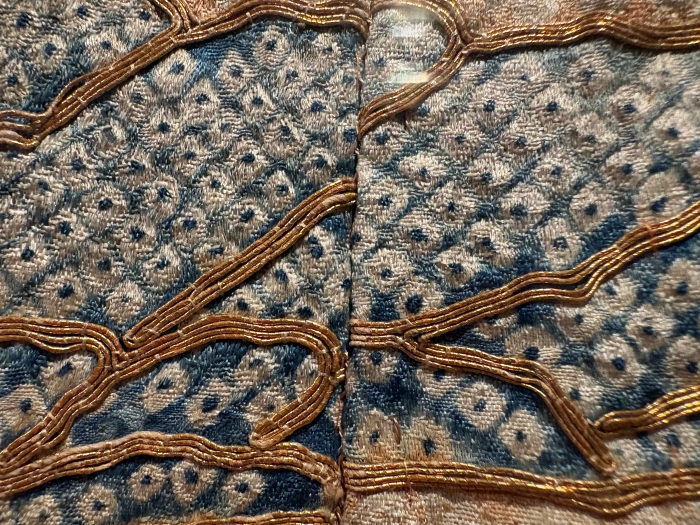
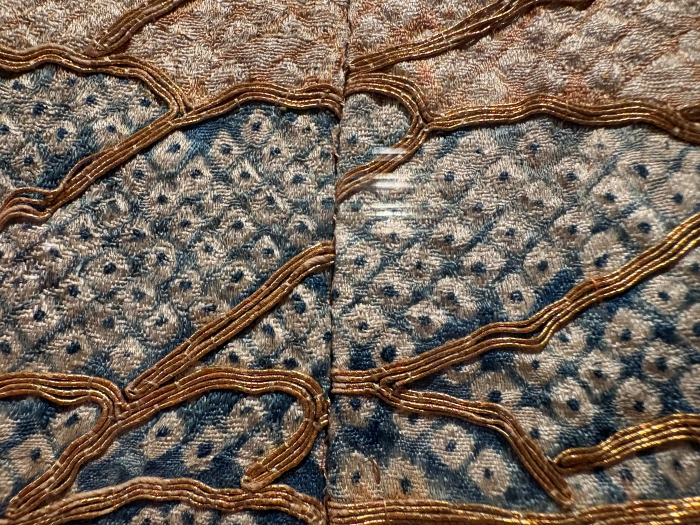
I suspect that the shibori dyeing was done prior to the panels being sewn together (or back together?) to form the yogi, with the embroidery being completed sometime after the shibori dyeing had been carried out. The central stem of one of the smaller embroidered paulownia motifs has been embroidered in such a way that, rather forming than one continuous stem, there is a gap to make way for part of the tail of the phoenix. Similar gaps in the embroidery, which make way for shibori details, can be found on some other parts of the yogi. This is one of the reasons I believe the embroidery was done after the shibori. We know that kimono could be and were taken apart and reconstructed again, so perhaps this really was done with our yogi at some point. [8] However, I am not an expert in garment construction or textiles more generally and could be completely wrong. If you have any ideas about the how any of these processes may have been carried out, do let me know in the comments.
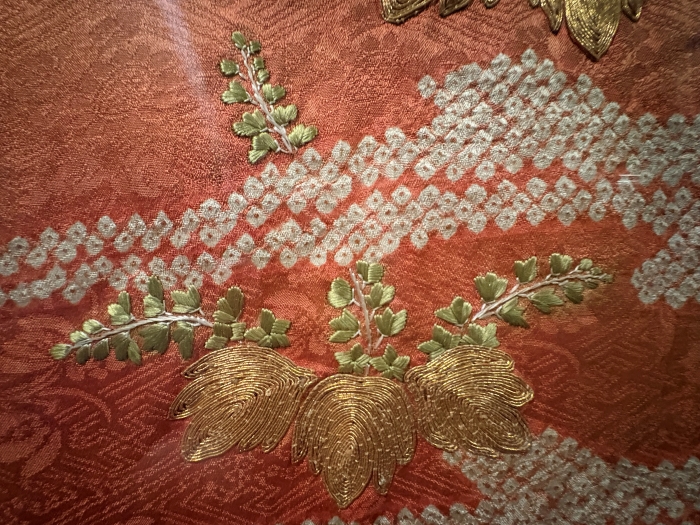
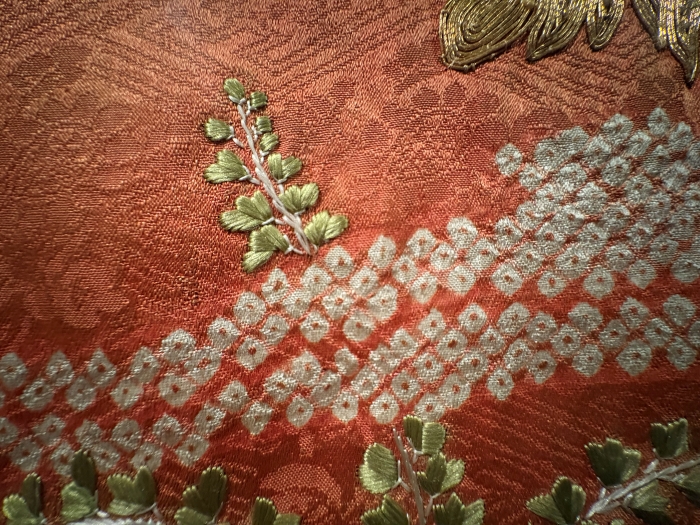
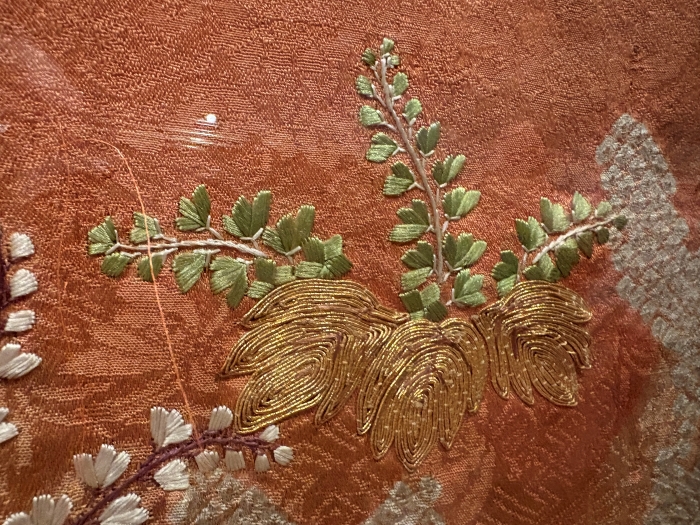
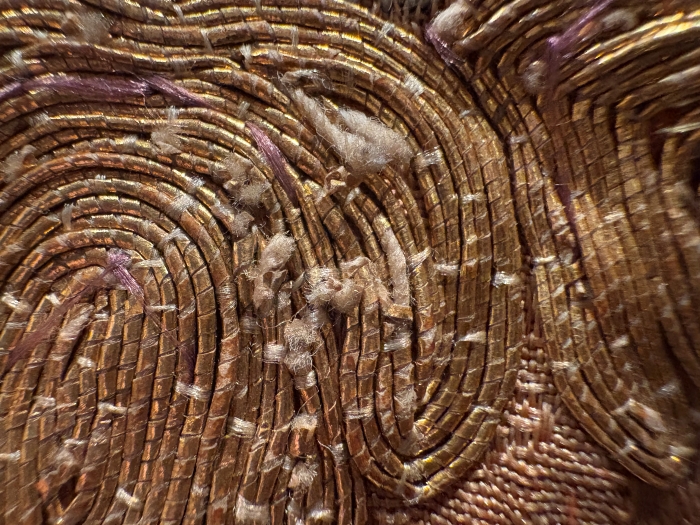
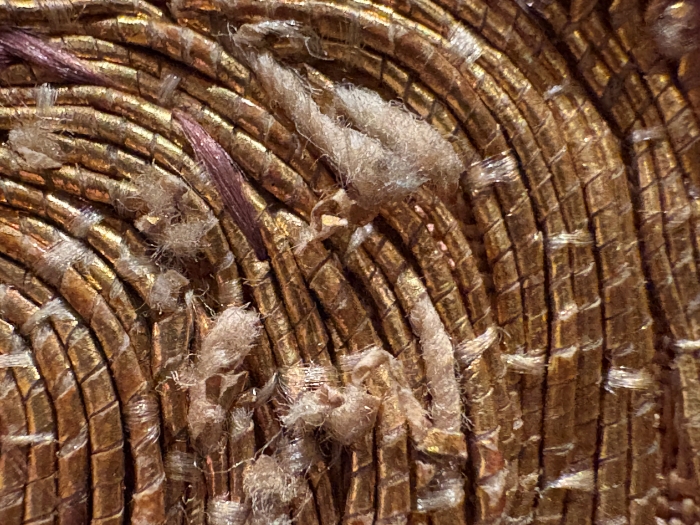
If we look closely at the couched metal embroidery, we can see areas on some of the small paulownia motifs where whatever metal was used seems to have unravelled from around a central thread.
As for the meaning of the motifs present on the yogi; the phoenix and the paulownia were thought to be closely associated, as the phoenix was thought to dwell or perch in paulownia trees. [9] The paulownia or foxglove tree, as it is sometimes known, was associated with the imperial family and later with Toyotomi Hideyoshi (1537 – 1598) and the rest of the Toyotomi clan. [10] Following the Meiji Restoration, a paulownia crest was later used as a symbol of the new government, and such crests are still used by various branches of government and by the Japanese prime minister today. During the Edo period the paulownia motif seems to have become even more popular, as appreciation for this symbol filtered down to other classes. [11]
Paulownia trees typically bloom in spring, whereas chrysanthemums are flowers of autumn. Despite the difference in blooming seasons, however, the two flowers have frequently been used in combination together as decoration on Japanese objects due to both being seen as auspicious flowers, with both plants also having been associated with the imperial family. [12] The chrysanthemum is also associated with longevity, and chrysanthemum cultivation appears to have been a popular horticultural past time for some during the Edo period, with new varieties having been developed then. [13]. The chrysanthemum can be found on Japanese passports and on coinage, having been adopted more broadly as a national symbol. Paulownia wood is used to create various items of furniture and to create boxes for the storage of sewing tools such as needles, as it is quite resistant to humidity and moisture.
The legislation surrounding divorce in Edo period Japan meant that a man had the right to divorce his wife and, upon divorce, her dowry had to be returned to her family. [14] Presumably this may have included any yogi she took with her to her marital home, as a dowry could consist of both goods and money. I quite like the idea of a woman being able to reclaim such a beautiful object if her marriage didn’t work out, although perhaps I am affording this imaginary woman with more agency than she may have really had in such a situation. Divorce in Edo period Japan doesn’t seem to have been associated with the same kind of embarrassment and stigma as annulment did in early modern England. Husbands, however, appear to have had more control over the initiation of a divorce than their wives, who might have to appeal to a Buddhist temple to intervene on their behalf and negotiate the end of a marriage. [15]
Now back to beautiful things. Much of the embroidery on our yogi seems to be comprised of couching, stem stitch, satin stitch and what I think is fly stitch in some places at the base of the paulownia flowers. I decided to try to recreate one of the embroidered paulownia motifs, as these seem to be comprised of all four types of stitch. The stems of the flowers are, unsurprisingly, stitched with I believe to be stem stitch. The flowers, which vary from a thread which appears off-white or ecru in colour on some of the paulownia motifs to a bright green on others, seem to be comprised of satin stitch. The paulownia leaves themselves have been formed using a metal thread and appear to have been created via couching.
See below for short explanations of the embroidery stitches I have mentioned above:
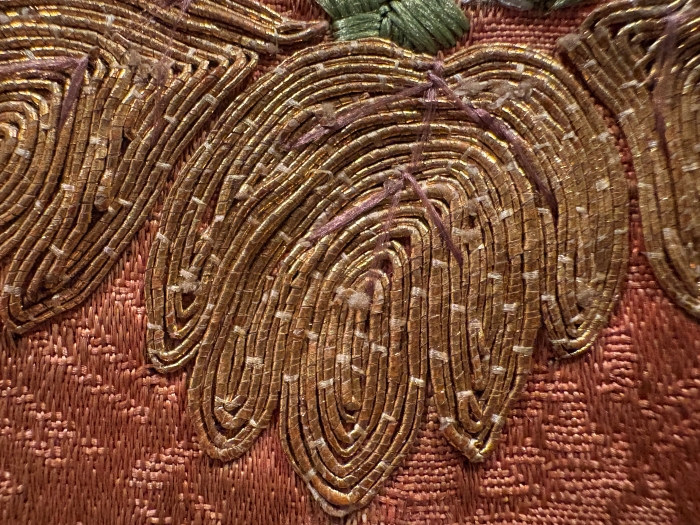
Couching is useful for building texture. A thicker thread is used to create a pattern on the surface of the fabric and is held in place by multiple horizontal stitches made in a thinner thread over the thicker thread. This technique is particularly useful when you are dealing with a thread that is quite thick and don’t want to repeatedly bring it through the fabric, as it prevents you from causing a lot of damage to the fabric by creating many large holes close together. Couching has been used for a long time and across many different cultures. According to the Royal School of Needlework’s StitchBank, is believed that the use of couching in Japan goes back to the Muromachi Period (1338-1573). [16] On the yogi in the Whitworth’s collection, couching has been used to create the small paulownia leaves. Two strands of metal thread have been couched over with each horizontal stitch to form the leaves. Couching was also used to form the centre of some of the embroidered chrysanthemums on our yogi.
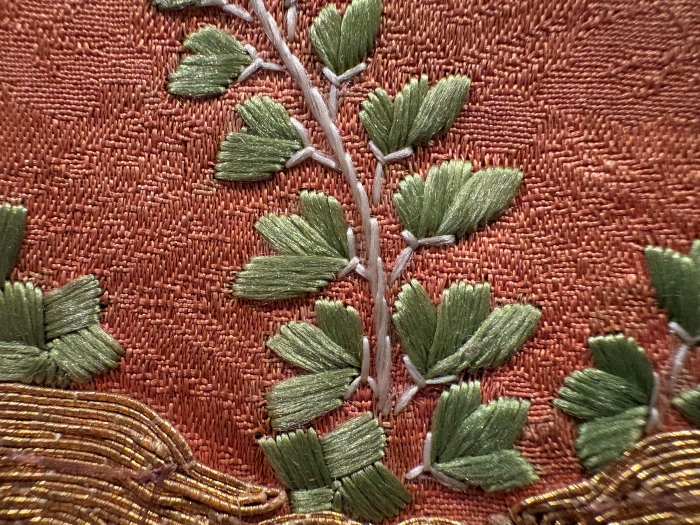
Fly stitch is a straight stitch which is made into a ‘V’ shape by another stitch pulling at the centre of the first stitch. The first stitch isn’t pulled taut right away, allowing you to bring your needle up through the back of your fabric, near the centre of the first stitch, and then over the top of the first stitch before going back down into your fabric and pulling the centre of the first stitch into a rough ‘V’ shape as you do. Once the second stitch has been pulled taut, it will pull the first stitch into a proper ‘V’ shape. The completed fly stitch resembles a ‘Y’ shape. On the yogi in the Whitworth’s collection, fly stitch or something like it seems to have been used to create the thinner, individual stems which attach the paulownia flowers to the main stems.
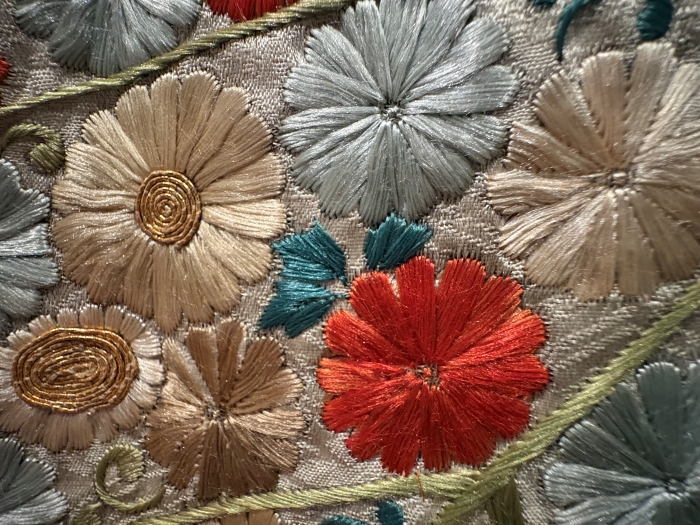
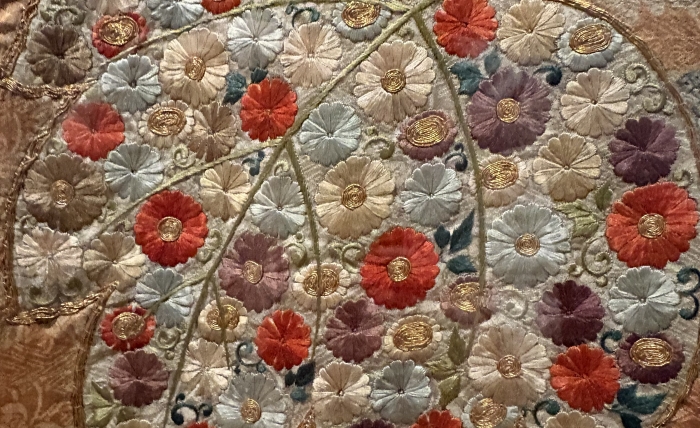
Satin stitch is a series of straight stitches next to each other and close together, used to fill an area with colour. On the yogi in the Whitworth’s collection, I think it has been used to stitch the paulownia flowers in green (for some of the paulownia motifs) and in what appears to be an off-white or light grey colour, which seems to have a blue tinge sometimes under the gallery lights, for other paulownia motifs. Satin stitch has also been used for the chrysanthemum petals. I’m not sure if some of the silk embroidery threads used for the paulownia motifs have lost their original colour over time.
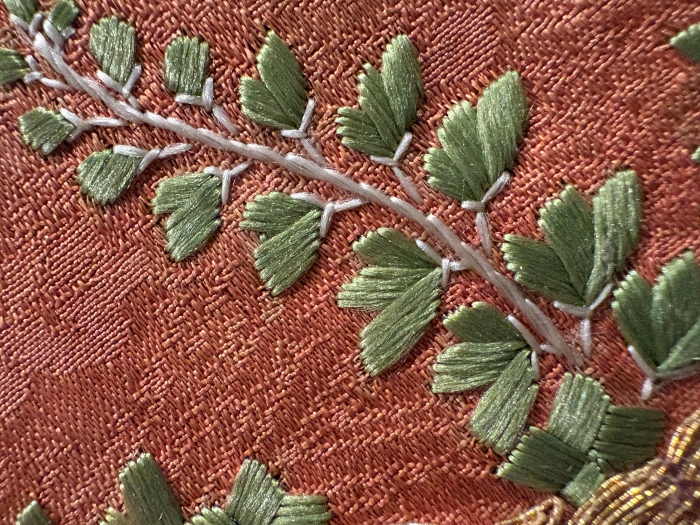
Stem stitch is a series of tightly packed stitches in the same direction which can be used to create curving lines and give an embroidery more texture. It is often used to stitch stems and vines, and I believe it has been used to create the thicker paulownia stems on the yogi in the Whitworth’s collection.
I hope you have enjoyed this deep dive into the various details on this beautiful Edo period bed cover. I am currently attempting to embroider one of the paulownia motifs on a larger scale to better understand how some of the embroidery on the yogi was done. If this proves successful, I will upload a free embroidery pattern and tutorial. If you have any thoughts or theories as to how the yogi was constructed or who you think could have owned it at some point, let me know in the comments! – Steph
References
[1] Jeanne Allen, The Designer’s Guide to Japanese Patterns 1 (London, 1988), pp. 78-79.
[2] Terry Satsuki Milhaupt, Kimono: A Modern History (London, 2014), pp. 21-22.
[3] Milhaupt, Kimono: A Modern History (London, 2014), p.21.
[4] Mary M. Dusenbury, Flowers, Dragons and Pine Trees: Asian Textiles in the Spencer Museum of Art (New York, 2004), pp.225-226.
[5] Dusenbury, Flowers, Dragons and Pine Trees: Asian Textiles in the Spencer Museum of Art (New York, 2004), p.227.
[6] Dusenbury, Flowers, Dragons and Pine Trees: Asian Textiles in the Spencer Museum of Art (New York, 2004), p.225.
[7] Petya Andreeva, ‘Redefining Edo Female Identity Through Iki Aesthetics in Undergarment textiles’ in Giovanna Motta and Antonello Biagini (editors), Fashion Through History: Costumes, Symbols, Communication Volume II (Cambridge, 2017), pp. 434-435.
[8] Milhaupt, Kimono: A Modern History (London, 2014), p.21.
[9] Dusenbury, Flowers, Dragons and Pine Trees: Asian Textiles in the Spencer Museum of Art (New York, 2004), p.227.
[10] Dusenbury, Flowers, Dragons and Pine Trees: Asian Textiles in the Spencer Museum of Art (New York, 2004), p.227.
[11] Dusenbury, Flowers, Dragons and Pine Trees: Asian Textiles in the Spencer Museum of Art (New York, 2004), p.227.
[12] Motoji Niwa (author) and Jay W. Thomas (translator), Snow, Wave, Pine: Traditional Patterns in Japanese Design (London, 2001), pp. 24-25.
[13] Noel Kingsbury, Garden Flora: The Natural and Cultural History of Plants in Your Garden (London, 2016), pp. 48-49.
[14] Constantine Nomikos Vaporis (editor and translator), Voices of Early Modern Japan: Contemporary Accounts of Daily life During the Age of the Shoguns (London, 2021), pp. 3-4.
[15] Agreement Regarding a Dowry (1815) in Constantine Nomikos Vaporis (editor and translator), Voices of Early Modern Japan: Contemporary Accounts of Daily life During the Age of the Shoguns (London, 2021), p. 4.
[16] Royal School of Needlework, StitchBank, Couching: https://rsnstitchbank.org/stitch/couching-stitch
Bibliography
Primary Sources
Agreement Regarding a Dowry (1815) in Constantine Nomikos Vaporis (editor and translator), Voices of Early Modern Japan: Contemporary Accounts of Daily life During the Age of the Shoguns (London, 2021), pp. 3-4.
Denchū Somei-Ōji Chrysanthemum culture guide, During the Kouka period (1844-1848), Tokyo Shiryō Collection https://www.library.metro.tokyo.lg.jp/portals/0/edo/tokyo_library/english/modal/index.html?d=5555
Excerpts from Prohibitions of 1645, in Constantine Nomikos Vaporis (editor and translator), Voices of Early Modern Japan: Contemporary Accounts of Daily life During the Age of the Shoguns (London, 2021), p. 31.
List of Prohibitions Concerning Clothing for Edo Townsmen (1719) in Constantine Nomikos Vaporis (editor and translator), Voices of Early Modern Japan: Contemporary Accounts of Daily life During the Age of the Shoguns (London, 2021), p.27.
Prohibitions of 1615, in Constantine Nomikos Vaporis (editor and translator), Voices of Early Modern Japan: Contemporary Accounts of Daily life During the Age of the Shoguns (London, 2021), pp. 30-31.
Ministry of Commerce and Industry Notification No. 58, in Official Gazette, English Edition. Issue 436. , Wednesday, September 10 1947, pp. 9-10.
Bedcover (Yogi) | Denver Art Museum
Sleeping Coverlet | Unknown | V&A Explore The Collections
yogi (night garment) | Spencer Museum of Art
https://www.metmuseum.org/art/collection/search/45412
https://www.metmuseum.org/art/collection/search/785510
https://www.metmuseum.org/art/collection/search/785510
https://www.vam.ac.uk/articles/kimono
Further Reading
Japanese traditional craft: Beni for cosmetics — Google Arts & Culture
Jisho.org: Japanese Dictionary
Kyo Kanoko Tie-Dyeing(Kyo Kanoko Shibori)- KOGEI JAPAN
Paulownia Craftwork – TRADITIONAL CRAFTS | Taito Official Traditional Crafts Site
Royal School of Needlework, StitchBank, Couching: https://rsnstitchbank.org/stitch/couching-stitch
Jeanne Allen, The Designer’s Guide to Japanese Patterns 1 (London, 1988)
Jeanne Allen, The Designer’s Guide to Japanese Patterns 2 (London, 1988)
Jeanne Allen, The Designer’s Guide to Japanese Patterns 3 (London, 1989)
Neil O. Andersen, ‘Conventional Breeding of Chrysanthemum’ in Malleshaiah SharathKumar and Ep Heuvelink (Boston, 2025), pp. 21-83.
Petya Andreeva, ‘Redefining Edo Female Identity Through Iki Aesthetics in Undergarment textiles’ in Giovanna Motta and Antonello Biagini (editors), Fashion Through History: Costumes, Symbols, Communication Volume II (Cambridge, 2017), pp. 436-437.
Monika Bincsik, ‘Japanese Weddings in the Edo Period (1615-1868)’, 1st March 2009, The Metropolitan Museum of Art: https://www.metmuseum.org/essays/japanese-weddings-in-the-edo-period-1615-1868
Mary M. Dusenbury, Flowers, Dragons and Pine Trees: Asian Textiles in the Spencer Museum of Art (New York, 2004).
Bonnie English, Japanese Fashion Designers: The Work and influence of Issey Miyake, Yohji Yamamoto and Rei Kawakubo (Oxford, 2011).
Cynthia Green, ‘The Surprising History of the Kimono’. 8th December 2017, on JSTOR The Surprising History of the Kimono – JSTOR Daily
Nobuyoshi Hamada, Colors in Japanese Art: The Use of Colour in Japan’s Fine and Decorative Arts (North Clarendon, 2024).
Noel Kingsbury, Garden Flora: The Natural and Cultural History of Plants in Your Garden (London, 2016).
Kazuko Koizumi, Traditional Japanese Furniture: A Definitive Guide (Kondansha International,1986)
Hiroko Kurokawa, ‘Traditional Japanese Forms and Patterns’ in Haruhiko Fujita and Christine Guth (editors), Encyclopedia of East Asian Design (London, 2020), pp. 210 – 214.
Terry Satsuki Milhaupt, Kimono: A Modern History (London, 2014), pp. 21-22.
Motoji Niwa (author) and Jay W. Thomas (translator), Snow, Wave, Pine: Traditional Patterns in Japanese Design (London, 2001).
Nobuko Shibayama, Maria Goretti Mieitis Alonso, Kristine Kamiya, Monica Bincsik and Marco Leona, ‘Kimono Under the Microscope: Japanese Fashion at the Cusp of the Chemical Revolution’, Impressions No.44 (2023), pp. 90-125.
Amy Stanley, ‘Fashioning the Family: A Temple, a Daughter, and a Wardrobe’ in Mary Elizabeth Berry and Marcia Yonemoto (editors), What is a Family?: Answers from Early Modern Japan (University of California Press, 2019), pp. 174-194.
Constantine Nomikos Vaporis (editor and translator), Voices of Early Modern Japan: Contemporary Accounts of Daily life During the Age of the Shoguns (London, 2021).
William Watson, ‘Textile Decoration in the Edo Period and Its Further Implication’, Modern Asian Studies Vol. 18, No. 4, Special Issue: Edo Culture and Its Modern Legacy (1984), pp. 657-666.

